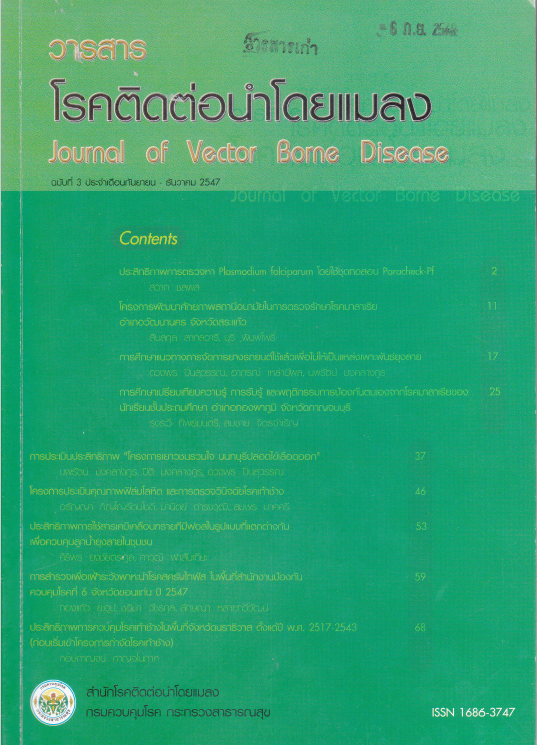
A comparative study of knowledge, perception and self-protection behaviors regarding malaria among schoolchildren in Thongphaphume District, Kanchanaburi Province
Article Sidebar
Main Article Content
Abstract
This cross-sectional study was carried out to investigate knowledge, perception and self- protection behaviors regarding malaria among schoolchildren in Thongphaphume District, Kanchanaburi Province. A self-administered questionnaire was used as a tool to gather data. Data was collected between 1st -15th July 2004. The study enrolled 151 respondents who were 5th year to 6th year primary school students. The results revealed that 34.4 % of respondents had some experience with malaria. The individual data was marked and classified into three groups as the percentage of correct answers: more than 70% was a good level, 50-69% was a fair level, and less than 50% was a poor level. Regarding knowledge about malaria, the majority of schoolchildren, about 78.8%, had a good level of knowledge. However, only 6.6 % knew that mosquitoes bite at dawn as well as dusk. For perception of malaria, approximately 96 % of schoolchildren were at a good level, and 61.6% of respondents agreed that they were at risk of getting malaria. In addition, for self-protection behaviors, the results showed that about 72.9% of respondents were at a good level, however 59.6% of schoolchildren had never used mosquito repellent. Furthermore, the comparison of the mean scores of knowledge and perception on malaria among 5 schools indicated that there were statistically significant difference in average scores of knowledge and perception with p-value=0.000 and p-value=0.039 respectively. However, there was no statistically significant difference in mean scores of self-protection behaviors among these schools. The results revealed that Banhauyseu School had the lowest level of knowledge. It is important that effort be made on emphasizing health education in all schools, with most immediate emphasis being on the Banhauyseu School. However, we must ensure that the methods and media should be suitable to create critical thinking processes to raise their awareness regarding malaria.
Downloads
Article Details

This work is licensed under a Creative Commons Attribution-NonCommercial-NoDerivatives 4.0 International License.
The opinions and content expressed in the articles are solely those of the individual authors and do not necessarily reflect the views of the journal or the authors’ affiliated institutions. Authors are fully responsible for the accuracy and correctness of their work.
Any reuse, reproduction, or redistribution of the articles, content, data, or images in other forms requires prior written permission from the Division of Vector Borne Diseases.
