
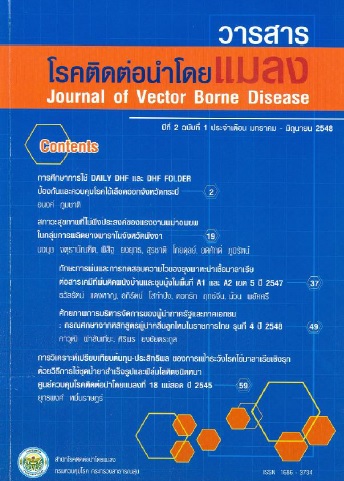
Application technique and suscepbility to insecticide for indoor residual spraying and impregnation mosquito net in high (A1) and low (A2) malaria transmission area In Region 5, BE.2547
Article Sidebar
Main Article Content
Abstract
According to malaria control strategies, methods of vector control, either residual house spraying or the use of impregnated bed nets, are considered to be the essential vector control measures Both aim to reduce vector density, man vector contact and vector longevity, in order to stop transmission. Therefore, the chosen insecticide should have good residual effect, effective against mosquito vector and most importantly is the appropriate application technique used. These are reasons for the Disease Control Centre 5 to conduct the study.
The study aimed to evaluate the performance of spray man, residual effect and the effectiveness of the insecticide against An. minimus. The insecticides used were Deltametrin 5 % wdp of 20 mg/m2 for residual spraying and Premetrin 10 % EC of 300 mg/m2 for impregnated bednets.
This is a survey research study. Data collected by interviewed and sprayman performance observation. Susceptibility and bioassay test followed WHO guideline were conducted to determine residual effect and effectiveness of insecticides. The tests were performed at 2, 4 and 6 month after insecticide application and impregnation of bednets. The study areas were perennial (A1) and periodic (A2) transmission areas in Surin, Nakornrajsima and Chiyaphom provinces which are under the Disease Control Centre 5 responsibility. From each province one study village and one control village were selected by random sampling technique.
The results showed that, on average, most spraymen could properly perform application technique (77.6%) mixing insecticide solution (90.3%) using equipment (71.0%) and spraying technique (70.9%). The household had been informed (93.5%) given health education before spraying (94.4%) and after spraying (77.6%). For indoor residual spraying, the susceptibility test of Deltamethrin 5% wdp using An. Minimus mosquitos with 30 minute exposure period provided that the knock down rate in the second fourth and sixth month were 87.2%, 83.7% and 76.7% respectively and all had 100% mortality at 24 hours observation. For impregnated mosquito nets, the killing effect of insecticide of bioassay test with 3 minutes exposure period showed that the knock down rate in the second, fourth and sixth month were 82.3%, 62.5% and 53.8% respectively and all had 100% mortality at 24 hours observation.
Downloads
Article Details

This work is licensed under a Creative Commons Attribution-NonCommercial-NoDerivatives 4.0 International License.
The opinions and content expressed in the articles are solely those of the individual authors and do not necessarily reflect the views of the journal or the authors’ affiliated institutions. Authors are fully responsible for the accuracy and correctness of their work.
Any reuse, reproduction, or redistribution of the articles, content, data, or images in other forms requires prior written permission from the Division of Vector Borne Diseases.
