
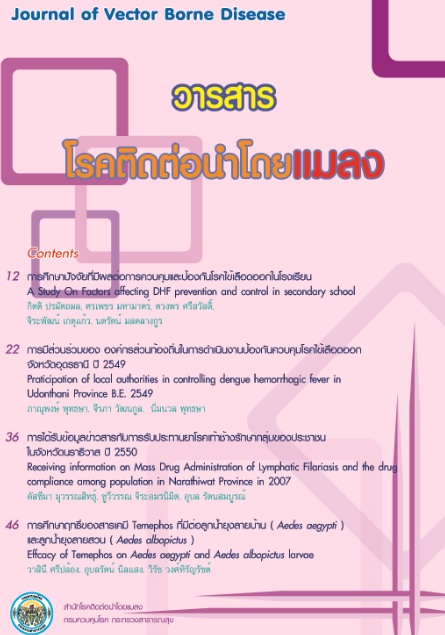
A Study on factors affecting DHF prevention and control in secondary school
Article Sidebar
Main Article Content
Abstract
The objectives of this study were to identify the factors affecting DHF prevention and control in secondary schools. The questionnaires were designed for directors, health teachers and students in secondary schools. The questionnaires were sent to 731 schools but only 438 schools (60%) responded to send back.
The results showed that the attitude of directors and health teachers to DHF prevention and control in schools was very good (79.1 % and 90.4 %, respectively). The factors include, education level, duration of working at school, duration of working as a health teacher, perception and attitude to DHF prevention, highly affect to success in DHF prevention and control in schools.
In conclusion, dengue prevention programme by School base approach is an advantage implementation because of the implantation of health behavior since childhood years, and still effective in practice in both of household and the school level. The important strategy for the success is the activity creation for the school executive and experienced school health teacher to be a heir and will be supported necessary equipment supply, such as the media education about the prevention and disease control which the students can apply to use in their life.
Downloads
Article Details

This work is licensed under a Creative Commons Attribution-NonCommercial-NoDerivatives 4.0 International License.
The opinions and content expressed in the articles are solely those of the individual authors and do not necessarily reflect the views of the journal or the authors’ affiliated institutions. Authors are fully responsible for the accuracy and correctness of their work.
Any reuse, reproduction, or redistribution of the articles, content, data, or images in other forms requires prior written permission from the Division of Vector Borne Diseases.
