
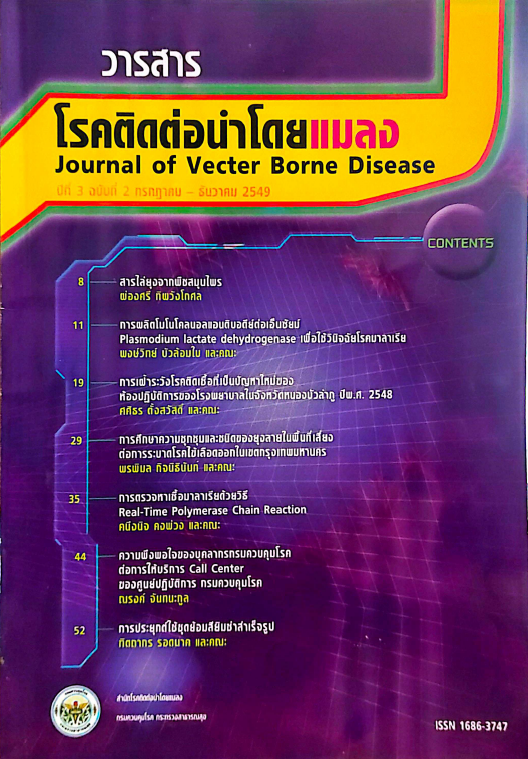
Production of a monoclonal antibody against Plasmodium lactate dehydrogenase for the diagnosis of malaria
Article Sidebar
Main Article Content
Abstract
Malaria is still a major public health problem in Thailand especially along the border areas. Early diagnosis and prompt appropriate treatment has been the current successful control strategy. To succeed the early diagnosis strategy, malaria rapid diagnostic test (MRDT) is an appropriate alternative diagnostic tool. Some limitations of MRDT includes its high cost and quality variation. Locally developed MRDT could reduce these limitations. Specific monoclonal antibodies (MAbs) are the crucial components for the success of the MRDT kit production. In this study Plasmodium lactate dehydrogenase (pLDH) was selected as a proteinomic antigen for the production of specific MAbs because it was a glycolytic enzymatic protein produced very specifically to each species of human Plasmodium with high amount. In addition, it was produced only by viable parasite; therefore, its detection would evidence the recent infection. The pLDH protein antigens originated from two sources, native and recombinant proteins. Native protein derived from in vitro culture of Plasmodium falciparum K1 strain. Culture parasites were concentrated by passing through Cibacron blue column and pLDH was then harvested. Two recombinant PLDH proteins i.e. pLDH-GST and pLDH-His were produced. Female BALB/c mice, separated into three groups, were immunized with native pLDH or PLDH-GST or PLDH-His. After appropriate period, hybridromas were created by fusing the hyper-immunised mice's spleenic lymphocytes with myeloma cell, followed by screening and cloning the pLDH antibody secreting hybridomas. Two screening methods. ELISA and Dot-ELISA were used to test the hybridomas. Then, MAbs specific to Plasmodium falciparum and pan malaria species (P. falciparum and P. vivax) were chosen by using three techniques, indirect immunofluorescence (IFA), SDS-polyacrylamide gel electrophoresis and Western blot analysis. Totally, 269 MAbs were raised, mostly derived from recombinant pLDH hybridomas. Activitiy of the 118 MAbs were strong and stable. 1, 35 and 63 clones with stable and strong activity were derived from native pLDH hybridomas, PLDH-GST hybridamas and pLDH-His hybridomas, respectively. However, all MAbs produced by the first two hybridomas were IgM class. Some of them were then class switched to IgG to suit the conjugation with colloidal gold. After performing class switching. 19 strong and stable clones were derived. Specificity of MAbs determined by IFA and Western blot analysis showed that 61, 15 and 33 MAbs were specific to P. falciparum, P. vivax and PAN malaria species, respectively. Some MAbs were chosen for embedding test trips. The developed test strip was tested by using blood samples collected from malaria patients. High sensitivity of the developed test kit was found. The detection limit was 312 parasites per microlitre.
Downloads
Article Details

This work is licensed under a Creative Commons Attribution-NonCommercial-NoDerivatives 4.0 International License.
The opinions and content expressed in the articles are solely those of the individual authors and do not necessarily reflect the views of the journal or the authors’ affiliated institutions. Authors are fully responsible for the accuracy and correctness of their work.
Any reuse, reproduction, or redistribution of the articles, content, data, or images in other forms requires prior written permission from the Division of Vector Borne Diseases.
