
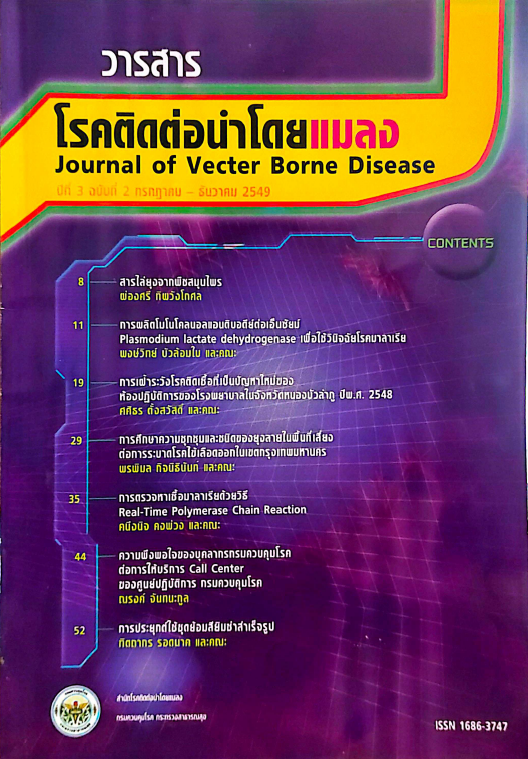
Malaria parasites detection by real-time polymerase chain reaction
Article Sidebar
Main Article Content
Abstract
Malaria parasite detection by polymerase chain reaction (PCR) is as sensitive and specific as standard microscopic examination of a Giemsa-stained thick blood film (GS-TBF). At present, PCR is not suitable for use in a malaria clinic because the method is time consuming and sophisticated. Real-time PCR is a new PCR technology developed for the detection of many infectious agents incluing malaria parasites. Besides its shortening of the detection time, the parasite density can also be quantified. This study was a method comparison of multiplex PCR or classical PCR with a TaqMan real-time PCR. A GS- TBF was the standard method for the comparison. One hundred and twenty six samples were malaria positive blood collected from patients attending malaria clinics in Pong Nam Ron District, Chanthaburi Province and Muang District, Ranong Province. In addition, 77 malaria negative samples were also studied. The results showed that multiplex PCR and real-time PCR used in this study were 100% sensitive and specific compared with the standard GS-TBF. However, real-time PCR has more advantages over multiplex PCR as it spent shorter duration and could quantify parasite density which is useful for the following up of treatment especially in areas where there is multidrug resistant P. falciparum.
Downloads
Article Details

This work is licensed under a Creative Commons Attribution-NonCommercial-NoDerivatives 4.0 International License.
The opinions and content expressed in the articles are solely those of the individual authors and do not necessarily reflect the views of the journal or the authors’ affiliated institutions. Authors are fully responsible for the accuracy and correctness of their work.
Any reuse, reproduction, or redistribution of the articles, content, data, or images in other forms requires prior written permission from the Division of Vector Borne Diseases.
