
Breeding sites of Aedes albopictus in epidemic area of Chikungunya
Article Sidebar
Main Article Content
Abstract
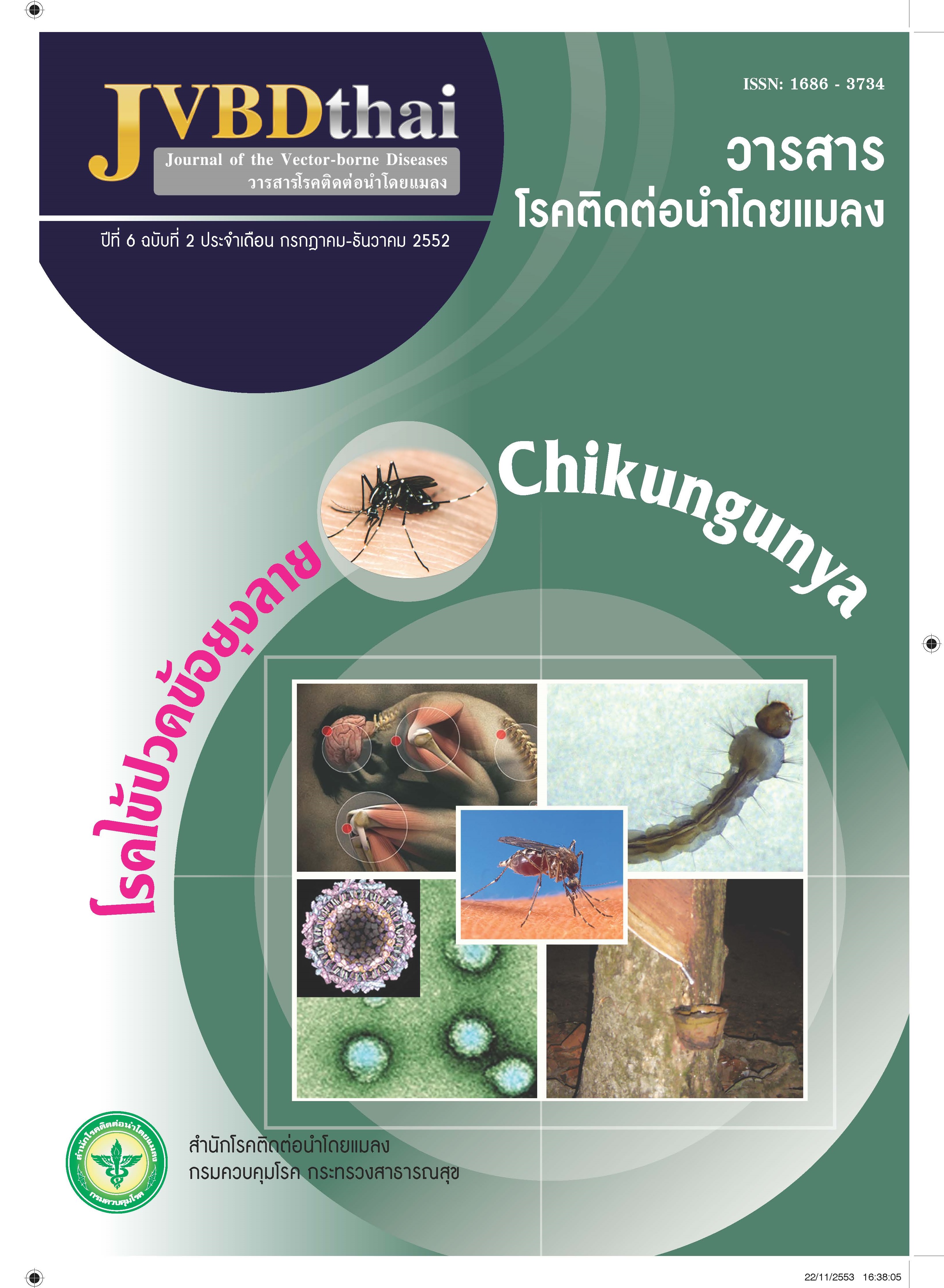
The present study aimed to delineate the key containers, breeding sites of Aedes mosquitoes in suburban and rural areas where Chikungunya outbreak occurred. The survey was carried out at Ampur Muang and Hui-Yod, Trang Province during July-August 2009. Both containers with and without water were surveyed, mosquito larva index were calculated and all the larvae were identified to species. The results revealed the house index of 73 and 75 were obtained from 26 and 12 surveyed houses of suburban area and rural area, respectively. The key containers in houses were cement tanks in toilet (CI 24.1) and all collected larvae were Aedes aegypti. The key containers in areas surrounding houses were coconut shells, plastic bottles, plant saucers and discarded types while in rubber plantations were broken rubber pots, coconut shells and coconut rubber pots. All the collected larvae in these areas were Aedes albopictus. The breeding sites found in areas surrounding houses had density more than one and in rubber plantations around 5.4 times. This study suggests that we should control the key breeding sites of Aedes mosquitoes such as discarded containers by big cleaning campaign. The activities should emphasize on in house and area surrounding house and followed by in rubber plantation.
Downloads
Article Details

This work is licensed under a Creative Commons Attribution-NonCommercial-NoDerivatives 4.0 International License.
The opinions and content expressed in the articles are solely those of the individual authors and do not necessarily reflect the views of the journal or the authors’ affiliated institutions. Authors are fully responsible for the accuracy and correctness of their work.
Any reuse, reproduction, or redistribution of the articles, content, data, or images in other forms requires prior written permission from the Division of Vector Borne Diseases.
