
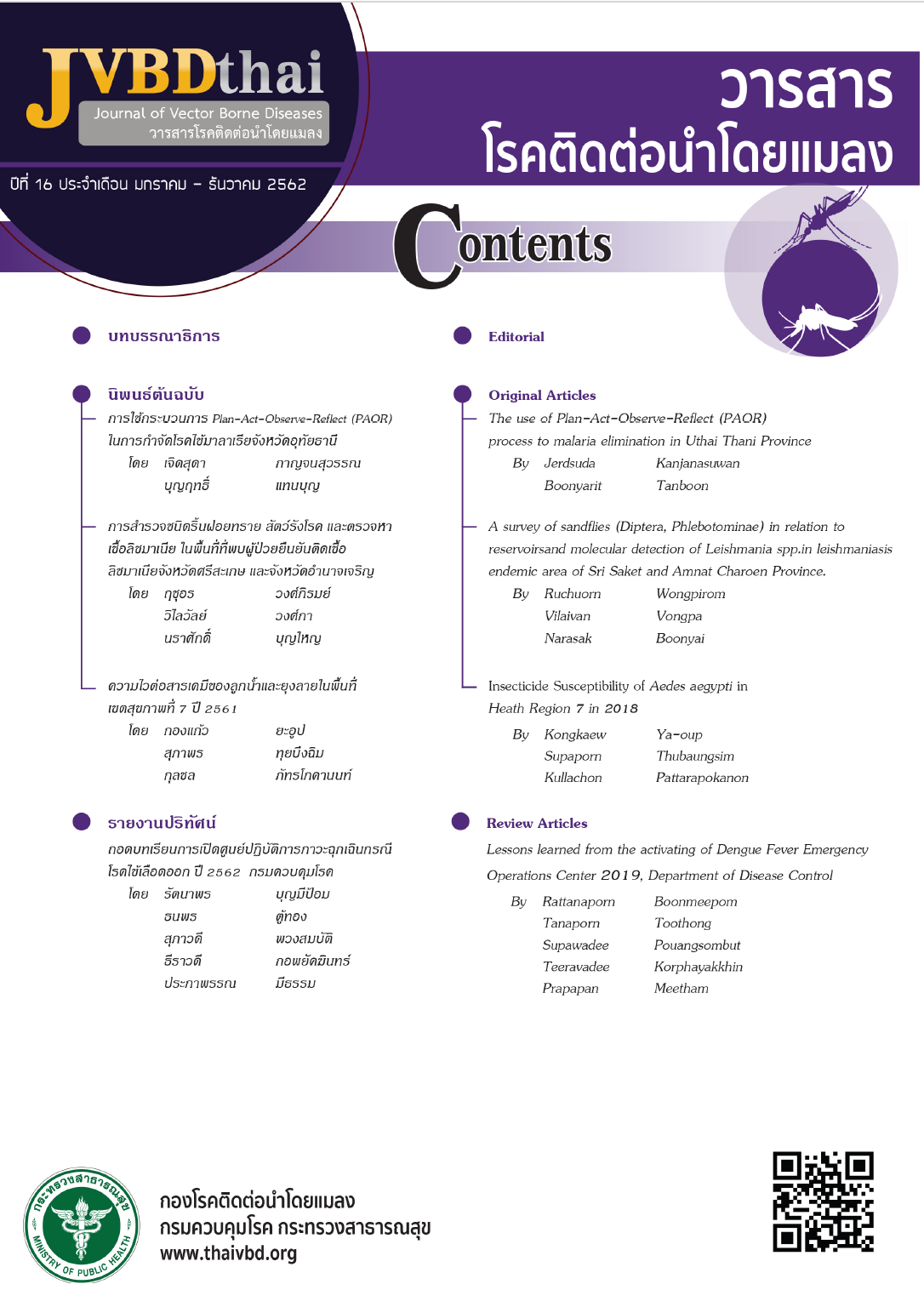
A survey of sandflies (Diptera, Phlebotominae) in relation to reservoirs and molecular detection of Leishmania spp. in leishmaniasis endemic area of Sri Saket and Amnat Charoen Province
Article Sidebar
Main Article Content
Abstract
Leishmaniasis is a major public health globally and is an emerging disease in Thailand. This study aims to detected leishmania in various sandflies species and reservoirs, which collected from in Leishmaniasis endemic area of Sri Saket and Amnat Charoen Province where the disease has been
reported. Species identification of sandflies and detection of Leishmania by Conventional Polymerase Chain Reaction method were conducted in the university and the village. The sampling of blood from suspected reservoir hosts was carried out and PCR technique was used for detection and identification of Leishmania species.
A total of 75 sandflies were collected, comprised of 30 males (40%) and 45 females (60%), and were classified into four species, including Sergentomyia gemmea, S. barruadi, S. hivernus and S. brevicaulis. There was no detection of Leishmania from any of the samples from all sandfly and blood samples of reservoirs. However, the vector species of sandflies, S. gemmea, was found in the study area that could be a vital important factor for leishmaniasis transmission. Moreover, various species of sandflies were found in this study that can be a elementary information for biodiversity study and monitoring of leishmaniasis. Prompt monitoring of reservoirs is important and strongly suggested for effective disease surveillance and action plan during epidemics.
Downloads
Article Details

This work is licensed under a Creative Commons Attribution-NonCommercial-NoDerivatives 4.0 International License.
The opinions and content expressed in the articles are solely those of the individual authors and do not necessarily reflect the views of the journal or the authors’ affiliated institutions. Authors are fully responsible for the accuracy and correctness of their work.
Any reuse, reproduction, or redistribution of the articles, content, data, or images in other forms requires prior written permission from the Division of Vector Borne Diseases.
