
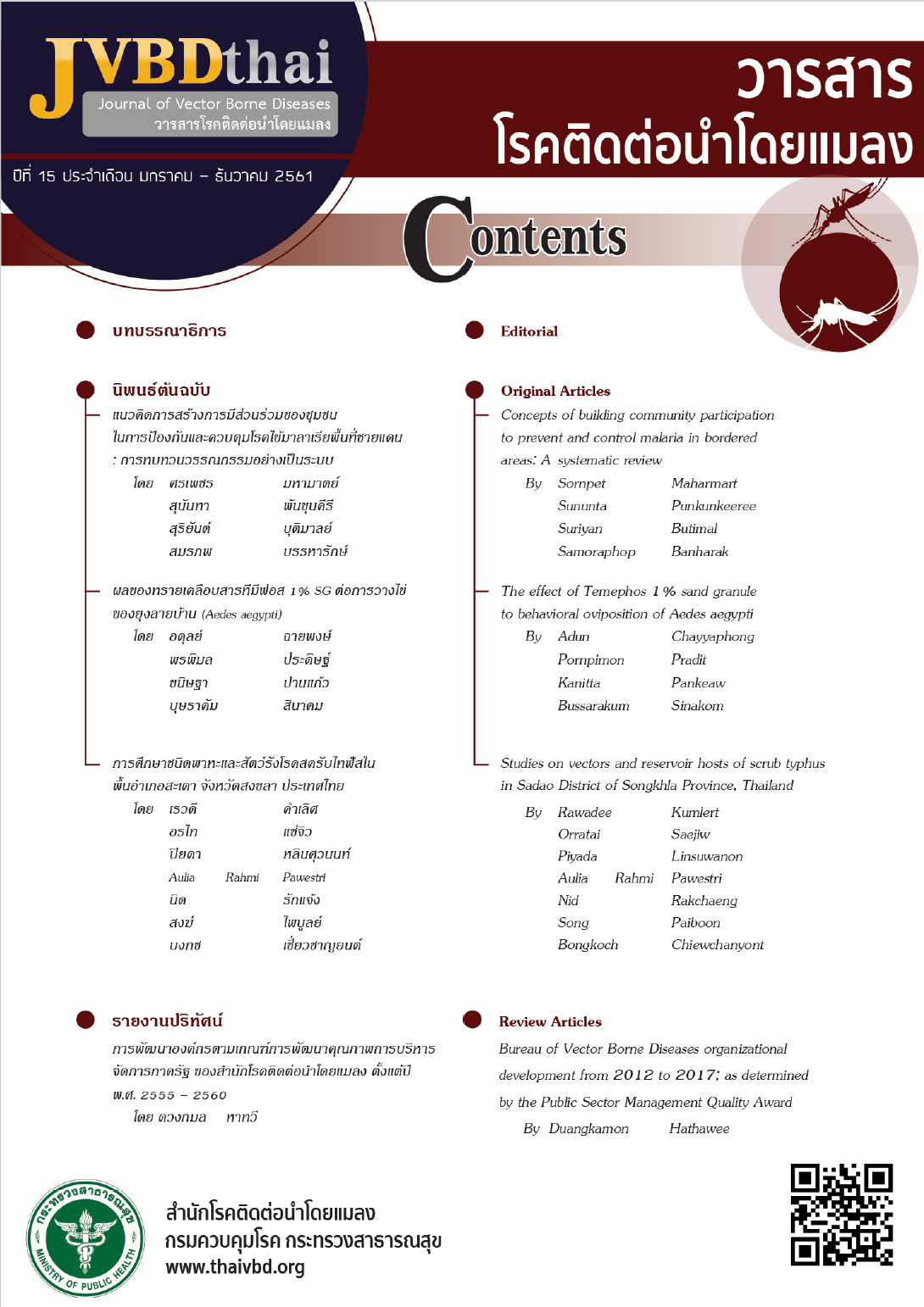
Concepts of building community participation to prevent and control malaria in bordered areas: A systematic review
Article Sidebar
Main Article Content
Abstract
Malaria epidemics are serious public health emergencies, especially in border areas. To deal with this disease, the community participation is needed. Studies reported several concepts of community participation; however, the results were not synthesized and conclusion were not provided. This systematic review aimed to summarize the concepts and review the effects of community participation in preventing and controlling of malaria. Key words were used for researching in four databases for published article between 1997 to 2018. Screening was independently conducted by three researchers. There were 18,026 for initial searching and seven studies were included for final review. Four studies were conducted in ASEAN countries and other three in Africa. The six concepts of community participations were applied. There were two for active community participation and one each for women empowerment, community empowerment, Appreciation-Influence-Control, community-based approach, and communication for behavioral impact. The important six steps of community participation were including: exploring problems, community needs assessment, health-oriented leaders building, joint planning, project monitoring and evaluation, and sustainability development in community. The outcomes after implementation were community participation rate, progressing in knowledge, attitude and behavior, bed net used, number of mosquitos, and malaria mobility rates. For application, health care professional are able to apply the six concepts and six steps; however, they should concern about contexts and situations different in each border area.
Downloads
Article Details

This work is licensed under a Creative Commons Attribution-NonCommercial-NoDerivatives 4.0 International License.
The opinions and content expressed in the articles are solely those of the individual authors and do not necessarily reflect the views of the journal or the authors’ affiliated institutions. Authors are fully responsible for the accuracy and correctness of their work.
Any reuse, reproduction, or redistribution of the articles, content, data, or images in other forms requires prior written permission from the Division of Vector Borne Diseases.
