
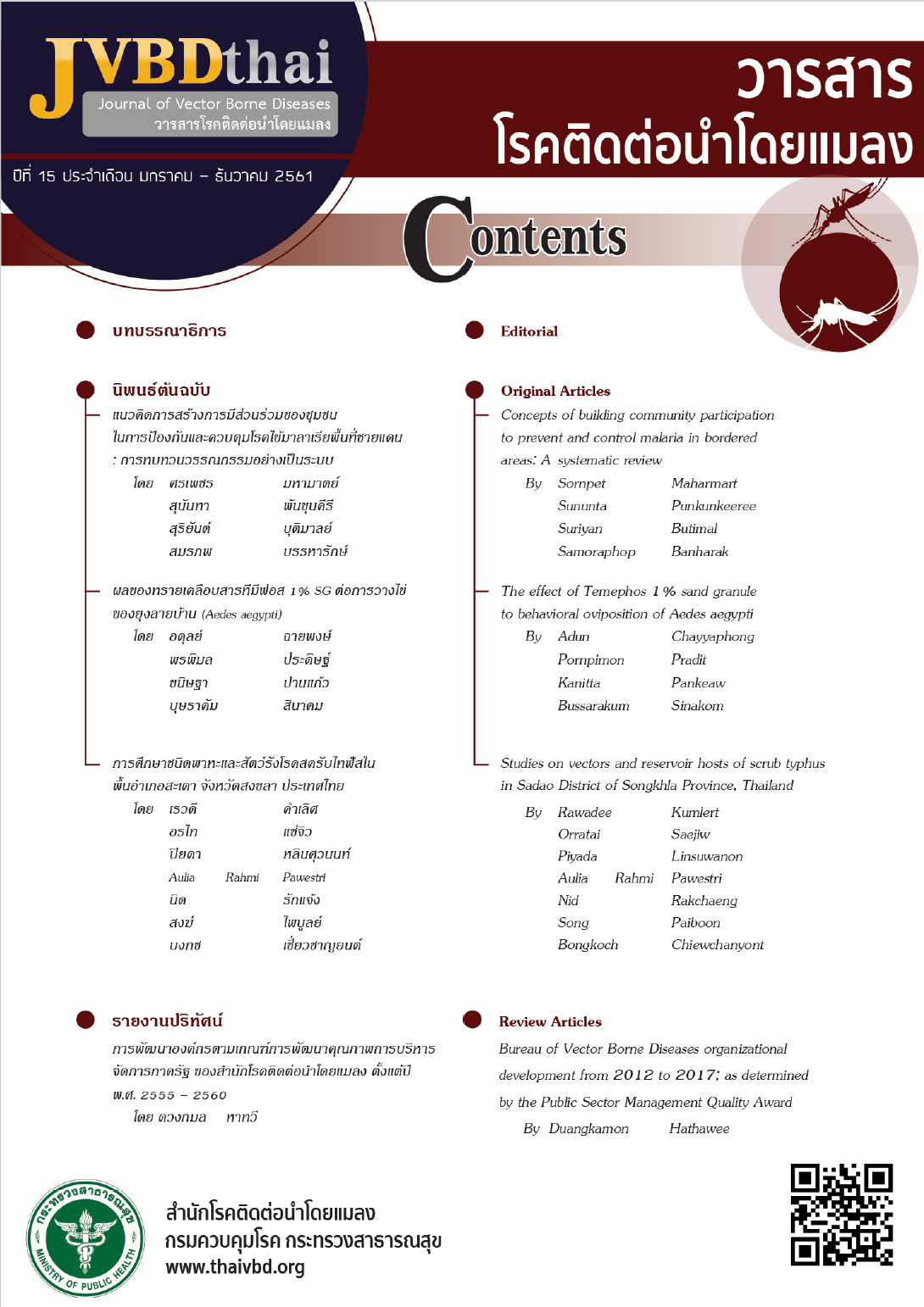
Studies on vectors and reservoir hosts of scrub typhus in Sadao District of Songkhla Province, Thailand
Article Sidebar
Main Article Content
Abstract
Scrub typhus, caused by Orientia tsutsugamushi infection, is a public health concern in agricultural areas, including special economic zones with population movements. Rodents are major reservoir hosts for this disease. Human frequently becomes infected by the bite of chigger mites, which transfer this pathogen during their tissue fluid-feeds, making them effective transmission vectors. This study aimed to identify species and distribution of chigger mite vectors and rodents in the special economic zone of Songkhla Province, Thailand. Chigger mite and rodent samples were collected from three sub-districts in the special economic zone of Sadao district, Songkhla Province. Ecological conditions of each sample were recorded. Rodents and chigger mites were identified by morphological identification keys. O. tsutsugamushi on the hosts was detected by molecular technique.
We obtained 75 rodents belonging to six species. Chigger mites were most frequently found in Rattus tanesumi and Bandicota indica species. The common habitats were fruit gardens, forests near villages, rubber gardens, sugar cane fields, banana fields and bamboo plantations, and country borders. Our chigger mite samples composed six genera in nine species. The highest number of chigger mite species was found in Prik and Samnakkham sub-districts (five species), followed by Sadao sub-district (three species).
In summary, our study successfully identified chigger mite and rodent habitats, which mostly related to agricultural areas. Scrub typhus was found in rodent hosts in the special economic zone of Sadao district, Songkhla province. This information will be beneficial for more effective surveillance strategies and contribute to target-specific disease prevention programs in the future.
Downloads
Article Details

This work is licensed under a Creative Commons Attribution-NonCommercial-NoDerivatives 4.0 International License.
The opinions and content expressed in the articles are solely those of the individual authors and do not necessarily reflect the views of the journal or the authors’ affiliated institutions. Authors are fully responsible for the accuracy and correctness of their work.
Any reuse, reproduction, or redistribution of the articles, content, data, or images in other forms requires prior written permission from the Division of Vector Borne Diseases.
