
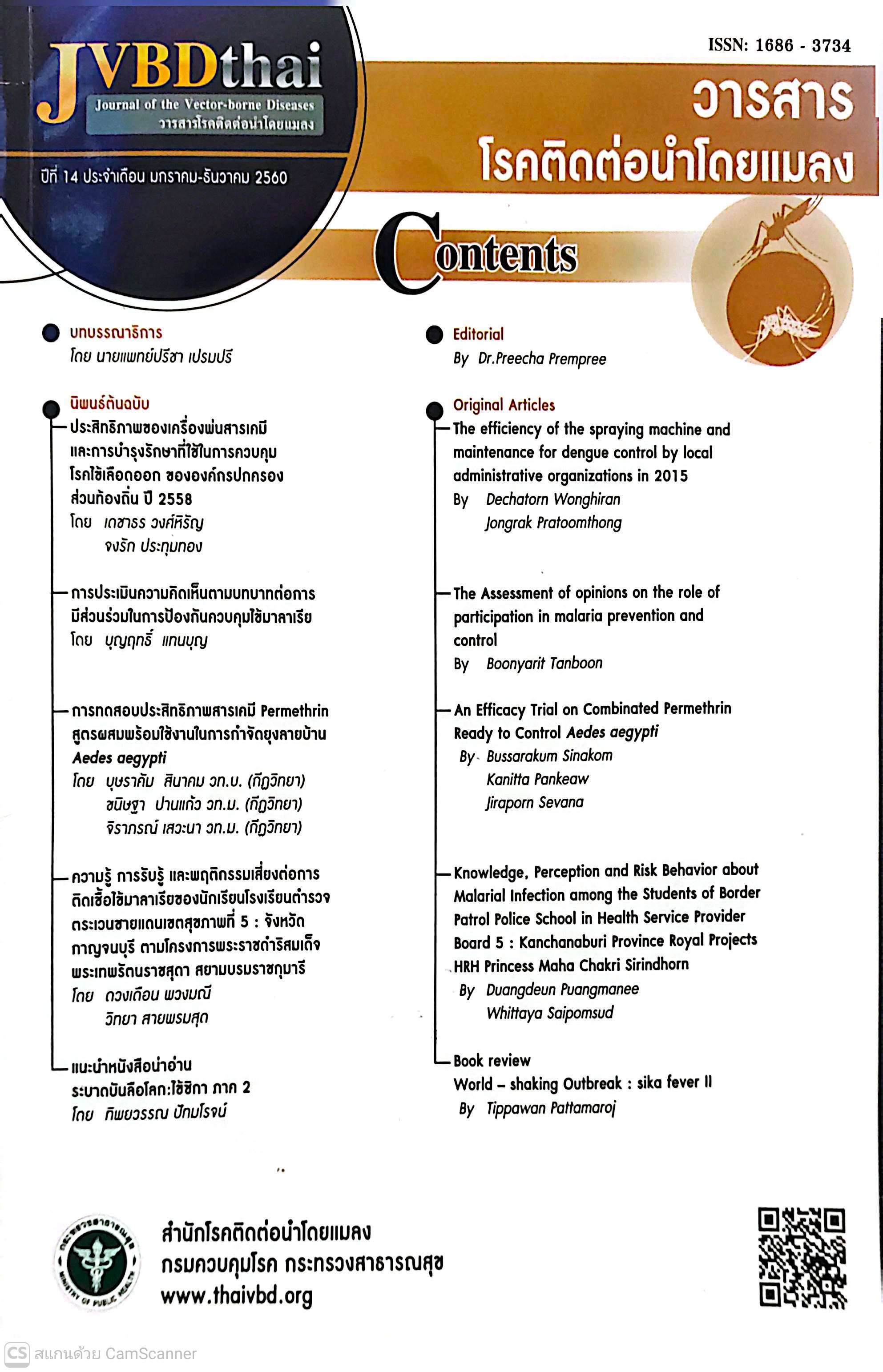
The efficiency of the spraying machine and maintenance for dengue control by local administrative organizations in 2015
Article Sidebar
Main Article Content
Abstract
The research aimed to evaluate the efficiency and maintenance of the spraying machine for control of dengue hemorrhagic fever among the authorities in Pak Chong District, Nakhon Ratchasima Province during the fiscal year 2015, compared to the standard set. The research population were 45 spraying machine and 14 officers who use and responsible for maintenance of the spraying machine from all 14 local authorities. Data were obtained from April 2015 to March 2016 by interview, observation, and test for the properties of the chemical sprayers.
The results showed that the 14 local authorities were divided into Subdistrict Administration Organizations (SAOs) for 64.3% and municipalities for 35.7%. SAOs and municipalities had 30 and 15 fogging spraying machine, respectively. Evaluating the efficiency of chemical sprayers in terms of pipe tip temperature, flow rate of chemical substances and aerosol size, it was found that 60.0% of spraying machine could be tested for all three components, while 24.4% were not detectable. Among the detectable spraying machine, 4.4% passed the evaluation criteria in which age of spraying machine affected the pass of the criteria. In addition, the results indicated that the maintenance of the spraying machine should be improved, the officers who use and responsible for maintenance of the spraying
machine must improve the mixing of chemicals and the duration of spraying.
Suggestions from the research findings, the local authorities should supply or repair fogging spraying machine to replace the unworkable machines, maintain the spraying machine properly and regularly, and strengthen the capacity of staff who are responsible for spraying mosquito vector continuously. The Disease Prevention and Control Office should set up an evaluation system covering all organizations and areas, provide advice for solving problems, establish learning center and improve capability of staff responsible for spraying mosquito vectors continuously.
Downloads
Article Details

This work is licensed under a Creative Commons Attribution-NonCommercial-NoDerivatives 4.0 International License.
The opinions and content expressed in the articles are solely those of the individual authors and do not necessarily reflect the views of the journal or the authors’ affiliated institutions. Authors are fully responsible for the accuracy and correctness of their work.
Any reuse, reproduction, or redistribution of the articles, content, data, or images in other forms requires prior written permission from the Division of Vector Borne Diseases.
