
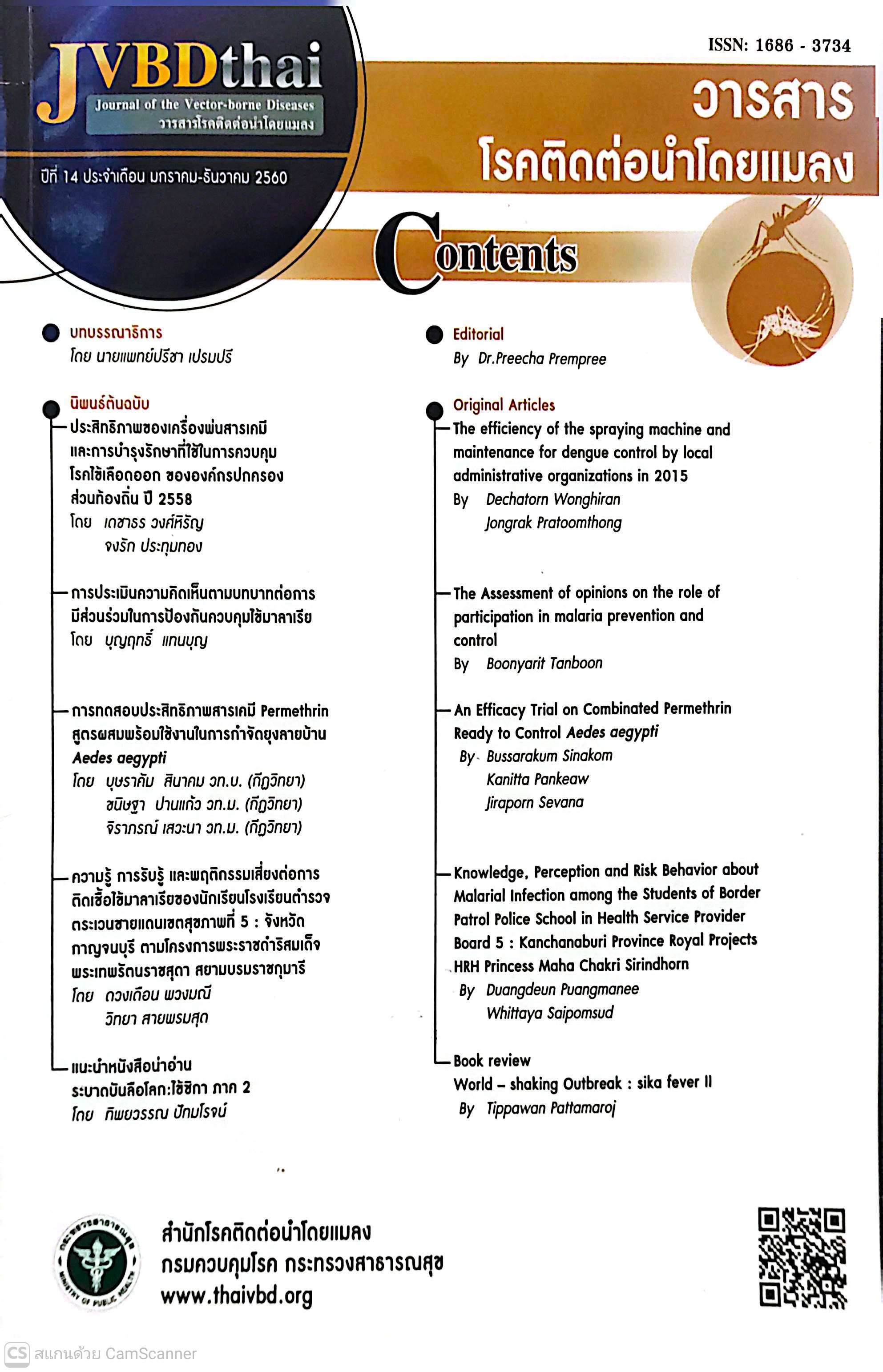
An Efficacy Trial on Combinated Permethrin Ready to Control Aedes aegypti
Article Sidebar
Main Article Content
Abstract
A mixed formulation of permethrin with active ingredients comprising permethrin 0.22%, prallethrin 0.01% and piperonyl butoxide 0.22% under the trade name "Stargrad RTU fogging" was tested by a fogging operation method. The objectives were to test its efficacy of killing Aedes aegypti and impact on crayfish Procambarus clarkii in open area of 60 square meters beneath a building at the spray rate of 1 ml per 2 square meters. The test cage of Aedes aegypti was 1.2 meter height and laid in 80 cubic meters of a closed room, which the spraying rate was 1 ml/volume of 2 cubic meters. The test cages of Aedes aegypti were laid on 3 levels at height 2.5, 1.5 m, and on-ground level. Only the crayfish, Procambarus clarkii, was tested on the ground level.
The results showed that Aedes aegypti in open area had a mortality rate of 92.44%, whereas in the closed rooms at the height of 2.5, 1.5 m, and on-floor level, the mortality rates were 99.78, 100 and 100, respectively. Procambarus clarkii, which was tested in the closed room, found no mortality after 3-days observation. The results showed that the combinated permethrin formulation spraying at the rate of 1 ml/2 cu.m. could kill Aedes aegypti under the WHO standard. However, an application of this result in the field, it is necessary to test the efficacy in terms of the insecticide resistance of Aedes aegypti. In addition, even if the above mentioned result, permethrin at the dose of fogging operation 1 ml/2 sq.m. did not affect the death of crayfish, Procambarus clarkii. However, in field operation it must be used with caution because crayfish larvae may die with other relevant factors.
Downloads
Article Details

This work is licensed under a Creative Commons Attribution-NonCommercial-NoDerivatives 4.0 International License.
The opinions and content expressed in the articles are solely those of the individual authors and do not necessarily reflect the views of the journal or the authors’ affiliated institutions. Authors are fully responsible for the accuracy and correctness of their work.
Any reuse, reproduction, or redistribution of the articles, content, data, or images in other forms requires prior written permission from the Division of Vector Borne Diseases.
