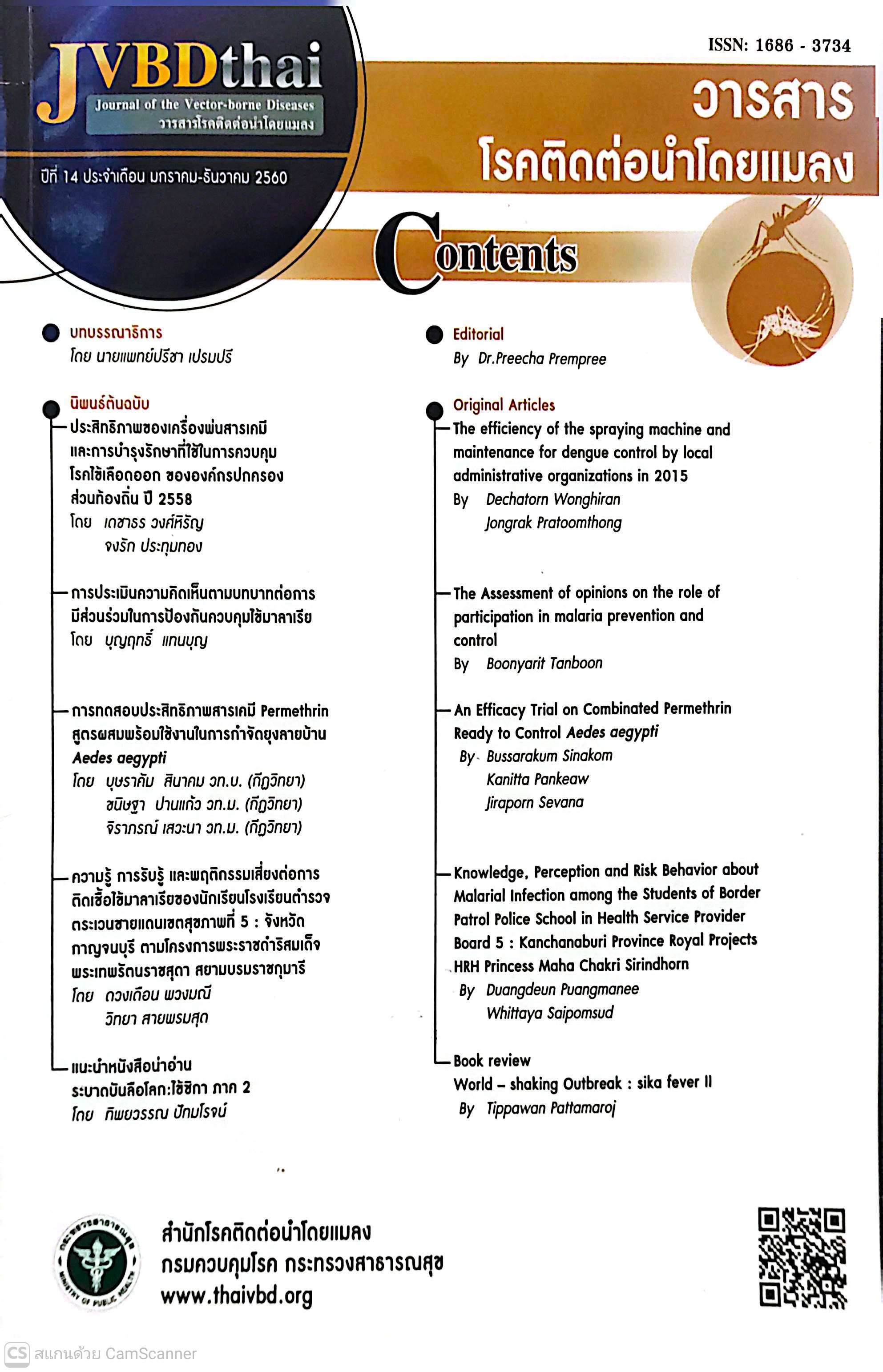
Knowledge, Perception and Risk Behavior about Malarial Infection among the Students of Border Patrol Police School in Health Service Provider Board 5 : Kanchanaburi Province Royal Projects HRH Princess Maha Chakri Sirindhorn.
Article Sidebar
Main Article Content
Abstract
The purpose of this study is to follow up the knowledge assessment understanding and behavior in malaria prevention and control of students of Border Patrol Police School at Regional Health 5: Kanchanaburi Province. The teachers use the evaluation form from Bureau of Vector Borne Diseases for pre and post assessment on malaria control, first time in May 2016 and second time in August 2016.
The statistics that use in this descriptive study were percentage and mean. Analyze the difference score of the knowledge and perception and behavior with independent t-test, the significant at level 0.05.
The results showed that giving knowledge about prevention and control of malaria did not affect "Know or hear about malaria" of students. The students often to mother and teacher when they were sick. Especially after the get perception that shows their "Mother and Teacher" is very important.
The students' knowledge were decreased at the significant p <0.05. The grade 4 students score were decreased at the significant p <0.05. The grade 5 students score were decreased but there is no significant and there is no different score from grade6 students of the pre - knowledge score.
Malaria perception of grade 4 students were decreased but no significantly and malaria perception of both grade 5 and grade 6 students were not different.
Students' malaria prevention behavior among pre and post giving knowledge were change statistically significant at level p <0.05. The prevalence of protective behaviors among students in grade 4 and grade 5 but there is no change in grade 6.
The results of this study indicate that teachers have not developed in the potential of knowledge about malaria control. It also has no content, format, method and suitable media. The students can be informed about the knowledge that will lead to the perception of risk. Awareness of the dangers of malaria as well as the prevention of malaria in concrete ways.
Therefore, the Department of Disease Control should have a policy to evaluate the lesson plan for malaria that is classed in 2016 and published in 2017 by assessing knowledge, understanding, and relevancy from the teacher using the lesson plan. This is to develop the curriculum to suit the application. Including knowledge assessment. Perception and behavior to protect Malaria control among school children in Border Patrol Police schools was provided by the school yearly malaria lesson plan and produced malaria media to communicate the risks among the people in the community around the school. The media used to support the prevention of malaria control in the community.
Downloads
Article Details

This work is licensed under a Creative Commons Attribution-NonCommercial-NoDerivatives 4.0 International License.
The opinions and content expressed in the articles are solely those of the individual authors and do not necessarily reflect the views of the journal or the authors’ affiliated institutions. Authors are fully responsible for the accuracy and correctness of their work.
Any reuse, reproduction, or redistribution of the articles, content, data, or images in other forms requires prior written permission from the Division of Vector Borne Diseases.
