
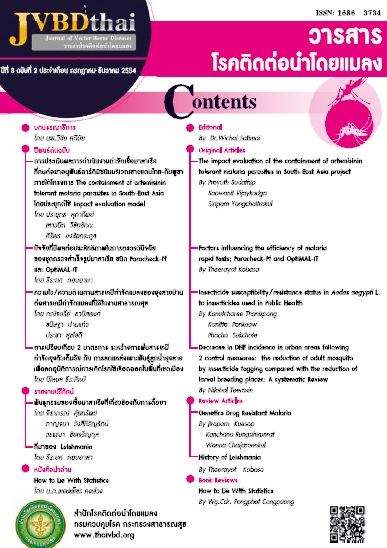
Decrease in DHF incidence in urban areas following 2 control measures: the reduction of adult mosquito by insecticide fogging compared with the reduction of larval breeding places: A systematic Review.
Article Sidebar
Main Article Content
Abstract
This was a systematic review of Aedes control in urban areas. Two control measures were reviews (1) the reduction of adult mosquito by insecticide fogging and (2) the reduction of larval breeding place. Relating articles were traced from Pubmed through website: www.pubmed.com. Key search terms included Dengue vector control, prevention and control of DHF. There were 40 articles from 1992 to 2011 showing the Dengue control interventions and the importance factors affected the decrease of DHF incidence in urban areas. In early stage of epidemic, only space spraying with insecticides was undertaken. Epidemic pattern was affected by seasonal climate factors. The optimal timing of insecticide fogging to effectively reduce dengue incidence was between the onset of wet season and prevalence peak. Insecticide resistance surveillance of vector and risk assessment by using larval index should be conducted. At lower operational costs and standardization, the HI CI BI can be applied as a measurement tool for assessing the infestation rate. Community participation in Ae. aegypti control via the reduction of larval breeding place was used. Community based strategies should be flexible and adapted to varied ecological, culture, social differences and localities in order to successful control. Prevention of dengue epidemics should be based on public health education in schools, community participation,
epidemiological surveillance, and competent vector control team. In order to effectively control DF/DHF, it is necessary to intensify the control measure, especially sanitary education, vector surveillance and control. The factors involved in the expansion of dengue risk areas comprised of urbanization, improved transportation and changing habitats. Development and widespread use of community based integrated approaches to Ae. aegypti control. There is a clear evidence for recommending insecticide fogging as a single, effective control intervention. The insecticide fogging is most likely the best application as part of an integrated vector management strategy. Systematic vector control and vector surveillance program should be continuously conducted to reduce or prevent dengue risk. It is concluded that a combination of vertically structured centralization and community-based approaches should provide short-term success as well as long-term sustainability.
Downloads
Article Details

This work is licensed under a Creative Commons Attribution-NonCommercial-NoDerivatives 4.0 International License.
The opinions and content expressed in the articles are solely those of the individual authors and do not necessarily reflect the views of the journal or the authors’ affiliated institutions. Authors are fully responsible for the accuracy and correctness of their work.
Any reuse, reproduction, or redistribution of the articles, content, data, or images in other forms requires prior written permission from the Division of Vector Borne Diseases.
