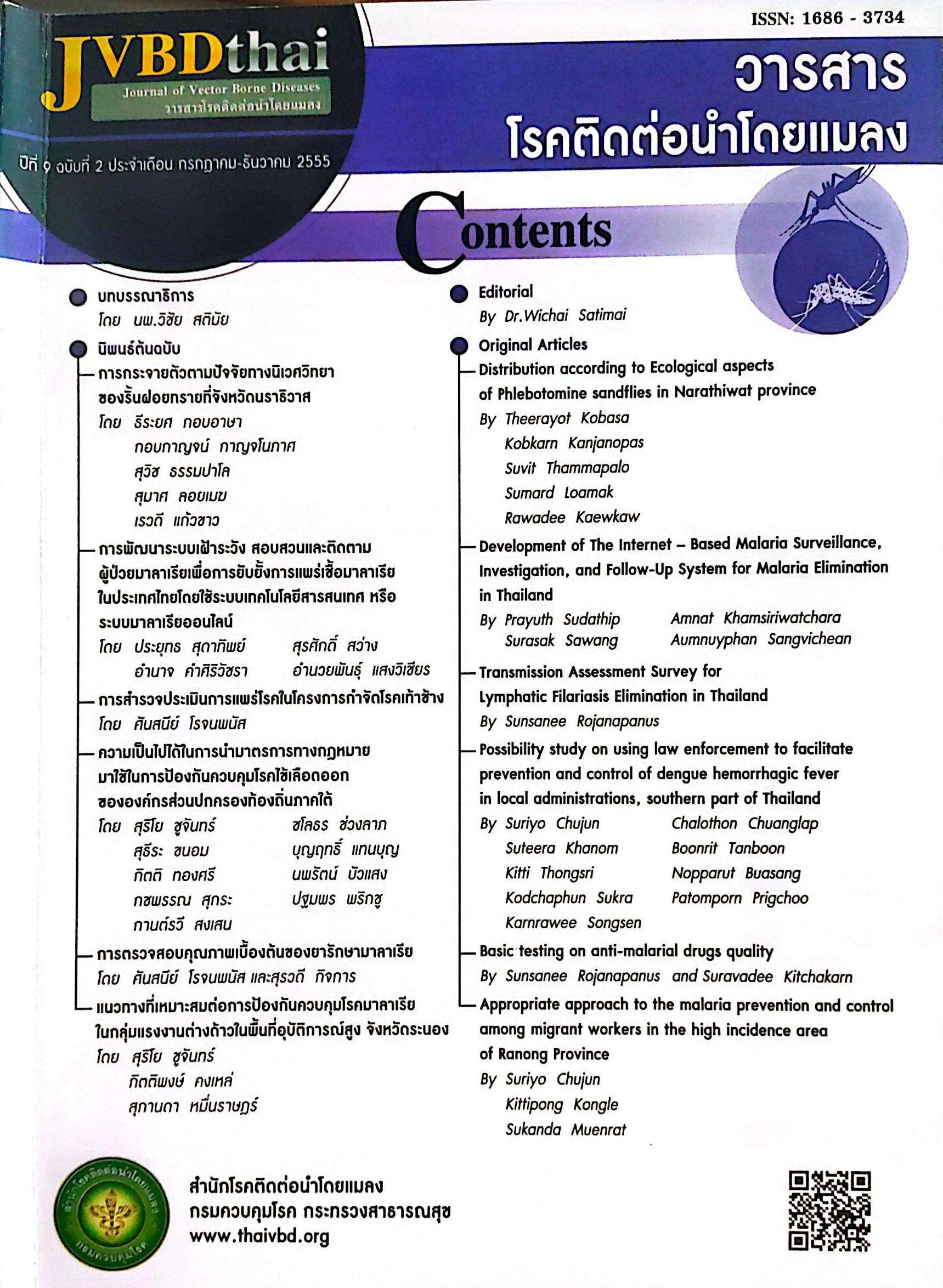
Transmission Assessment Survey for Lymphatic Filariasis Elimination in Thailand
Article Sidebar
Main Article Content
Abstract
Transmission assessment survey (TAS) is a standard methodology, published by WHO to assess whether a series of mass drug administration (MDA) have successfully reduced the prevalence of infection to level where transmission is assumed to be no longer sustainable and recrudescence is unlikely to occur. TAS should be a standard component of monitoring and evaluation for elimination programme with objectives of providing the evidence base for programme manager that MDA can be stopped in 87 lymphatic filariasis (LF) endemic implementation units (IU), Narathiwat province. And to assure national government that national programme have achieved elimination goal in 270 LF endemic IUs, province of Maehongson, Chiangmai, Lamphun, Tak, Kanchanaburi, Ratchaburi, Ranong. Suratthani, Nakhonsithammarat and Krabi. TAS provides a simple, robust survey for documenting that the LF prevalence among 6-7 years old children is below a predetermined threshold, which is differ by the type of filarial parasites and prevailing mosquitoes vector. The study areas selected for TAS were designated as an evaluation unit (EU), combining 357 IUs to 3 EUs and using school-based survey design. 213 schools in LF endemic areas were randomized systematically to sample of 108 schools with numbers of 3,111 children. 2,933 children were tested for antigenemia in bancroftian area and antibody in area where were brugian infection. No antigenemia positive case and 8 antibody positive cases were found, which is below critical cut-off value. From this survey, national elimination programme have achieved the elimination goal in country, except Narathiwat which is decided to stop MDA and will be implement post-MDA surveillance. TAS will be conducted in Narathiwat after this surveillance to declare elimination in the whole country.
Downloads
Article Details

This work is licensed under a Creative Commons Attribution-NonCommercial-NoDerivatives 4.0 International License.
The opinions and content expressed in the articles are solely those of the individual authors and do not necessarily reflect the views of the journal or the authors’ affiliated institutions. Authors are fully responsible for the accuracy and correctness of their work.
Any reuse, reproduction, or redistribution of the articles, content, data, or images in other forms requires prior written permission from the Division of Vector Borne Diseases.
