
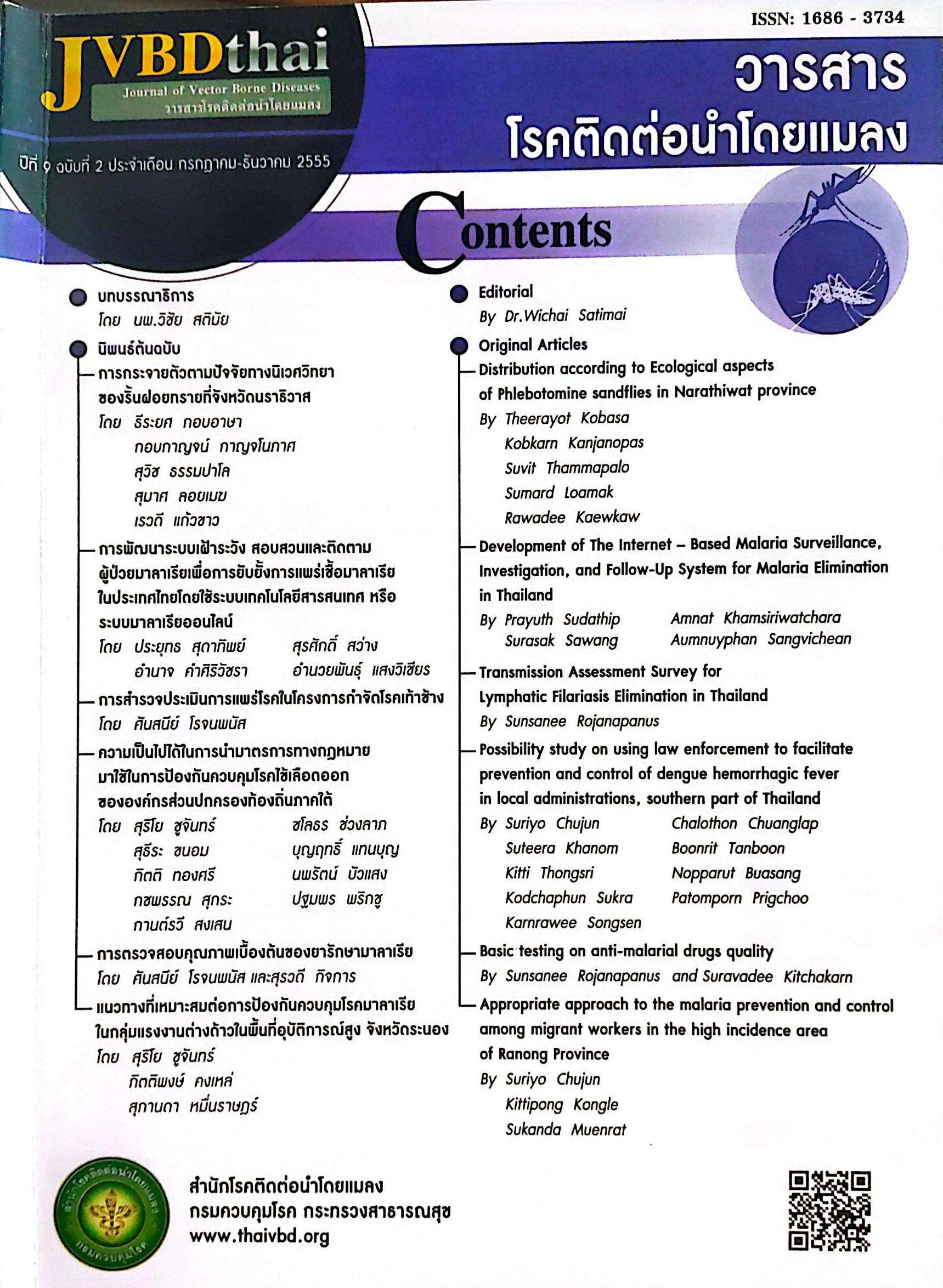
Possibility study on using law enforcement to facilitate prevention and control of dengue hemorrhagic fever in local administrations, southern part of Thailand.
Article Sidebar
Main Article Content
Abstract
Dengue is a significant public health problem in Thailand. Existing prevention and control
measures seem not capable of effectively combating this disease. In despite of having law enforcement with a procedure and penalty, it may be opposed by both governmental and societal stakeholders. This enforcement impediment urged the need of feasibility study prior to its implementation. This survey research aimed at assessing the need and opinion on law enforcement to facilitate dengue prevention and control according to the Public Health Act, B.E. 2535 (A.D.1992), chapter 5 "nuisance" and the announcement of the Ministry of Public Health prescribing Aedes breeding sources are nuisances The other study objective was to study effect in the wake of local legislation measures implemented in pilot area. Areas with a high degree and a continuous dengue incidence between 2005 and 2007 in Chumporn, Phang-nga, and Songkhla Provinces were purposively selected for the study. Study samples from selected areas of 9 local administrative organizations included 36 public officers and 45 community leaders. By using constructed questionnaire, both qualitative and quantitative data collection were carried out between from January and February 2010. Descriptive statistics including percentages, means. standard deviations were used for quantitative data whiles content analysis was applied for qualitative data.
Study subjects used for assessing the need and opinion on law enforcernent were 79% male. 49% aged 41-50 year old, and 36% diploma/bachelor. Findings of assessment of knowledge and attitude about law relevant to dengue showed that 64% of respondents had high level of knowledge (=8.94,SD =1.82) while 70% of respondents had a high level of attitude (=9.6,SD=1.02). Results of need on law enforcement demonstrated that 85% of respondents agreed with the implementation of a local legislation as a vector control measure as well as a social sanction. In case of having local legislation. 92% of respondents conceived that it would benefit on case reduction, environment improvement, facilitating health workers in doing control activities, and increase in cooperation of community members. As to the impact following implementation, majority of respondents (80%) believed that this would not affect their family routine practice and a diverse group of popular polls. Findings regarding effects on regulations implemented in pilot areas of Jatingpra local administration organization, Songkhla Province showed that this implemented local legislation gave rise to a community acceptance, a better collaboration. and a reduction of Aedes larvae and having no effect on a diverse group of popular polls of lawmakers.
The study suggests that it is seems highly possible to apply law enforcement in prevention and control of dengue in local administrations. Jatingpra local administration organization can be the prototype for applying in other areas of Thailand. However, the possibility of law enforcement should be verified and expanded in other regions.
Downloads
Article Details

This work is licensed under a Creative Commons Attribution-NonCommercial-NoDerivatives 4.0 International License.
The opinions and content expressed in the articles are solely those of the individual authors and do not necessarily reflect the views of the journal or the authors’ affiliated institutions. Authors are fully responsible for the accuracy and correctness of their work.
Any reuse, reproduction, or redistribution of the articles, content, data, or images in other forms requires prior written permission from the Division of Vector Borne Diseases.
