
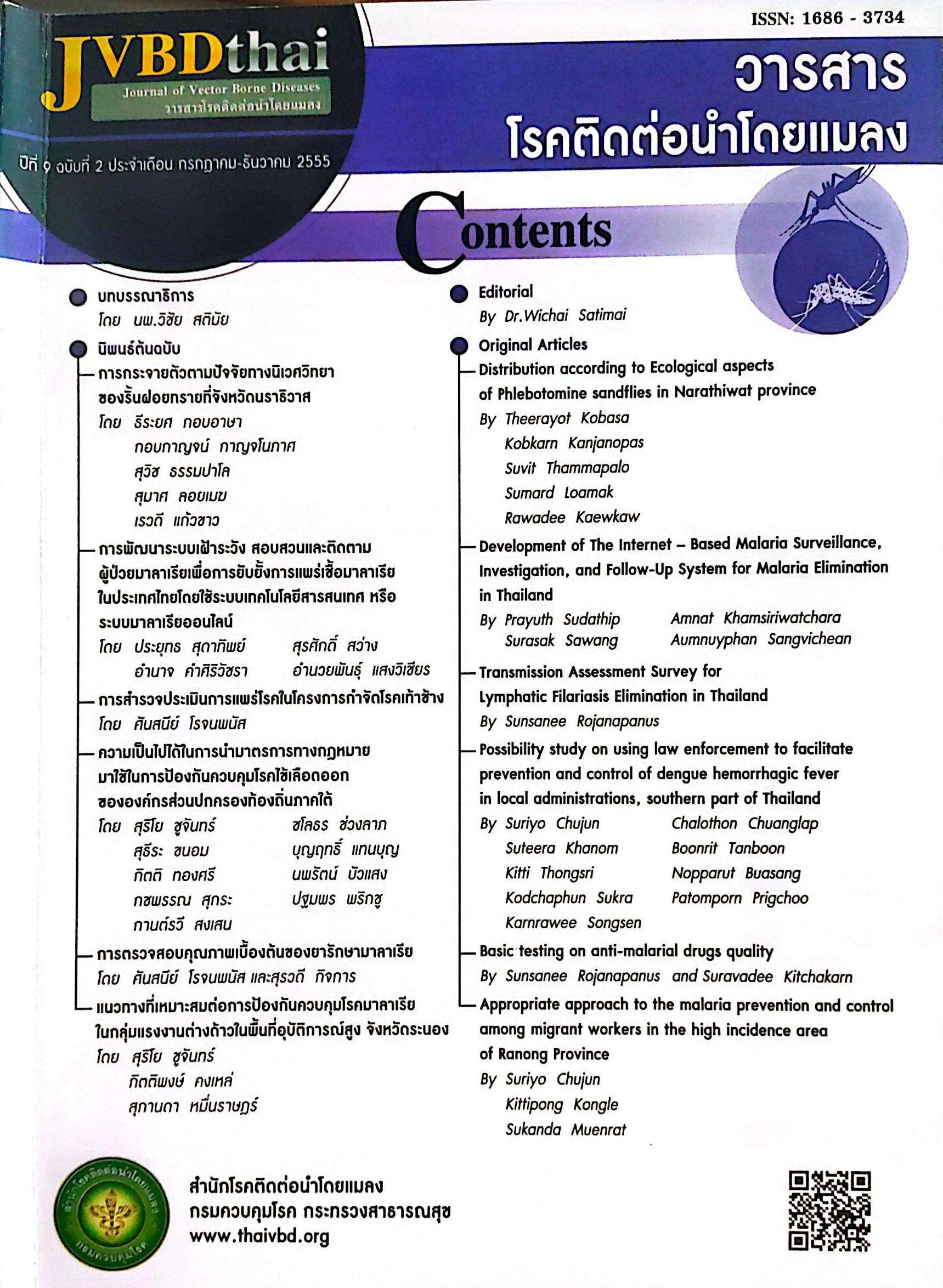
Appropriate approach to the malaria prevention and control among migrant workers in the high incidence area of Ranong Province
Article Sidebar
Main Article Content
Abstract
Malaria is a major public health problem in Thailand particularly to the Thai Myanmar border. The current malaria prevention and control approach cannot effectively solve the problem of malaria, thus resulting in the continued high incidence. This requires the development of appropriate control measures to prevent such problem. The survey research was employed to know the epidemiology of malaria and search for ways to the development of appropriate prevention and control approach. The study area was high incidence areas of Kraburi District, Ranong Province. The primary and secondary data were collected and used for the study. The primary data regarding socio-demographic context were obtained from 20 5category migrant workers and 18 private and public stakeholders by using an observation, photography, group discussions, and in-depth interviews. The secondary data regarding epidemiological situation were obtained from reported Myanmar migrant malaria cases of Ranong Province in 2010, retrieving from the electronic reporting system (506). Data analyses have been performed by applying descriptive epidemiology and content analysis.
Epidemiological research findings indicated that the overall rate of malaria incidence was higher than the Thais and the malaria cases were mostly male (80%), aged 25-44 years (37%). agricultural practices (63%). The proportion of male to female was three times, the rate of infection while the close correspondence was observed between Plasmodium falciparum and Plasmodium vivax. Of the 20 Myanmar worker participants examining using various qualitative techniques, the majority were male (80%) aged 3-40 years (40%), agricultural workers (80%), secondary school (70%) while the content analysis in relation to health services, research results showed that the samples were primarily concerned about leaving the area and the cost of health services. They also requested the closer health posts, proactive service, effective communication, and appropriate rnedia. An analysis in the stakeholder group revealed they were 20-60 years of age, the same numbers of males and females, graduated from elementary through undergraduate. The content analysis provided prevention and control guidelines suitable for migrant workers. The guidelines recommended an approach be driven by the community via project submitting to the sub-district administrative organization to receive financial support by local fund health security while public health agencies provide technical support in conducting the project and monitoring and local non-government organizations advocate the development of communication skills used in the Myanmar language service as well as the support and production of adequately appropriate media.
Such findings can be applied to solve the problems of malaria in migrant workers in Ranong Province and other areas containing a similar context, particularly in the border area of which migrant agricultural workers dwell in.
Downloads
Article Details

This work is licensed under a Creative Commons Attribution-NonCommercial-NoDerivatives 4.0 International License.
The opinions and content expressed in the articles are solely those of the individual authors and do not necessarily reflect the views of the journal or the authors’ affiliated institutions. Authors are fully responsible for the accuracy and correctness of their work.
Any reuse, reproduction, or redistribution of the articles, content, data, or images in other forms requires prior written permission from the Division of Vector Borne Diseases.
