
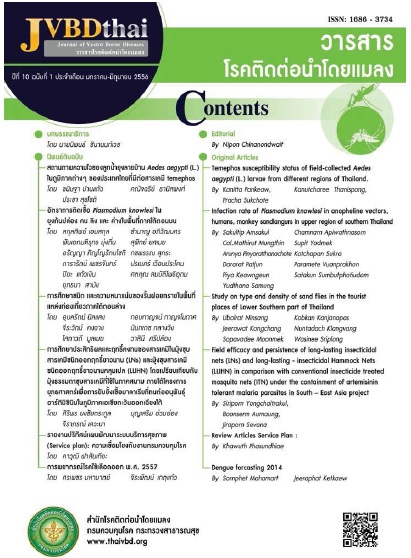
Infection rate of Plasmodium knowlesi in anopheline vectors, humans, monkey sandlangurs in upper region of southern Thailand
Article Sidebar
Main Article Content
Abstract
In 2004, human malaria caused by Plasmodium knowlesi was reported from Southeast Asian countries. The natural hosts of P. knowlesi are Long-tailed macaques, Pig-tailed macaques and Leaf monkeys. Morphological identification of P. knowlesi can easily confused with P. falciparum and P. malariae. A few reports showed that Anopheles leucosphyrus group such as An. hackeri, An. cracens, and An. latenswere the vector of P.knowlesi. ln Thailand, malaria caused by P. knowlesi was reported from different areas such as Prajuabkirikhan, Narathiwas, Yala, Tak and Chonburi. The upper south of Thailand comprises forest and hill areas which are inhabited by these natural reservoirs of P. knowlesi. Some people in this area have forest-related activities so that they could be at risk of getting malaria caused by P. knowlesi.
Our study was to identify P. knowlesi infection in human, macaque and also Anopheles mosquitoes in 3 provinces of the upper south of Thailand, i.e., Chumporn, Ranong and Suratthani from December 2009 to September 2011 using PCR technique.
Mosquitoes were collected from 3 different levels from the ground, i.e., 0, 3 and 6 meters from 06.00 pm to 06.00 am. Anopheles spp., Mansonia spp., Culex spp., Stegomye spp., Armigeres spp. And Adeomyei spp. were identified. Using PCR technique, P. knowlesi was found in An. minimus, An. maculatus, An. barbirostris and An. nivipes collected from Suratthani. From Ranong, the parasite was identified in An.maculatus, An. peditaeniatus, An. tessellatus and An. nigerrimus. Anopheles minimus and An. Tessellatus collected from Chumporn were also positive for P. knowlesi. However no P. knowlesi was identified in human and macaque samples.
Our study showed that Anopheles mosquitoes in the study areas contained P. knowlesi. This parasite was not found in humans and macaques. However the transmission of P. knowlesi in this area could not be ruled out. A larger scale of study should be further conducted.
Downloads
Article Details

This work is licensed under a Creative Commons Attribution-NonCommercial-NoDerivatives 4.0 International License.
The opinions and content expressed in the articles are solely those of the individual authors and do not necessarily reflect the views of the journal or the authors’ affiliated institutions. Authors are fully responsible for the accuracy and correctness of their work.
Any reuse, reproduction, or redistribution of the articles, content, data, or images in other forms requires prior written permission from the Division of Vector Borne Diseases.
