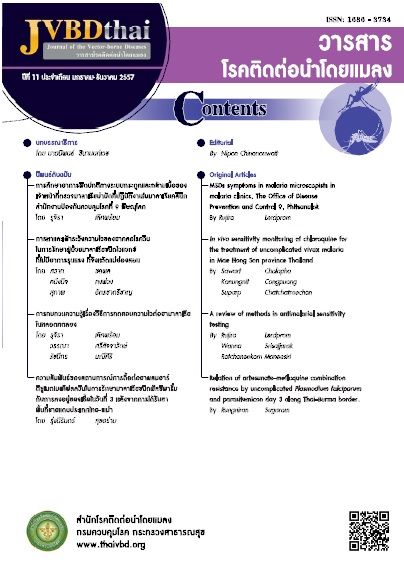
In vivo sensitivity monitoring of chloroquine for the treatment of uncomplicated vivex malaria in Mae Hong Son province Thailand
Article Sidebar
Main Article Content
Abstract
Background & objectives: Chloroquine (CQ), followed by 14-day primaquine, is a recommended regimen for the treatment of Plasmodium vivax infection in Thailand. CQ resistant P. vax (CRPv) has not yet challenged the efficacy of the drug. The present study was conducted to assess the current response of P. vivax to CQ alone in Mae Hong Son province.
Methods: A 28-day in vivo therapeutic efficacy study was conducted from June 2009 to December 2010 in 2 sentinel sites. Recurrence of parasitaemia and the clinical condition of patients were assessed on each visit during follow-up. The drug levels in recurrent patients' blood were measured using HPLC. Data were analyzed using the WHO 2008 program for the analysis of in vivo tests.
Results: Of the total 56 patients included in the study, 49 completed the 28-days follow-up, while 7 cases were excluded. Adequate Clinical and Parasitological Response: ACPC in Mae Hong Son were 100 (49/49), respectively.
Conclusion: Although in vivo sensitivity monitoring of chloroquine for the treatment of uncomplicated vivax malaria in Mae Hong Son province (border province of north-western border with Myanmar during 2009-2010 ACPR in Mae Hong Son is 100 % but the resistance of P. vivax to chloroquine is emerging in Kanchanaburi province, near the border of Myanmar. Chloroquine remains the first-line drug for P. vivax infections Thailand; regular monitoring is need to detect further development of parasite resistance in this area. The monitoring is also need in the other areas of the country where malaria endemic to estimate the level of burden across the country.
Downloads
Article Details

This work is licensed under a Creative Commons Attribution-NonCommercial-NoDerivatives 4.0 International License.
The opinions and content expressed in the articles are solely those of the individual authors and do not necessarily reflect the views of the journal or the authors’ affiliated institutions. Authors are fully responsible for the accuracy and correctness of their work.
Any reuse, reproduction, or redistribution of the articles, content, data, or images in other forms requires prior written permission from the Division of Vector Borne Diseases.
