
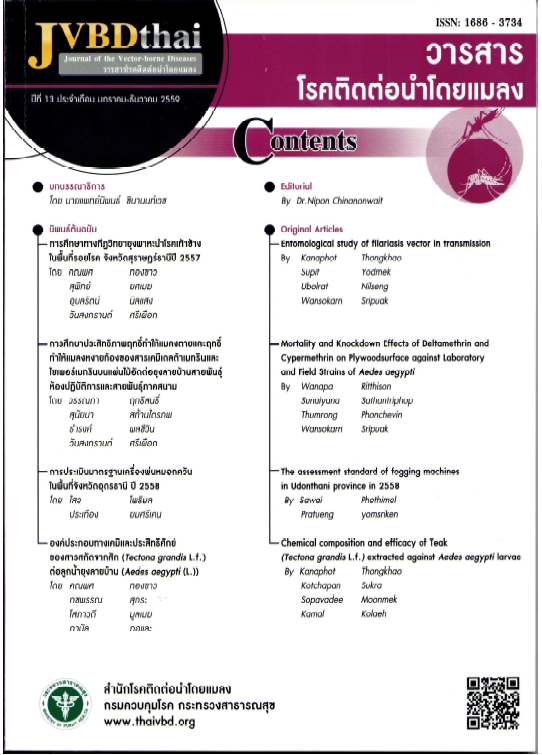
Mortality and Knockdown Effects of Deltamethrin and Cypermethrin on Plywoodsurface against Laboratory and Field Strains of Aedes aegypti
Article Sidebar
Main Article Content
Abstract
Deltamethrin and cypermethrin have been used for Aedes aegypti mosquito control, a primary vector of dengue viruses in Thailand. The objective of this study was to determine the lethal and knockdown effects of Emulsifiable concentrate (EC) formulations of deltamethrin at doses of 0.025, 0.05, 0.1, and 0.2 g/m2, and cypermethrin at doses of 0.1, 0.3, 0.5 and 0.7 g/m2 sprayed on unpainted plywood against Ae. aegypti. Background insecticide susceptibility of the Chanthaburi strain of Ae. aegypti was compared with a lab susceptible strain showing the field strain was highly resistant to 0.05% concentrations of both chemicals. At 30-min test exposure, the Chanthaburi strain with deltamethrin EC at 0.025 g/m2 produced a 34% knockdown and 10% mortality after 48-hour post-exposure, while the highest dose (0.2 g/m2) had a higher knockdown (83.3%) but relatively low mortality (18.8%) showing significant post-exposure recovery. Cypermethrin EC at 0.1 g/m2 displayed low knockdown effect (26.5%) and mortality (6.1%), while at 0.7 g/m2, it produced a much greater knockdown response (83.7%) but high recovery with only 26.8% final mortality. Conversely, deltamethrin at 0.025-0.2 g/m2 showed complete knockdown, but only at 0.1-0.2 g/m2 gave >80% mortality in the laboratory strain. Similarly, cypermethrin (0.1-0.7 g/m2) provided 100% knockdown and high mortality (92-100%) after 48 hours holding time.
Downloads
Article Details

This work is licensed under a Creative Commons Attribution-NonCommercial-NoDerivatives 4.0 International License.
The opinions and content expressed in the articles are solely those of the individual authors and do not necessarily reflect the views of the journal or the authors’ affiliated institutions. Authors are fully responsible for the accuracy and correctness of their work.
Any reuse, reproduction, or redistribution of the articles, content, data, or images in other forms requires prior written permission from the Division of Vector Borne Diseases.
