
Adverse General Health Outcomes of Myanmar Migrant Workers in Parawood Production Cluster in Phang-Nga Province
Article Sidebar
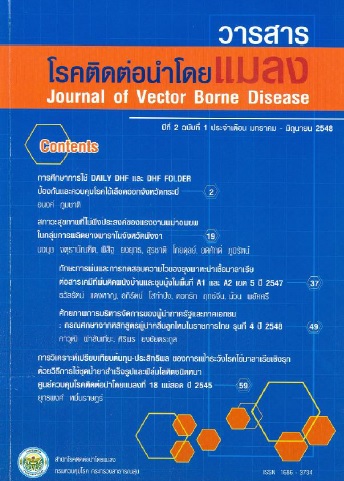
Main Article Content
Abstract
This cross-sectional study was conducted between July and August 2004 in order to analyze health status of Myanmar migrant workers in parawood production cluster of Phang-Nga Province. using a health survey form which was translated into Myanmar languge. Two groups included parawood plantation area (site A) (n-363) and parawood production plant (site B) (n-114). Adverse general health outcomes including 68 self-reported symptoms in the past month in individual respondents were recorded by severity classification (eg mild, moderate, and severe). Adverse effect score (AES) of the symptoms was mathematically derived: the frequency of the "Total yes" symptom by the respondents who developed mild, moderate, or severe symptoms, were divided by the frequency of the"No" symptom by the respondents who did not respond at all. Of the 68 symptoms in the respondents with "Total yes" and "No" frequencies, there were 14 symptoms significantly different from the sites A and B. Also, 15 and 19 symptoms with significant difference were found between the age groups (<30 and ≥ 30 years) and between the genders, respectively. Of the 16 common symptoms with the AEStotal yes ≥ 5, there were 4 most common symptoms (AEStotal yes>1.0), which included low back pain, headache. myalgia and fatigue. For genders, the mean scores of the AEStotal yes (Z=-1.609, P=0.108). AESmild (Z=-1.395, P=0.163), and AESmoderate (Z=-0.890, P=0.378) were all not significantly different. The mean score of the AESsevere in females rather than in males was significantly different (Z=-3.216, P=0.001). Findings suggest that, for disease prevention and control measures, social measures and laws in those with high backgrounds of adverse general health outcomes, point-of-care monitoring of adverse events or general health cares in occupation in the Myanmars would likely be necessary.
Downloads
Article Details

This work is licensed under a Creative Commons Attribution-NonCommercial-NoDerivatives 4.0 International License.
The opinions and content expressed in the articles are solely those of the individual authors and do not necessarily reflect the views of the journal or the authors’ affiliated institutions. Authors are fully responsible for the accuracy and correctness of their work.
Any reuse, reproduction, or redistribution of the articles, content, data, or images in other forms requires prior written permission from the Division of Vector Borne Diseases.
