
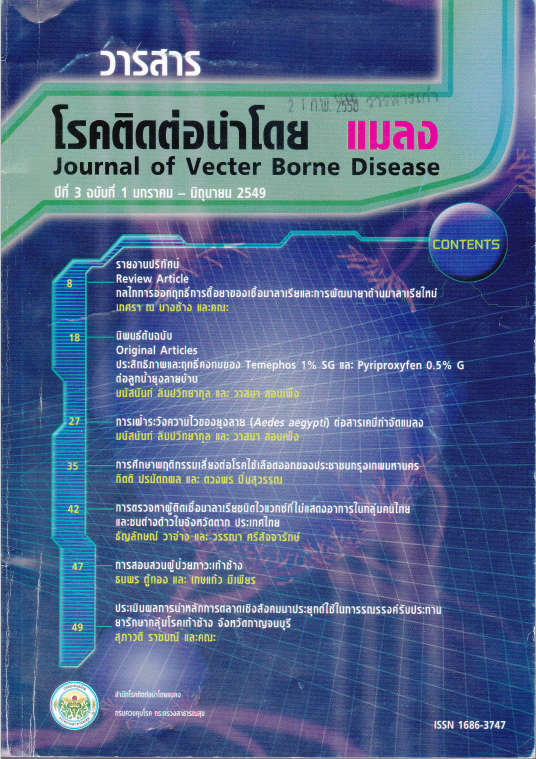
Efficacy and sustainable killing effect of Temephos 1% SG and Pyriproxyfen 0.5% G against Aedes aegypti larva
Article Sidebar
Main Article Content
Abstract
Aedes aegypti is the main vector of dengue virus, a causative agent of dengue fever and dengue hemorrhagic fever. Control of the larval stage of this vector is the easiest strategy which can be achieved by several methods, i.e. physical, chemical and biological control. The most appropriate method is through the prolonged use of Temephos. At present, in some area, Pyriproxyfen, an insect growth regulator is also used for the control of A. aegypti. This study compared the efficacy and sustainable killing effect of Temephos 1% SG with Pyriproxyfen 0.5% G in water containers either in the laboratory or the community environment. The results showed that Temephos 1% SG maintained its ability in killing 50% of larva within 24 hours by 12 weeks in store water container and 8 weeks in used water container. Pyriproxyfen 0.5% G maintained longer killing effect. They were 13 weeks in store water container and 9 weeks in used water container, respectively. However, most deaths occurred at the pupal stage or 3-15 days after dipping them into the solution. The sustainable killing effect was also studied in 4 villages. Larva was found by weeks 12 in containers with Temephos 1% SG and by weeks 3 in containers with Pyriproxyfen 0.5% G. It was also found that the sustainable killing effects of both Temephos 1% SG and Pyriproxyfen 0.5% G decreased according to the amount of water used and the time.
Downloads
Article Details

This work is licensed under a Creative Commons Attribution-NonCommercial-NoDerivatives 4.0 International License.
The opinions and content expressed in the articles are solely those of the individual authors and do not necessarily reflect the views of the journal or the authors’ affiliated institutions. Authors are fully responsible for the accuracy and correctness of their work.
Any reuse, reproduction, or redistribution of the articles, content, data, or images in other forms requires prior written permission from the Division of Vector Borne Diseases.
