
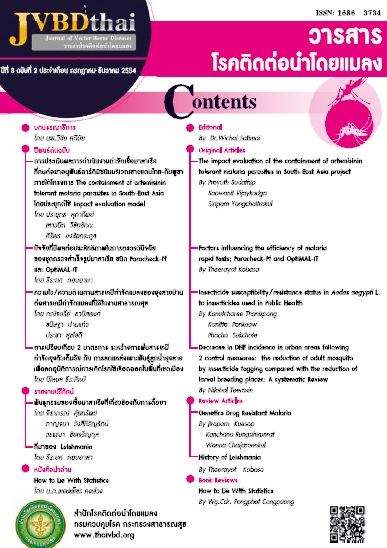
The impact roaluation of the containest of arte minininin tolerant malaria parasitea in South-East Asia project
Article Sidebar
Main Article Content
Abstract
Malaria remains one of the infectious diseases with highest burden in developing countries. In Greater Mekong Sub-region (GMS), there is increasing evidence that artemisinin resistant malaria parasites are present on the Thai-Cambodian border. Therefore, a project of a strategy for the containment of artemisinin tolerant malaria parasites in South-East Asia had been implemented to contain artemisinin-resistant malaria in the Thai-Cambodian border between 2009 and 2011.
This analysis utilized the secondary data collected during project implementationto assess the impact of the interventions and to draw lessons to guide the operationof the malaria elimination program in Thailand. The epidemiological information wasgathered from the web-based national malaria surveillance system. Random samplingsurveys were conducted to measure behavioral changes including malaria knowledge,perception, and practice.
The results indicated that the implemented activities and strategies in this project including new strategies for prevention, vector control, case management, behavioral change communication (BCC)/information, education and communication (IEC), and strengthening of the health system (surveillance, monitoring and evaluation system) significantly contributed to the reduction of the overall parasite incidence rates, Plasmodium falciparum incidence rates, and malaria transmission areas in target areas.
Containment efforts should sustain as the local transmission is continuing. The keys interventions that should emphasize including active case detection to eliminate asymptomatic cases, behavioral change communication among mobile-migrant population to improve utilization of health services, and coverage of long lasting insecticide treated nets in vulnerable populations. Additionally, operational research on innovative malaria elimination strategies in mobile-migrant population is urgently needed.
Downloads
Article Details

This work is licensed under a Creative Commons Attribution-NonCommercial-NoDerivatives 4.0 International License.
The opinions and content expressed in the articles are solely those of the individual authors and do not necessarily reflect the views of the journal or the authors’ affiliated institutions. Authors are fully responsible for the accuracy and correctness of their work.
Any reuse, reproduction, or redistribution of the articles, content, data, or images in other forms requires prior written permission from the Division of Vector Borne Diseases.
