Study on the Application of Solar Energy and Hydropower for Fish Farming to Generate Electricity
DOI:
https://doi.org/10.53848/ssstj.v12i2.1125Keywords:
Solar energy , Hydropower, Solar panels, Fish farming box, Electricity generationAbstract
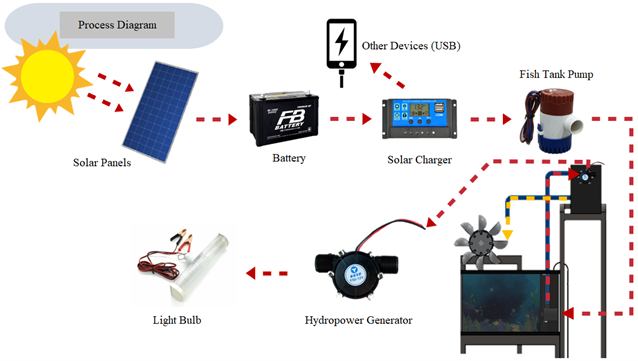
The objective of this research is to study and develop an energy-efficient fish farming box with dimensions of 0.30m x 0.60m x 0.38m to provide a simple, efficient, energy-saving, cost-effective, designed for remote rural areas. But conventional fish farming boxes require electricity to power various devices, such as bright light bulbs and oxygenators. In this study, solar energy and hydropower were employed as alternative sources of electricity to replace the conventional household electricity, a natural resource that can be harnessed without limitations, free from fuel production costs, and environmentally friendly. Over the course of 8 days of experimentation, the average electricity output was found to be 110.37 W, with the maximum current reaching 8.30 A at 12:00 PM. When compared to regular fish farming boxes, this energy-efficient fish farming box can save approximately 1,938.53 Baht/year in electricity costs. Over 10 years of use, the total electricity cost savings amount to approximately 19,385.28 Baht, which is about seven times higher than those of conventional fish farming boxes. It was found that the average DO value in the energy-efficient fish tank using the waterwheel was 7.18 mg/l, while the average DO value in the regular water was 4.08 mg/l. This indicates a difference of 3.10 mg/l in the DO values between the two conditions.
References
Laodee, P., Ketjoy, N., & Rakwichian, W. (2005, May 11–13). Pico hydro power generation: Case study of Ban Thapan, Luang PhaBang,
LAO PDR. The 1st Conference on Energy Network of Thailand, Cholburi.
Lima, G. M., Belchior, F. N., Villena, J. E. N., Domingos, J. L., Freitas, M. A. V., & Hunt, J. D. (2024). Hybrid
electrical energy generation from hydropower, solar photovoltaic and hydrogen. International Journal of
Hydrogen Energy, 53, 602–612. https://doi.org/10.1016/j.ijhydene.2023.12.092
Mahamai, P., Viriyah, W., & Phechsuwan, P. (2014). The paddle wheels aerator used solar and backward energy for fish pound. Naresuan
Phayao Journal, 7(2), 142–150. https://li01.tci-thaijo.org/index.php/journalup/article/view/42776/35396
Mbasso, W. F., Naoussi, S. R. D., Molu, R. J. J., Saatong, K. T., & Kamel, S. (2023). Technical assessment of a stand-alone hybrid renewable
system for energy and oxygen optimal production for fishes farming in a residential building using HOMER pro. Cleaner
Engineering and Technology, 17, 100688. https://doi.org/10.1016/j.clet.2023.100688
Noilublao, N. (2012). Development of a wastewater treatment turbine using solar energy [Thesis], Rajabhat
Maha Sarakham University, Thailand. (in Thai)
Pangteerasukmai, P. (2011). Hydro generator [Thesis]. Faculty of Engineering, Rajamangala University of
Technology PhraNakhon, Thailand. (in Thai)
Pathi, T., Pankong, N., & Phoomkittipich, K. (2010, December 15–17). Design of 5 kW with hydro and photovoltaic power station.
Academic Symposium on Renewable Energy for Communities in Thailand, Rajamangala University of Technology Thanyaburi.
Petrasathien, T., Khongrit, S., & Ratnoomnoi, A. (2018). Design’s and taking hydroelectric power plant
experimental. Department of Mechanical and Automotive Engineering Technology, Faculty of
Engineering and Technology, King Mongkut’s University of Technology North Bangkok, Thailand.
(in Thai)
Polizelli, M. A., Menegalli, F. C., Telis, V. R. N., & Telis-Romero, J. (2003). Friction losses in valves and fittings for power-law fluids. Brazilian
Journal of Chemical Engineering, 20(4), 455–463. https://doi.org/10.1590/S0104-66322003000400012
Ratchapakdee, P., & Geendoung, R. (2019). Solar aerator for fish farm cage. Faculty of Science and Technology, Rajamangala University
of Technology Srivijaya, Thailand. (in Thai)
Saniso, E. (2010). Pico-hydropower generator. The Journal of Industrial Technology, 13(1), 1–9.
Thanasin, K., Kumnerdjang, R., Phutthala., S., & Wanichayanan, C. (2018). Development of protypes for electricity generation using
hydropower. Advanced Science Journal, 18(2), 62–75.
Downloads
Published
How to Cite
Issue
Section
License
Copyright (c) 2025 Suan Sunandha Rajabhat University

This work is licensed under a Creative Commons Attribution 4.0 International License.