Human Fecal Contamination of Toilet Doors and Food Preparation Surfaces in Households with Poor-Quality Sanitation Facilities in Ibule-Soro, Nigeria
Infection risks from faecal contamination of surfaces
DOI:
https://doi.org/10.53848/ssstj.v13i1.1215Keywords:
Bacteria, faecal contamination, fomites, hygeine, sanitationAbstract
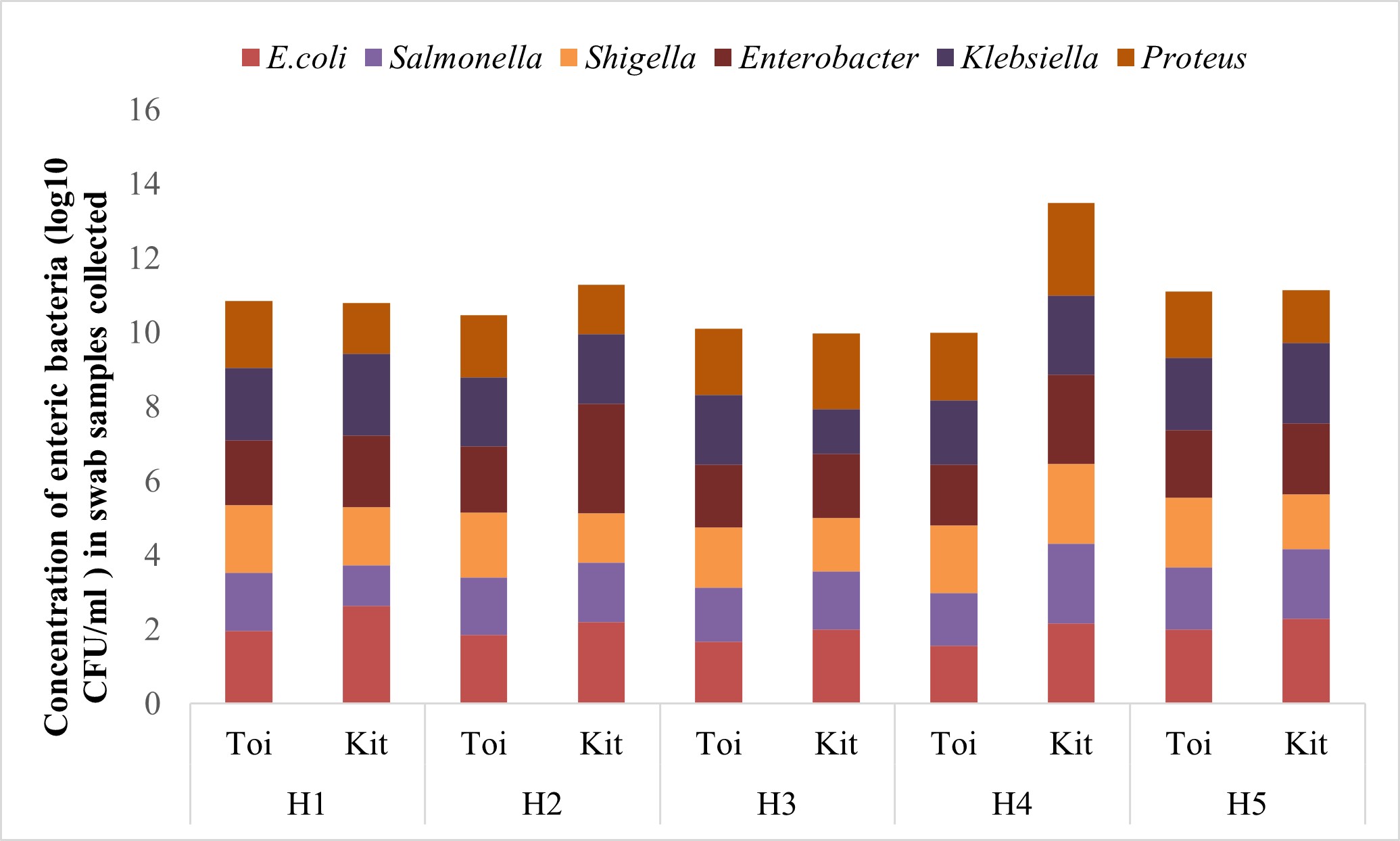
Contaminated surfaces are potential breeding habitats for pathogenic organisms. Toilet doors and food preparation surfaces may serve as fomites in the indirect transmission of pathogens as a result of fecal contamination. This study set out to determine the bacterial communities and levels of enteric bacteria on toilet doors and food preparation surfaces in households with poor-quality toilet facilities in Ibule-Soro, Nigeria. 24 Swab samples from toilet doors and food preparation surfaces were collected from each of the five households over a period of six months within 12 sampling events. The abundance and identity of bacteria in the samples were determined using both culture-based and molecular methods (16S rRNA gene sequencing). Risks factors of fecal contamination were also assessed. Results revealed that the concentration of Escherichia coli ranged from 2.15 to 2.64 log10 CFU/ml) while Salmonella ranged from 1.07 to 2.15 log10 CFU/ml. The common bacterial phyla detected were Proteobacteria, Actinobacteria and Firmicutes while Proteobacteria was the most abundant (42.45%) phylum. Risk factors such as toilet facilities, most especially ‘No toilet’ and ‘Manageable access to soap’ exhibited high significant association with the presence and load of Enterobacter, Klebsiella, Proteus. Toilet doors had higher frequency of occurrence of enteric bacteria than food preparation surfaces but food preparation surfaces had higher load of enteric bacteria than toilet doors. Isolates from toilet doors had higher normal distribution pattern than isolates from food preparation surfaces. In order to protect human health from infections, the quality of the toilet facilities in the households must be improved, adequate hygiene practices must be encouraged and food preparation surfaces must be cleaned and sanitized regularly.
References
Abney, S. E. (2022). Application of quantitative microbial risk assessment to domestic hygiene [Doctoral dissertation, The University of Arizona]. The University of Arizona Libraries.
Abney, S. E., Bright, K. R., McKinney, J., Ijaz, M. K., & Gerba, C. P. (2021). Toilet hygiene—review and research needs. Journal of Applied Microbiology, 131(6), 2705–2714.
Ali, R., Hayat, A., Fatima, M., & Noman, M. (2016). Detection and enumeration of enteric bacteria associated with food handlers and surfaces of food manufacturing industry located in Hub City, Pakistan. World Scientific News, 49(2), 192–203.
Alonge, O. O., Auwal, B. M., & Aboh, M. I. (2019). Bacterial contamination of toilet door handles on Baze University Campus, Abuja, Nigeria. African Journal of Clinical and Experimental Microbiology, 20(1), 35–41. https://doi.org/10.4314/ajcem.v20i1.5
Andere, D. M., Kayaro, B. O., & Kibet, C. K. (2022). Study of the presence of microorganisms in washroom door locks of UEA, Baraton as a prime factor to infectious disease in Kenya. Journal of Microbiology and Biotechnology, 7(2). https://doi.org/10.23880/oajmb-16000224
Appiah, P. O., Odoom, A., Tetteh-Quarcoo, P. B., Kotey, F. C., & Donkor, E. S. (2025). Microbial contamination of door handles: A global systematic review and meta-analysis of public and healthcare settings. Environmental Health Insights, 19, 11786302251328550.
Aydamo, A. A., Robele Gari, S., & Mereta, S. T. (2024). Seasonal variations in household water use, microbiological water quality, and challenges to the provision of adequate drinking water: A case of peri-urban and informal settlements of Hosanna town, Southern Ethiopia. Environmental Health Insights, 18, 11786302241238940.
Bain, R., Cronk, R., Wright, J., Yang, H., Slaymaker, T., & Bartram, J. (2014). Fecal contamination of drinking-water in low- and middle-income countries: A systematic review and meta-analysis. PLoS Medicine, 11(5), e1001644. https://doi.org/10.1371/journal.pmed.1001644
Bishoge, O. K. (2021). Challenges facing sustainable water supply, sanitation and hygiene achievement in urban areas in sub-Saharan Africa. Local Environment, 26(7), 893–907. https://doi.org/10.1080/13549839.2021.1931074
Bloomfield, S. F., Exner, M., Signorelli, C., Nath, K. J., & Scott, E. A. (2012). The chain of infection transmission in the home and everyday life settings, and the role of hygiene in reducing the risk of infection. International Scientific Forum on Home Hygiene.
Borrusso, P. A., & Quinlan, J. J. (2017). Prevalence of pathogens and indicator organisms in home kitchens and correlation with unsafe food handling practices and conditions. Journal of Food Protection, 80(4), 590–597. https://doi.org/10.4315/0362-028X.JFP-16-354
Byun, K.-H., Han, S. H., Yoon, J.-W., Park, S. H., & Ha, S.-D. (2021). Efficacy of chlorine-based disinfectants (sodium hypochlorite and chlorine dioxide) on Salmonella enteritidis planktonic cells, biofilms on food contact surfaces and chicken skin. Food Control, 123, 107838.https://doi.org/10.1016/j.foodcont.2020.107838
Carrascosa, C., Raheem, D., Ramos, F., Saraiva, A., & Raposo, A. (2021). Microbial biofilms in the food industry—A comprehensive review. International Journal of Environmental Research and Public Health, 18(4), 2014. https://doi.org/10.3390/ijerph18042014
Carstens, C. K., Salazar, J. K., Sharma, S. V., Chan, W., & Darkoh, C. (2022). Evaluation of the kitchen microbiome and food safety behaviors of predominantly low-income families. Frontiers in Microbiology, 13, 987925. https://doi.org/10.3389/fmicb.2022.987925
Chard, A. N., Levy, K., Baker, K. K., Tsai, K., Chang, H. H., Thongpaseuth, V., Sistrunk, J. R., & Freeman, M. C. (2020). Environmental and spatial determinants of enteric pathogen infection in rural Lao People’s Democratic Republic: A cross-sectional study. PLoS Neglected Tropical Diseases, 14(4), e0008180.
Delbès, C., Ali-Mandjee, L., & Montel, M.-C. (2007). Monitoring bacterial communities in raw milk and cheese by culture-dependent and -independent 16S rRNA gene-based analyses. Applied and Environmental Microbiology, 73(6), 1882–1891.
Dorsa, W. J., Cutter, C. N., & Siragusa, G. R. (1996). Evaluation of six sampling methods for recovery of bacteria from beef carcass surfaces. Letters in Applied Microbiology, 22(1), 39–41
Gallo, M., Ferrara, L., Calogero, A., Montesano, D., & Naviglio, D. (2020). Relationships between food and diseases: What to know to ensure food safety. Food Research International, 137, 109414.https://doi.org/10.1016/j.foodres.2020.109414
Gerba, C. P., & Pepper, I. L. (2015). Domestic and indoor microbiology. In I. L. Pepper, C. P. Gerba, & T. J. Gentry (Eds.), Environmental microbiology (3rd ed., pp. 665–675). Academic Press.https://doi.org/10.1016/B978-0-12-394626-3.00030-2
Gume, B., Berhanu, L., Kassa, T., Bediru, H., Fikre, A. G., Dadi, L. S., & Mereta, S. T. (2023). Bacterial hazard identification and exposure assessment of raw milk consumption in Jimma zone, South West Ethiopia. BMC Microbiology, 23, 166. https://doi.org/10.1186/s12866-023-02910-0
Güner, T. E., Göçmez, E. B., Merkan, B., Kireçci, S., & Tavşanlı, H. (2025). Comparison of microbial contaminaiton on fomite surfaces in public restrooms based on location and gender factors. Balıkesir Health Sciences Journal, 14(2), 281–287.
Haque, S. S., & Freeman, M. C. (2021). The applications of implementation science in water, sanitation, and hygiene (WASH) research and practice. Environmental Health Perspectives, 129(6), 65002. https://doi.org/10.1289/EHP7762
Kashchenko, G., Taldaev, A., Adonin, L., & Smutin, D. (2025). Investigating aerobic hive microflora: Role of surface microbiome of Apis mellifera. Biology, 14(1), 88. https://doi.org/10.3390/biology14010088
Kelly, G. C., Rachmat, A., Hontz, R. D., Sklar, M. J., Tran, L. K., Supaprom, C., Luy, M., Lina, S., Gregory, M. J., Sopheab, H., Brooks, J. S., Sutherland, I. W., Corson, K. S., & Letizia, A. G. (2023). Etiology and risk factors for diarrheal disease amongst rural and peri-urban populations in Cambodia, 2012–2018. PloS One, 18(3), e0283871. https://doi.org/10.1371/journal.pone.0283871
Kumar, S., Anwer, R., Sehrawat, A., Yadav, M., & Sehrawat, N. (2021). Assessment of bacterial pathogens in drinking water: A serious safety concern. Current Pharmacology Reports, 7(5), 206–212.
Lani, M. N., Azmi, M. F. M., Ibrahim, R., Alias, R., & Hassan, Z. (2014). Microbiological quality of food contact surfaces at selected food premises of Malaysian Heritage Food (‘Satar’) in Terengganu, Malaysia. International Journal of Engineering and Science, 3(9), 66–70.
Lawal, O. L., Omole, F. K., & Basorun, J. O. (2024). Examination of housing quality in the peri-urban areas of Akure, Nigeria. British Journal of Environmental Sciences, 12(4), 56–74.
McGinnis, S., Marini, D., Amatya, P., & Murphy, H. M. (2019). Bacterial contamination on latrine surfaces in community and household latrines in Kathmandu, Nepal. International Journal of Environmental Research and Public Health, 16(2), 257.
Mihucz, V. G., Ruus, A., Raamets, J., Wimmerová, L., Vera, T., Bossi, R., & Huttunen, K. (2022). A review of microbial and chemical assessment of indoor surfaces. Applied Spectroscopy Reviews, 57(9-10), 817–889. https://doi.org/10.1080/05704928.2021.1995870
Møretrø, T., Moen, B., Almli, V. L., Teixeira, P., Ferreira, V. B., Åsli, A. W., Nilsen, C., & Langsrud, S. (2021). Dishwashing sponges and brushes: Consumer practices and bacterial growth and survival. International Journal of Food Microbiology, 337, 108928. https://doi.org/10.1016/j.ijfoodmicro.2020.108928
Nguyen, J., Lara-Gutiérrez, J., & Stocker, R. (2021). Environmental fluctuations and their effects on microbial communities, populations and individuals. FEMS Microbiology Reviews, 45(4), fuaa068.https://doi.org/10.1093/femsre/fuaa068
Nwankwo, E. O., Okey-kalu, E. U., & Eze, F. A. (2023). Bacterial contamination of door handles of commercial buses in Umuahia Metropolis Abia State. Suan Sunandha Science and Technology Journal, 10(1), 54–61. https://doi.org/10.53848/ssstj.v10i1.414
Nwankwo, E. O., & Okochi, D. I. (2020). Possible bacteria pathogens found in the internal surface of ladies handbags in Umuahia, Abia State, South-Eastern Nigeria. UMYU Journal of Microbiology Research (UJMR), 5(2), 66–73. https://doi.org/10.47430/ujmr.2052.008
Olaitan, I. A. (2020). Bacteriological assessment of door handles and knobs at the Federal School of Medical Laboratory Technology offices in Jos. American Journal of Biomedical Science & Research, 17(5), 40–45
Olalemi, A. O., Atiba, R., Weston, S., & Howard, G. (2023). Sanitary inspection and microbial health risks associated with enteric bacteria in groundwater sources in Ilara-Mokin and Ibule-Soro, Nigeria. Journal of Water and Health, 21(12), 1784–1794.
Oranusi, S., Dahunsi, S. O., Owoso, O. O., & Olatile, T. (2013). Microbial profile of hands, food, easy contact surfaces and food surfaces: A case study in a university campus. Novus International Journal of Biotechnology and Biosciences, 2(1), 30–38.
Orimoloye, E. O., Amadi, C. O. A., Amadi, A. N., Azuamah, Y. C., Nwoke, E. A., Zacchaeus, U., & Dozie, I. N. S. (2015). Assessment of water sanitation and hygiene practices in Ibadan, Nigeria. International Journal of Research, 2(2), 94–100.
Potgieter, N., Aja-Okorie, U., Mbedzi, R. L., & Traore-Hoffman, A. N. (2020). Bacterial contamination on household latrine surfaces: A case study in rural and Peri-urban communities in South Africa. In A. Abia, & Lanza, G. (Eds.), Current microbiological research in Africa: Selected applications for sustainable environmental management (pp. 175–183). Springer.
Rossi, F., Poltronieri, P., Pomilio, F., & Centorotola, G. (2025). Latest developments of research on the viable non-culturable state of L. monocytogenes and implications for food safety. Applied Sciences, 15(3), 1454.https://doi.org/10.3390/app15031454
Sibanyoni, J. J., & Tabit, F. T. (2019). An assessment of the hygiene status and incidence of foodborne pathogens on food contact surfaces in the food preparation facilities of schools. Food Control, 98, 94–99.https://doi.org/10.1016/j.foodcont.2018.11.009
Tiku, D. R., Bassey, I. U., & Asikong, E. B. E. (2019). Evaluation of public health hazards of door handles in University of Calabar Community. International Journal of Scientific and Engineering Research, 10(6), 38–71.
Troeger, C., Forouzanfar, M., Rao, P. C., Khalil, I., Brown, A., Reiner, R. C., Fullman, N., Thompson, R. L., Abajobir, A., Ahmed, M., Alemayohu, M. A., Alvis-Guzman, N., Amare, A. T., Antonio, C. A., Asayesh, H., Avokpaho, E., Awasthi, A., Bacha, U., Barac, A., … Mokdad, A. H. (2017). Estimates of global, regional, and national morbidity, mortality, and aetiologies of diarrhoeal diseases: A systematic analysis for the Global Burden of Disease Study 2015. The Lancet Infectious Diseases, 17(9), 909–948.
World Health Organization. (2019). Water, sanitation, hygiene and health: A primer for health professionals (No. WHO/CED/PHE/WSH/19.149). World Health Organization.
World Health Organization. (2023). Burden of disease attributable to unsafe drinking-water, sanitation and hygiene, 2019 update. World Health Organization.
World Health Organization and United Nations Children’s Fund (UNICEF). (2019). Progress on household drinking water, sanitation and hygiene 2000-2017: Special focus on inequalities.https://www.who.int/publications/i/item/9789241516235
Zhao, B., Dewald, C., Hennig, M., Bossert, J., Bauer, M., Pletz, M. W., & Jandt, K. D. (2019). Microorganisms @ materials surfaces in aircraft: Potential risks for public health –A systematic review. Travel Medicine and Infectious Disease, 28, 6–14. https://doi.org/10.1016/j.tmaid.2018.07.011
Zhao, P., Chan, P.-T., Gao, Y., Lai, H.-W., Zhang, T., & Li, Y. (2019). Physical factors that affect microbial transfer during surface touch. Building and Environment, 158, 28–38.https:/doi.org/10.1016/j.buildenv.2019.05.005
Downloads
Published
How to Cite
Issue
Section
License
Copyright (c) 2026 Suan Sunandha Rajabhat University

This work is licensed under a Creative Commons Attribution 4.0 International License.