การศึกษาเปรียบเทียบประสิทธิภาพการจำแนกภาวะกระดูกหักจากภาพเอกซเรย์กระดูกรยางค์ด้วยโครงข่ายประสาทคอนโวลูชัน
DOI:
https://doi.org/10.57260/stc.2026.1100คำสำคัญ:
การจำแนกภาวะกระดูกหัก , ภาพเอกซเรย์กระดูกรยางค์ , โครงข่ายประสาทคอนโวลูชัน , การจำแนกภาพถ่ายทางการแพทย์, การศึกษาเปรียบเทียบประสิทธิภาพบทคัดย่อ
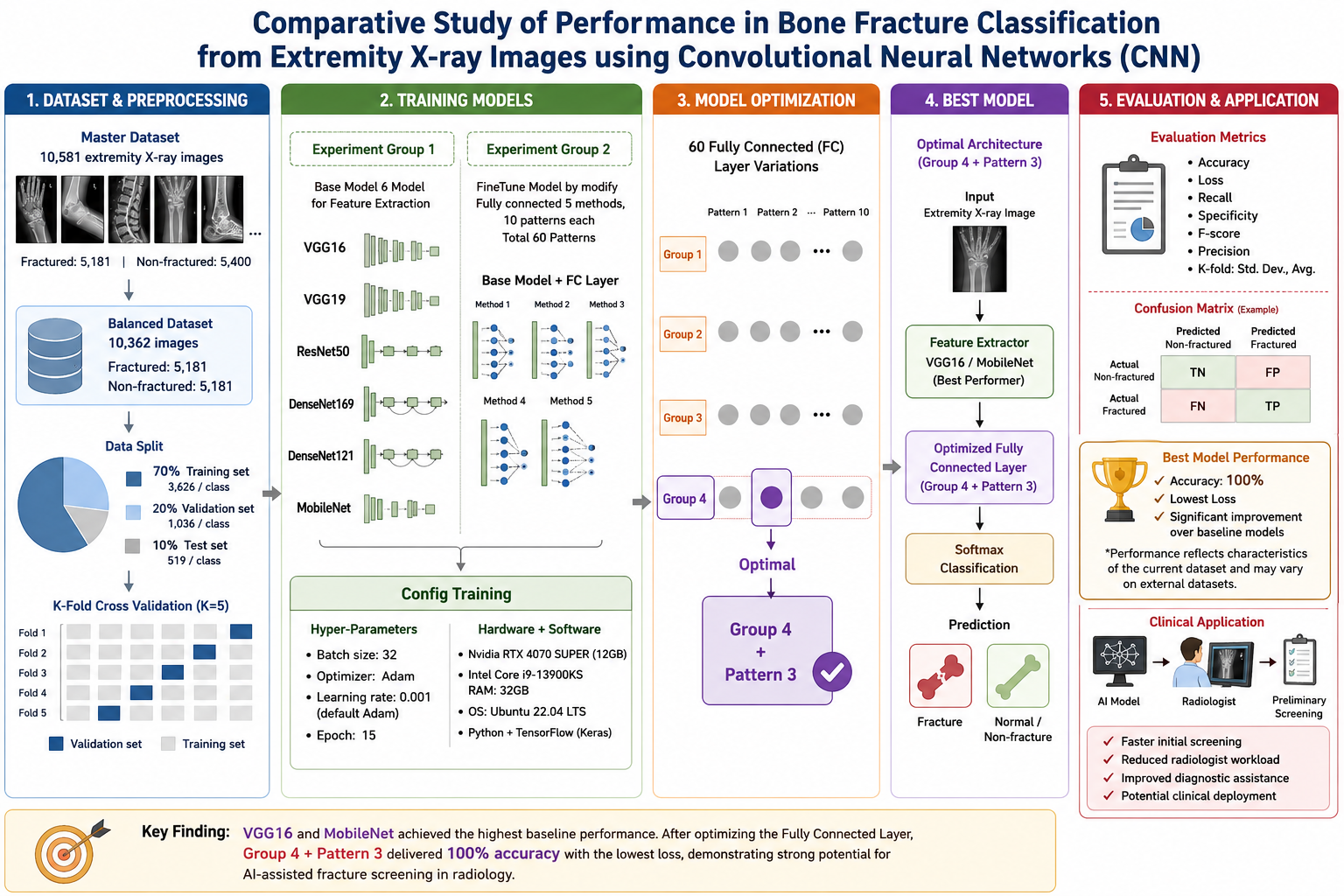
งานวิจัยนี้มีวัตถุประสงค์เพื่อศึกษาเปรียบเทียบประสิทธิการจำแนกภาวะกระดูกหักจากภาพเอกซเรย์กระดูกรยางค์โดยใช้โครงข่ายประสาทเทียมแบบคอนโวลูชันจากชุดข้อมูล Bone Fracture Multi-Region X-ray จำนวนทั้งหมด 10,432 ภาพ แบ่งเป็นภาพกระดูกหักและไม่หักอย่างละจำนวน 5,216 ภาพ แบ่งสัดส่วนข้อมูลสำหรับการเรียนรู้ การตรวจสอบ และการทดสอบแบบจำลองเป็นร้อยละ 70, 20 และ 10 ตามลำดับ กระบวนการทดลองแบ่งเป็น 2 ระยะ ได้แก่การประเมินแบบจำลองพื้นฐาน 6 ชนิดเพื่อสกัดคุณลักษณะเด่นและการปรับปรุงประสิทธิภาพชั้นเชื่อมโยงแบบสมบูรณ์ รวม 60 รูปแบบ ผลการศึกษาพบว่าแบบจำลอง VGG16 และ MobileNet ให้ประสิทธิภาพสูงสุดในกลุ่มแบบจำลองพื้นฐาน มีค่าความถูกต้องร้อยละ 99.450 ค่าความสูญเสีย 0.030 และเมื่อนำมาร่วมกับชั้นเชื่อมโยงแบบสมบูรณ์ในรูปแบบที่เหมาะสม (Group 4 + Pattern 3) สามารถเพิ่มค่าความถูกต้องเป็นร้อยละ 100 และลดค่าความสูญเสียลงได้อย่างมีนัยสำคัญเมื่อเปรียบเทียบกับแบบจำลองพื้นฐาน โดยค่าความถูกต้องนี้เป็นผลลัพธ์เฉพาะชุดข้อมูลที่ใช้ในการทดสอบครั้งนี้ งานวิจัยนี้แสดงให้เห็นถึงศักยภาพในการพัฒนาเป็นเครื่องมือช่วยรังสีแพทย์เพื่อสนับสนุนการวินิจฉัยเบื้องต้น ซึ่งจะช่วยลดภาระงานและเพิ่มความรวดเร็วในการคัดกรองเบื้องต้นได้อย่างมีประสิทธิภาพ
Downloads
เอกสารอ้างอิง
Barua, K., Mahmud, T., Barua, A., Sharmen, N., Basnin, N., Islam, D., & Hossain, S. (2023). Explainable AI-based humerus fracture detection and classification from X-ray images. In 2023 26th International Conference on Computer and Information Technology (ICCIT), Cox's Bazar, Bangladesh, (pp. 1-6). IEEE. https://doi.org/10.1109/ICCIT60459.2023.10441124
Chedsom, P., & Kanarkard, W. (2023). Analysis of student engagement in online classroom using Convolutional Neural Networks (CNN). ECTI Transaction on Application Research and Development, 3(3), 39–52. https://doi.org/10.37936/ectiard.2023-3-3.250499
Chedsom, P. (2025). Pneumonia Detection from Chest X-ray Images using Convolutional Neural Networks and Transfer Learning Techniques. Journal of Applied Informatics and Technology, 7(2), 406–431. https://ph01.tci-thaijo.org/index.php/jait/article/view/255187
Islam, M. U., Fathima, A., & Ghosh, D. (2025). An improved technique for bone fracture classification using visual transformers and convolutional neural networks. Proceedings of the International Conference on Innovative Computing & Communication (ICICC 2024). http://dx.doi.org/10.2139/ssrn.5191555
Navale, S. (2023). Bone abnormalities detection and classification using deep learning-Vgg16 algorithm. International Journal for Science Technology and Engineering, 11(7), 122–129. https://doi.org/10.22214/ijraset.2023.54582
Rodrigo, M. (2025). Bone fracture multi-region X-ray data. https://www.kaggle.com/datasets/bmadushanirodrigo/fracture-multi-region-x-ray-data
Sahin, M. E. (2023). Image processing and machine learning‐based bone fracture detection and classification using X‐ray images. International Journal of Imaging Systems and Technology, 33(3), 853–865. https://doi.org/10.1002/ima.22849
Senapati, B., Naeem, A. B., Ghafoor, M. I., Gulaxi, V., Almeida, F., Anand, M. R., & Jaiswal, C. (2024). Wrist Crack Classification Using Deep Learning and X-Ray Imaging. In: Daimi, K., Al Sadoon, A. (eds). Proceedings of the Second International Conference on Advances in Computing Research (ACR’24). ACR 2024. Lecture Notes in Networks and Systems, vol 956. Springer, Cham. https://doi.org/10.1007/978-3-031-56950-0_6
Simonyan, K., & Zisserman, A. (2015). Very Deep Convolutional Networks for Large-Scale Image Recognition. 3rd International Conference on Learning Representations, ICLR 2015, San Diego, 7-9 May 2015, 1-14.
https://arxiv.org/pdf/1409.1556.pdf
Thota, S., Kandukuru, P., Sundaram, M., Ali, A., Basha, S. M., & Bindu, N. H. (2024). "Deep Learning based Bone Fracture Detection," 2024 International Conference on Smart Systems for applications in Electrical Sciences (ICSSES), Tumakuru, India, (pp. 1-7). https://doi.org/10.1109/ICSSES62373.2024.10561360
ดาวน์โหลด
เผยแพร่แล้ว
รูปแบบการอ้างอิง
ฉบับ
ประเภทบทความ
สัญญาอนุญาต
ลิขสิทธิ์ (c) 2026 วารสารวิทยาศาสตร์และเทคโนโลยีสู่ชุมชน

อนุญาตภายใต้เงื่อนไข Creative Commons Attribution-NonCommercial-NoDerivatives 4.0 International License.
1. บทความ ข้อมูล เนื้อหา รูปภาพฯลฯ ที่ได้รับการตีพิมพ์ใน “วารสารวิทยาศาสตร์และเทคโนโลยีสู่ชุมชน” ถือเป็นลิขสิทธิ์ของวารสารวิทยาศาสตร์และเทคโนโลยีสู่ชุมชน มหาวิทยาลัยราชภัฏเชียงใหม่ หากบุคคลหรือหน่วยงานใดต้องการนำทั้งหมดหรือส่วนหนึ่งส่วนใดไปเผยแพร่ต่อหรือกระทำการใดๆ จะต้องได้รับอนุญาตเป็นลายลักษณ์อักษรจาก วารสารวิทยาศาสตร์และเทคโนโลยีสู่ชุมชน มหาวิทยาลัยราชภัฏเชียงใหม่
2. เนื้อหาบทความที่ปรากฏในวารสารเป็นความรับผิดชอบของผู้เขียนบทความโดยตรง ซึ่งกองบรรณาธิการวารสารไม่จำเป็นต้องเห็นด้วยหรือร่วมรับผิดชอบใดๆ