Documentation of Traditional Local Culinary Knowledge and Development of Multicultural Gastronomy Tourism Media in Phimonrat Subdistrict, Nonthaburi Province
DOI:
https://doi.org/10.57260/stc.2026.1544คำสำคัญ:
Phimonrat subdistrict, Local culinary knowledge, Tourism media, Multiculturalismบทคัดย่อ
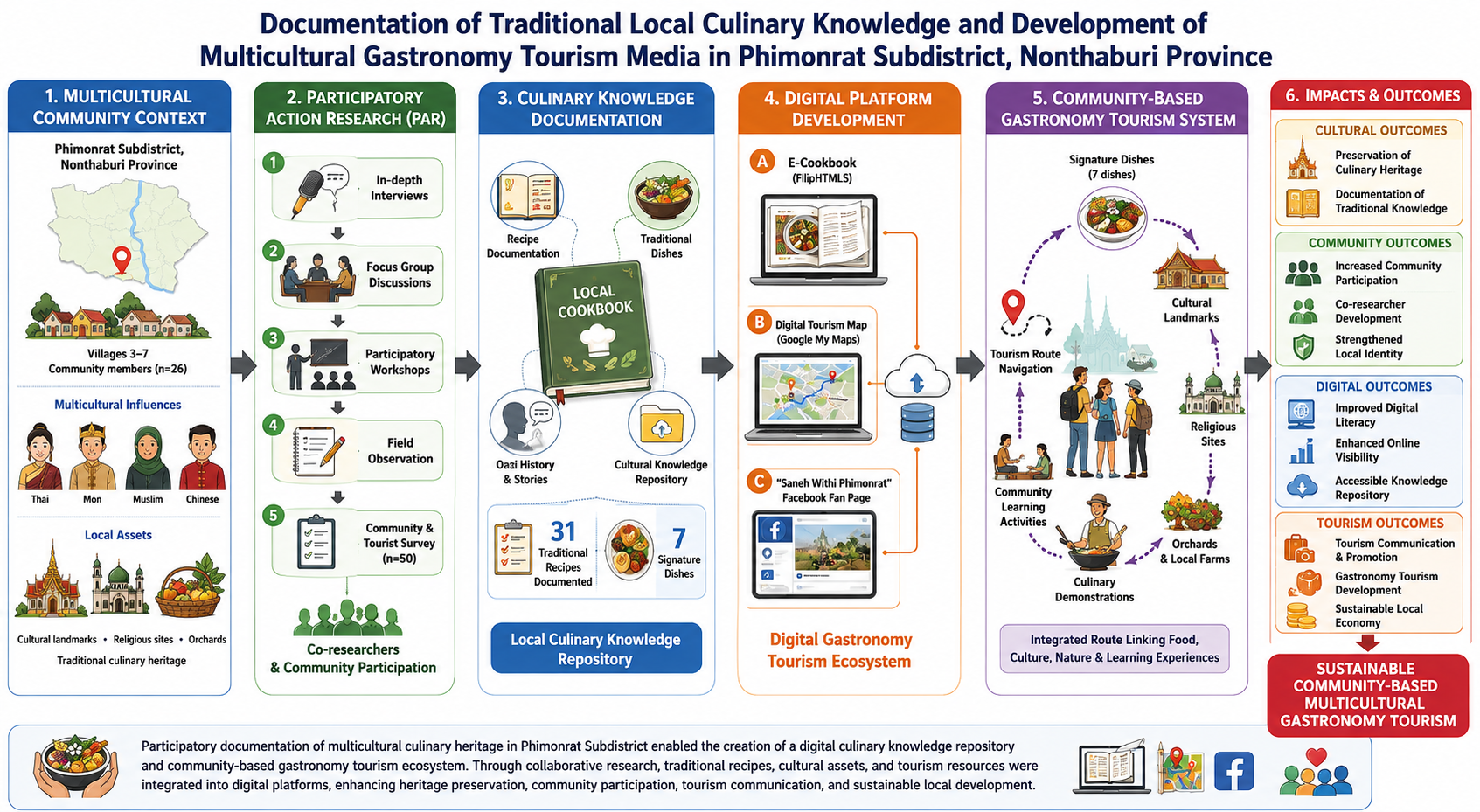
Phimonrat Subdistrict, Bang Bua Thong District, Nonthaburi Province, is a multicultural canal-side community whose local cuisine reflects the integration of Thai, Chinese, and Muslim cultural traditions. This research aimed to 1) investigate the cultural foundations and multicultural influences on local culinary practices in Phimonrat, develop a digital repository of local culinary knowledge, and 2) create a community-based gastronomy tourism system using digital technologies for tourism communication and promotion. The study employed Participatory Action Research integrated with qualitative and quantitative methods. The target group consisted of 26 community members from Villages 3–7 and 50 tourists/community participants. Research instruments included in-depth interviews, focus group discussions, participatory workshops, questionnaires, and field observations. Digital tools developed included an electronic cookbook through FlipHTML5, digital tourism maps using Google My Maps, and the Facebook fan page “Saneh Withi Phimonrat.” The findings revealed that the community documented 31 traditional recipes and identified seven signature dishes representing its multicultural gastronomic identity. Multicultural gastronomy tourism routes integrating local food, cultural landmarks, religious sites, orchards, and community learning activities were also developed. The digital platforms enhanced public access to local culinary knowledge, increased online visibility, strengthened community participation and digital literacy, and supported tourism communication and promotion. Overall, the study contributed to preserving local culinary heritage and promoting sustainable community-based gastronomy tourism in Phimonrat.
Downloads
เอกสารอ้างอิง
Andjanie, I. F., Asyifa, N., Pratama, R. K., Asyifa, A. F.(2023). Strengthening Community Involvement: An In-Depth Exploration of the Community-Based Tourism (CBT) Approach in Lamajang Tourism Village, Bandung Regency. Jurnal Kepariwisataan Indonesia 17 (2) (2023) 182-205.
Coombs, W. T. (2021). Ongoing crisis communication: Planning, managing, and responding (5th ed.). Thousand Oaks, CA: Sage.
Dolgui, A., Ivanov, D., & Sokolov, B. (2017). Ripple effect in supply chains: An analysis. International Journal of Production Research, 56(1–2), 414–430. https://doi.org/10.1080/00207543.2017.1281660
Ginanjar, R., Sri Runingsawitri, H. (2023). Community Empowerment In Tourism Development: Concepts And Implications. The Eastasouth Management and Business. Vol. 01, No. 03, May, pp. 111-119
Goodwin, H., & Santilli, R. (2009). Community-based tourism: A success? ICRT Occasional Paper 11.
Hall, D., & Richards, G. (2000). Tourism and sustainable community development. London: Routledge.
Jackson L. A. (2025). Community-Based Tourism: A Catalyst for Achieving the United Nations Sustainable Development Goals One and Eight. Tourism and Hospitality, 2025, 6(1), 29; https://doi.org/10.3390/tourhosp6010029
National Strategy Secretariat Office. (2018). National Strategy 2018 - 2037. Bangkok: Office of the National Economic and Social Development Board.
Tseng, S.-C., Wang, D., Shen, C.-C., & Chung, H.-P. (2023). A Study on the Relationship between Tourists’ Experience and Experience Value and Satisfaction in Taiwan’s Farmer’s Markets. Sustainability, 15(10), 8347. https://doi.org/10.3390/su15108347
Office of Strategy and Planning, Ministry of Tourism and Sports. (2021). Tourism statistics and policy framework. Bangkok: Ministry of Tourism and Sports.
Phatthaphanpee, T. (2023). Development of a model community occupational group to serve as a community tourism destination in Bang Pla Subdistrict, Bang Phli District, Samut Prakan Province. Panyapiwat Journal, 15(1), 140–157.
Salazar-Estrada, J. G. (2022). Digital heritage preservation for community tourism. Heritage & Society, 15(1), 1–17. https://doi.org/10.1080/2159032X.2022.2030456
Scheyvens, R. (2002). Tourism for development: Empowering communities. Harlow: Prentice Hall.
Scheyvens, R. (2007). Exploring the tourism–poverty nexus. Current Issues in Tourism, 10(2–3), 231–254. https://doi.org/10.2167/cit318.0
Sihem, L. & Amine, M. (2025). Comparative Study of the Impact of Digital Content on Travel Intention. Economic Sciences, Management and Commercial Sciences Review. Volume: 18, p. 345-359.
Silva, M.J. (2025). Crisis: Challenges and Impacts on Tourism Value Chain. University of Aveiro. DOI:10.13140/RG.2.2.33151.32161
Smolčić Jurdana, D., & Agbaba, R. (2025). Management of Crisis Situations Towards Tourism Destination Sustainability: Key Factors and Measures. Sustainability, 17(23), 10871. https://doi.org/10.3390/su172310871
Suriyankietkaew, S., Krittayaruangroj, K., Thinthan, S., Lumlongrut, S. (2025). Creative tourism as a driver for sustainable development: A model for advancing SDGs through community-based tourism and environmental stewardship. Environmental and Sustainability Indicators. Environmental and Sustainability Indicators, Volume 27, September 2025.
United Nations. (2015). Transforming our world: The 2030 agenda for sustainable development. New York: United Nations.
Yodsurang, P., Kiatthanawat, A., Sanoamuang, P., Kraseain, A., & Pinijvarasin, W. (2022). Community-based tourism and heritage consumption in Thailand: An upside-down classification based on heritage consumption. Cogent Social Sciences, 8(1). https://doi.org/10.1080/23311886.2022.2096531
Zielinski, S., Jeong, Y., Kim, S.-i., & B. Milanés, C. (2020). Why Community-Based Tourism and Rural Tourism in Developing and Developed Nations are Treated Differently? A Review. Sustainability, 12(15), 5938. https://doi.org/10.3390/su12155938
ดาวน์โหลด
เผยแพร่แล้ว
รูปแบบการอ้างอิง
ฉบับ
ประเภทบทความ
สัญญาอนุญาต
ลิขสิทธิ์ (c) 2026 วารสารวิทยาศาสตร์และเทคโนโลยีสู่ชุมชน

อนุญาตภายใต้เงื่อนไข Creative Commons Attribution-NonCommercial-NoDerivatives 4.0 International License.
1. บทความ ข้อมูล เนื้อหา รูปภาพฯลฯ ที่ได้รับการตีพิมพ์ใน “วารสารวิทยาศาสตร์และเทคโนโลยีสู่ชุมชน” ถือเป็นลิขสิทธิ์ของวารสารวิทยาศาสตร์และเทคโนโลยีสู่ชุมชน มหาวิทยาลัยราชภัฏเชียงใหม่ หากบุคคลหรือหน่วยงานใดต้องการนำทั้งหมดหรือส่วนหนึ่งส่วนใดไปเผยแพร่ต่อหรือกระทำการใดๆ จะต้องได้รับอนุญาตเป็นลายลักษณ์อักษรจาก วารสารวิทยาศาสตร์และเทคโนโลยีสู่ชุมชน มหาวิทยาลัยราชภัฏเชียงใหม่
2. เนื้อหาบทความที่ปรากฏในวารสารเป็นความรับผิดชอบของผู้เขียนบทความโดยตรง ซึ่งกองบรรณาธิการวารสารไม่จำเป็นต้องเห็นด้วยหรือร่วมรับผิดชอบใดๆ