การออกแบบและพัฒนาบ่อชุบแข็งด้วยน้ำมันสำหรับอุตสาหกรรมการผลิตมีดชุมชน
DOI:
https://doi.org/10.57260/stc.2026.1719คำสำคัญ:
การชุบแข็งด้วยน้ำมัน , บ่อชุบแข็ง , สมดุลพลังงาน , เหล็กกล้าเกรด AISI 5160 , มีดชุมชนบทคัดย่อ
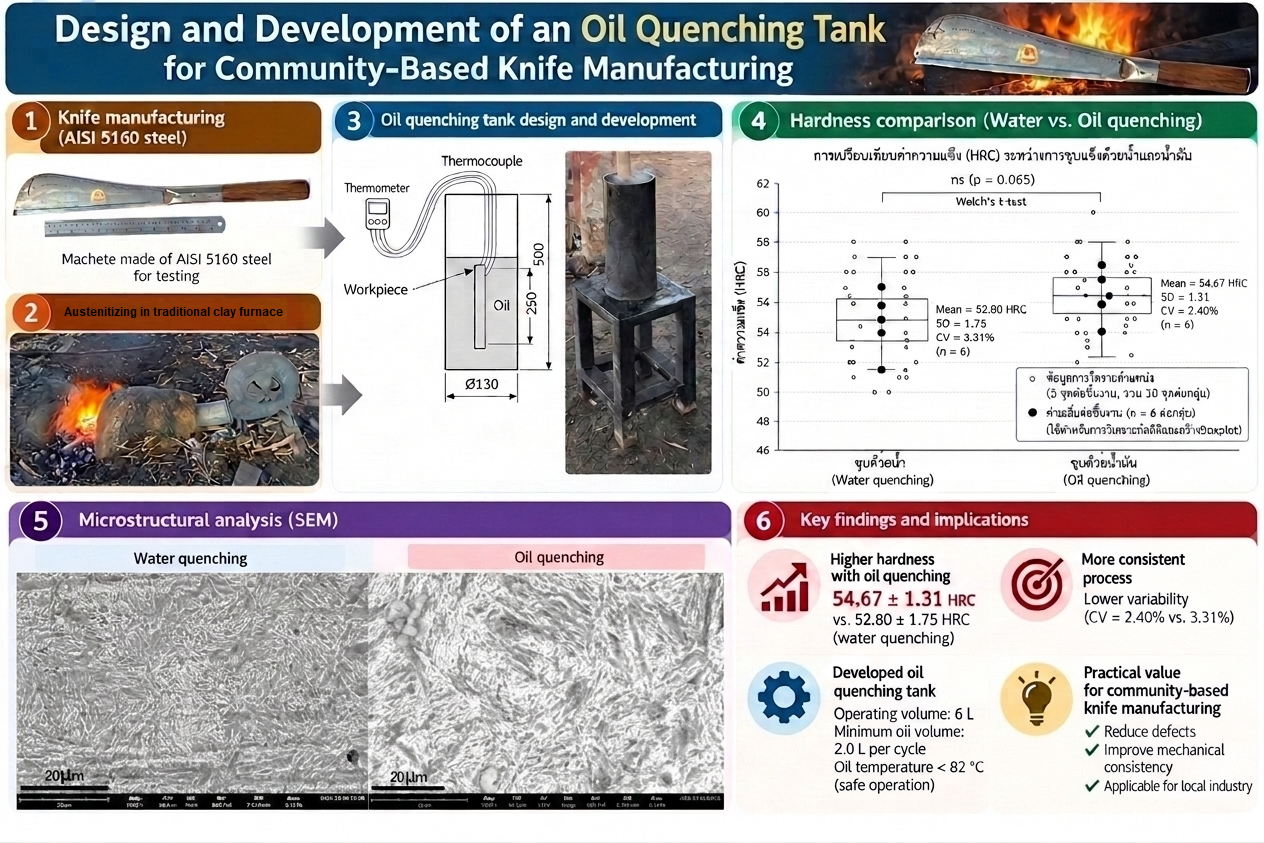
การผลิตมีดในระดับอุตสาหกรรมชุมชน ซึ่งใช้เหล็กกล้าเกรด AISI 5160 เป็นวัสดุหลักในการทำใบมีด มักประสบปัญหาของเสียจากการชุบแข็งด้วยน้ำ เนื่องจากอัตราการเย็นตัวที่รุนแรงส่งผลให้เกิดการแตกร้าวและความแปรปรวนของสมบัติเชิงกล งานวิจัยนี้มีวัตถุประสงค์เพื่อ 1) ออกแบบและพัฒนาบ่อชุบน้ำมันโดยอาศัยหลักสมดุลพลังงาน(2) ประเมินสมรรถนะของระบบผ่านการทดสอบความแข็งและการวิเคราะห์โครงสร้างจุลภาค และ 3) เปรียบเทียบผลลัพธ์กับการชุบน้ำภายใต้เงื่อนไขการชุบที่แตกต่างกัน โดยใช้มีดพร้าเหล็กกล้าเกรด AISI 5160 เป็นชิ้นทดสอบ ผลการออกแบบระบุว่าปริมาตรน้ำมันขั้นต่ำเท่ากับ 2.0 ลิตรต่อการชุบหนึ่งครั้ง และได้พัฒนาบ่อชุบที่มีปริมาตรใช้งาน 6 ลิตรเพื่อเพิ่มเสถียรภาพทางความร้อน โดยอุณหภูมิน้ำมันระหว่างใช้งานต่อเนื่องไม่เกิน 82 °C ซึ่งต่ำกว่าจุดวาบไฟอย่างปลอดภัย ผลการทดลองที่ระดับชิ้นงาน (n = 6 ต่อกลุ่ม) พบว่ากลุ่มชุบน้ำมันให้ค่าความแข็งเฉลี่ย 54.67 ± 1.31 HRC สูงกว่ากลุ่มชุบน้ำที่ 52.80 ± 1.75 HRC โดยมีขนาดอิทธิพลระดับสูง (Cohen's d = 1.21) และค่าสัมประสิทธิ์ความแปรปรวนต่ำกว่า (2.40% เทียบกับ 3.31%) แม้ค่าความแข็งอาจแตกต่างในระดับเข้าใกล้นัยสำคัญทางสถิติ (Welch's t-test, p = 0.065) เนื่องจากข้อจำกัดด้านขนาดตัวอย่าง แต่ค่าความแปรปรวนที่ลดลงอย่างชัดเจนนี้สะท้อนถึงความสม่ำเสมอของกระบวนการที่เหนือกว่าได้อย่างเป็นรูปธรรม การวิเคราะห์โครงสร้างจุลภาคด้วย SEM สนับสนุนผลดังกล่าว โดยกลุ่มชุบน้ำมันมีโครงสร้างที่ละเอียดและสม่ำเสมอกว่า สอดคล้องกับลักษณะของ tempered martensite อย่างไรก็ตาม สมบัติเชิงกลของชิ้นงานได้รับอิทธิพลร่วมกันจากทั้งชนิดของตัวกลางชุบและเงื่อนไขกระบวนการชุบ โดยสรุป ระบบบ่อชุบน้ำมันที่พัฒนาขึ้นไม่เพียงแต่มีแนวโน้มเพิ่มความแข็งของชิ้นงาน แต่ยังสามารถแก้ปัญหาความแปรปรวนในกระบวนการผลิตได้อย่างเป็นรูปธรรม จึงมีความเหมาะสมที่จะนำไปใช้เป็นแนวทางเชิงวิศวกรรมเพื่อยกระดับมาตรฐานการชุบแข็งในอุตสาหกรรมชุมชนต่อไป
Downloads
เอกสารอ้างอิง
Apichai, P. (2020). Effects of quenchants on microstructures and mechanical properties of steel grade AISI 5160. Journal of Metals, Materials and Minerals, 30(3), 15–23. https://doi.org/10.55713/jmmm.v30i3.631
ASTM International. (2007). ASTM D6710-02(2007): Standard guide for evaluation of hydrocarbon-based quench oils. ASTM International.
ASTM International. (2023a). ASTM E165/E165M-23: Standard practice for liquid penetrant testing for general industry. ASTM International.
ASTM International. (2023b). ASTM E407-23: Standard practice for microetching metals and alloys. ASTM International.
Cohen, J. (1988). Statistical power analysis for the behavioral sciences. (2nd ed.). Lawrence Erlbaum Associates.
Dhinnabutra, P., & Nansaang, S. (2022). Development hardening process of big knife: Case study: Muang Wan knife products, Nam Phong District, Khon Kaen Province. In Proceedings of the Conference of Industrial Engineering Network (IE NETWORK 2022) (pp. 405–411).
Dossett, J. L. (2020). Transformation of austenite and quenching of steel. In Practical heat treating: Basic principles (pp. 55–78). ASM International. https://doi.org/10.31399/asm.tb.phtbp.t59310055
FM Global. (2022). Data Sheet 7-41: Heat treating of materials using oil quenching and molten salt baths. FM Global Property Loss Prevention Data Sheets. https://www.fm.com
Krauss, G. (1999). Martensite in steel: Strength and structure. Materials Science and Engineering: A, 273–275, 40–57. https://doi.org/10.1016/S0921-5093(99)00288-9
López-García, R. D., García-Pastor, F. A., Maldonado-Reyes, A., Jiménez-Gómez, M. A., & Rodríguez-García, J. A. (2019). Analysis of the effect of immersion rate on the distortion and residual stresses in quenched SAE 5160 steel using FEM. Journal of Materials Research and Technology, 8(6), 5557–5571. https://doi.org/10.1016/j.jmrt.2019.09.024
Lozano, D. E., Martínez-Cázares, G. M., & Bedolla-Gil, Y. (2024). Metallurgical fundamentals of quenching. In G. E. Totten, R. S. Otero, X. Luo, & L. C. F. Canale (Eds.), ASM Handbook, Vol. 4F: Quenchants and quenching technology (pp. 3–25). ASM International. https://doi.org/10.31399/asm.hb.v4F.a0006995
MacKenzie, D. S. (2024). Calculating quench tank size for continuous furnaces. Gear Solutions. https://gearsolutions.com/departments/hot-seat/calculating-quench-tank-size-for-continuous-furnaces/
Montgomery, D. C. (2019). Design and analysis of experiments. (10th ed.). John Wiley & Sons.
Ramesh, G., & Prabhu, K. N. (2014). Wetting and cooling performance of mineral oils for quench heat treatment of steels. ISIJ International, 54(6), 1426–1435. https://doi.org/10.2355/isijinternational.54.1426
Rhayim, T. (2010). A study of community handicraft products of knife-making group in the middle region of Thailand. https://so01.tci-thaijo.org/index.php/ajnu/article/view/26372
Samuel, A., & Prabhu, K. N. (2022). Residual stress and distortion during quench hardening of steels: A review. Journal of Materials Engineering and Performance, 31(7), 5161–5188. https://doi.org/10.1007/s11665-022-06667-x
Sudiyanto, A., Amalia, Y., & Pujiyulianto, E. (2021). The effect of varying quenching media on cooling time and microstructures of leaf spring steel AISI 5160. AIP Conference Proceedings, 2363(1), 030024. https://doi.org/10.1063/5.0066030
Thai Industrial Standards Institute. (2003). TCPS 82/2546: Thai community product standard for knives. TISI.
The World Bank. (2023). Employment in agriculture (% of total employment) (modeled ILO estimate) – Thailand. World Development Indicators. https://data.worldbank.org/indicator/SL.AGR.EMPL.ZS?locations=TH
Totten, G. E., Bates, C. E., & Clinton, N. A. (1993). Handbook of quenchants and quenching technology. ASM International.
Welch, B. L. (1947). The generalization of 'Student's' problem when several different population variances are involved. Biometrika, 34(1/2), 28–35. https://doi.org/10.2307/2332510
ดาวน์โหลด
ไฟล์ประกอบ
เผยแพร่แล้ว
รูปแบบการอ้างอิง
ฉบับ
ประเภทบทความ
สัญญาอนุญาต
ลิขสิทธิ์ (c) 2026 วารสารวิทยาศาสตร์และเทคโนโลยีสู่ชุมชน

อนุญาตภายใต้เงื่อนไข Creative Commons Attribution-NonCommercial-NoDerivatives 4.0 International License.
1. บทความ ข้อมูล เนื้อหา รูปภาพฯลฯ ที่ได้รับการตีพิมพ์ใน “วารสารวิทยาศาสตร์และเทคโนโลยีสู่ชุมชน” ถือเป็นลิขสิทธิ์ของวารสารวิทยาศาสตร์และเทคโนโลยีสู่ชุมชน มหาวิทยาลัยราชภัฏเชียงใหม่ หากบุคคลหรือหน่วยงานใดต้องการนำทั้งหมดหรือส่วนหนึ่งส่วนใดไปเผยแพร่ต่อหรือกระทำการใดๆ จะต้องได้รับอนุญาตเป็นลายลักษณ์อักษรจาก วารสารวิทยาศาสตร์และเทคโนโลยีสู่ชุมชน มหาวิทยาลัยราชภัฏเชียงใหม่
2. เนื้อหาบทความที่ปรากฏในวารสารเป็นความรับผิดชอบของผู้เขียนบทความโดยตรง ซึ่งกองบรรณาธิการวารสารไม่จำเป็นต้องเห็นด้วยหรือร่วมรับผิดชอบใดๆ