การพัฒนาถ่านจากเปลือกทุเรียนเพื่อกำจัดสีย้อมผ้าในน้ำทิ้ง
DOI:
https://doi.org/10.57260/stc.2026.1680คำสำคัญ:
ถ่านจากเปลือกทุเรียน, วัสดุดูดซับ, การกำจัดสีย้อมผ้า, น้ำทิ้ง , การปรับสภาพด้วยโซเดียมคลอไรด์บทคัดย่อ
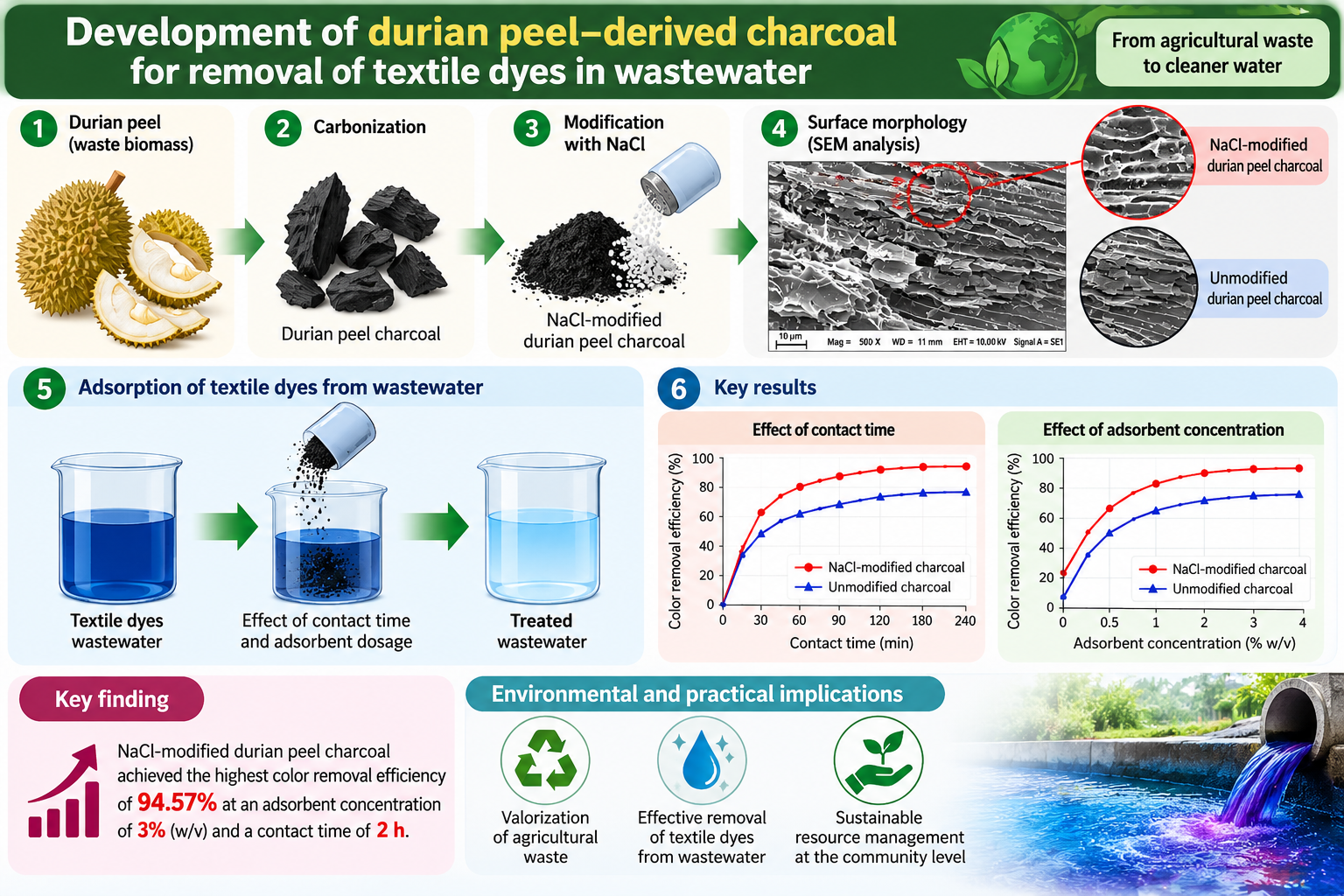
การปนเปื้อนของสีย้อมผ้าในน้ำทิ้งจากกิจกรรมในชุมชนและอุตสาหกรรมสิ่งทอเป็นปัญหาสิ่งแวดล้อมที่สำคัญ งานวิจัยนี้มีวัตถุประสงค์เพื่อพัฒนาถ่านจากเปลือกทุเรียนเป็นวัสดุดูดซับสำหรับการกำจัดสีย้อมผ้าจากน้ำทิ้ง โดยเปรียบเทียบประสิทธิภาพการกำจัดสีของถ่านจากเปลือกทุเรียนที่ไม่ผ่านการปรับสภาพและถ่านจากเปลือกทุเรียนที่ปรับสภาพด้วยโซเดียมคลอไรด์ (NaCl) และประเมินผลของระยะเวลาสัมผัสและความเข้มข้นของตัวดูดซับต่อประสิทธิภาพการกำจัดสี ผลการทดลองพบว่าประสิทธิภาพการกำจัดสีเพิ่มขึ้นตามระยะเวลาในการดูดซับและความเข้มข้นของตัวดูดซับจนกระทั่งเข้าสู่สภาวะสมดุล นอกจากนี้ ถ่านจากเปลือกทุเรียนที่ผ่านการปรับสภาพด้วย NaCl มีประสิทธิภาพการดูดซับสูงกว่าถ่านที่ไม่ปรับสภาพ โดยถ่านที่ผ่านการปรับสภาพมีประสิทธิภาพการดูดซับสูงสุด 94.57 % ที่ความเข้มข้นตัวดูดซับ 3 % (w/v) และระยะเวลาในการดูดซับ 2 ชั่วโมง ดังนั้น ผลการศึกษานี้แสดงให้เห็นถึงศักยภาพของถ่านจากเปลือกทุเรียนในการเป็นวัสดุดูดซับสำหรับการกำจัดสีย้อมผ้าจากน้ำทิ้ง การนำเปลือกทุเรียนซึ่งเป็นวัสดุเหลือทิ้งทางการเกษตรมาใช้เป็นวัสดุดูดซับสามารถเพิ่มมูลค่าให้แก่วัสดุเหลือทิ้งทางการเกษตร และมีส่วนช่วยส่งเสริมการจัดการทรัพยากรอย่างยั่งยืนในระดับชุมชน
Downloads
เอกสารอ้างอิง
ธนากร คีเรียง, อาทิตย์ หูเต็ม และ ปิยรัตน์ มูลศรี. (2568). การเตรียมถ่านกัมมันต์จากเศษลำต้นกัญชงเหลือทิ้งทางการเกษตรโดยใช้กระบวนการไพโรไลซิสและการกระตุ้นด้วยคลื่นไมโครเวฟเพื่อการกำจัดสีย้อมเมทิลเรด. วารสารวิทยาศาสตร์และเทคโนโลยี มหาวิทยาลัยราชภัฏเพชรบูรณ์, 5(2). 1-12. https://so04.tci-thaijo.org/index.php/jstpcru/article/view/280101
โยธิน กัลยาเลิศ, วิชัย กองศรี, นพมาศ ประทุมสูตร และ ชุมพล บุษบก. (2566). โครงสร้างจุลภาคและองค์ประกอบธาตุของถ่านกัมมันต์จากเปลือกทุเรียน. วารสารฟิสิกส์และวิทยาศาสตร์ทั่วไป, 7(2). 1-9. http://journalpags.skru.ac.th/ojs/index.php/jpags/article/view/83
สำนักงานเศรษฐกิจการเกษตร. (2568). สถานการณ์สินค้าเกษตรที่สำคัญและแนวโน้ม ปี 2569: ทุเรียน. https://oae.go.th/uploads/files/2026/01/22/AD96BF9855DA.pdf?utm_source= chatgpt.com
Alawam, A. S., Mahgoub, S. M., Allam, A. A., Radalla, A. M., Shemy, M. H., & Mahmoud, R. (2025). Sustainable zeolite/activated carbon nanocomposite for dual-dye adsorption, kinetic and thermodynamic studies, and urea electro-oxidation applications. RSC Advances, 15(51), 43983-44006. https://doi.org/10.1039/D5RA06559C
Azfaralariff, A., Ahmad, M. I., Che Zain, M. S., & Abdul Khalil, H. P. S. (2025). Transforming agricultural waste into sustainable bioadsorbents and advanced bioaerogels from durian (Durio zibethinus) peel. Biofuels, Bioproducts and Biorefining. 19(6), 1706-1727. https://doi.org/10.1002/bbb.2771
Bharathi, K. S., & Ramesh, S. T. (2013). Removal of dyes using agricultural waste as low-cost adsorbents: A review. Applied Water Science, 3, 773-790. https://doi.org/10.1007/s13201-013-0117-y
Crini, G. (2006). Non-conventional low-cost adsorbents for dye removal: A review. Bioresource Technology, 97(9), 1061-1085. https://doi.org/10.1016/j.biortech.2005.05.001
Farqi, N. N. A. N. L. T., Abdulhameed, A. S., Surip, S. N., AlOthman, Z. A., & Jawad, A. H. (2023). Tropical fruit wastes including durian seeds and rambutan peels as a precursor for producing activated carbon using H3PO4-assisted microwave method: RSM-BBD optimization and mechanism for methylene blue dye adsorption. International Journal of Phytoremediation, 25(12), 1567-1578. https://doi.org/10.1080/15226514.2023.2175780
Forgacs, E., Cserhati, T., & Oros, G. (2004). Removal of synthetic dyes from wastewaters: A review. Environment International, 30(7), 953-971. https://doi.org/10.1016/j.envint.2004.02.001
Gupta, V. K., & Suhas. (2009). Application of low-cost adsorbents for dye removal-A review. Journal of Environmental Management, 90, 2313-2342. https://doi.org/10.1016/j.jenvman.2008.11.017
Huong, D. T., Ngan, N. N. P., Anh, D. T. T., Vinh, N. D., & Xuan, V. T. (2025). Durian peel-seed biochar for efficient methylene blue removal from water: Synthesis, characterization, and adsorption performance. RSC Advances, 15(40), 33726-33749. https://doi.org/10.1039/d5ra05313g
Kuyucu, A. E., Selcuk, A., Onal, Y., Alacabey, I., & Erol, K. (2025). Effective removal of dyes from aqueous systems by waste-derived carbon adsorbent: Physicochemical characterization and adsorption studies. Scientific Reports, 15, 28835. https://doi.org/10.1038/s41598-025-13685-x
Lee, Y. E., Jo, J. H., Kim, I. T., & Yoo, Y. S. (2018). Influence of NaCl concentration on food-waste biochar structure and templating effects. Energies, 11(9), 2341. https://doi.org/10.3390/en11092341
Tran, D. K., & Huong, D. T. G. (2021). Research on synthetic methods for activated carbon materials from durian peels to decolorize Reactive Blue 220 in textile dye wastewater. Ho Chi Minh City University of Education Journal of Science, 18(9), 1359-1367. https://vjol.info.vn/index.php/sphcm/article/view/67481
Tran, H. N. (2023). Adsorption technology for water and wastewater treatments. Water, 15(15), 2857. https://doi.org/10.3390/w15152857
Tsoutsa, E. K., Tolkou, A. K., Kyzas, G. Z., & Katsoyiannis, I. A. (2024). An update on agricultural wastes used as natural adsorbents or coagulants in single or combined systems for the removal of dyes from wastewater. Water, Air, & Soil Pollution, 235, 178. https://doi.org/10.1007/s11270-024-06979-9
Uddin, M. T., Rahman, M. A., Rukanuzzaman, M., & Islam, M. A. (2017). A potential low cost adsorbent for the removal of cationic dyes from aqueous solutions. Applied Water Science, 7(6), 2831-2842. https://doi.org/10.1007/s13201-017-0542-4
Yusop, M. F. M., Ahmad, M. A., Rosli, N. A., Gonawan, F. N., & Abdullah, S. J. (2021). Scavenging malachite green dye from aqueous solution using durian peel based activated carbon. Malaysian Journal of Fundamental and Applied Sciences, 17(1), 95-103. https://scispace.com/pdf/scavenging-malachite-green-dye-from-aqueous-solution-using-1yfukkgpnd.pdf
Zeitoun, Z., & Selem, N. Y. (2023). A comprehensive review on textile wastewater treatment by coupling TiO2 with PVDF membrane. Bulletin of the National Research Centre, 47, 153. https://bnrc.springeropen.com/articles/10.1186/s42269-023-01131-9
ดาวน์โหลด
ไฟล์ประกอบ
เผยแพร่แล้ว
รูปแบบการอ้างอิง
ฉบับ
ประเภทบทความ
สัญญาอนุญาต
ลิขสิทธิ์ (c) 2026 วารสารวิทยาศาสตร์และเทคโนโลยีสู่ชุมชน

อนุญาตภายใต้เงื่อนไข Creative Commons Attribution-NonCommercial-NoDerivatives 4.0 International License.
1. บทความ ข้อมูล เนื้อหา รูปภาพฯลฯ ที่ได้รับการตีพิมพ์ใน “วารสารวิทยาศาสตร์และเทคโนโลยีสู่ชุมชน” ถือเป็นลิขสิทธิ์ของวารสารวิทยาศาสตร์และเทคโนโลยีสู่ชุมชน มหาวิทยาลัยราชภัฏเชียงใหม่ หากบุคคลหรือหน่วยงานใดต้องการนำทั้งหมดหรือส่วนหนึ่งส่วนใดไปเผยแพร่ต่อหรือกระทำการใดๆ จะต้องได้รับอนุญาตเป็นลายลักษณ์อักษรจาก วารสารวิทยาศาสตร์และเทคโนโลยีสู่ชุมชน มหาวิทยาลัยราชภัฏเชียงใหม่
2. เนื้อหาบทความที่ปรากฏในวารสารเป็นความรับผิดชอบของผู้เขียนบทความโดยตรง ซึ่งกองบรรณาธิการวารสารไม่จำเป็นต้องเห็นด้วยหรือร่วมรับผิดชอบใดๆ