Development of Durian Peel-Derived Charcoal for Removal of Textile Dyes in Wastewater
DOI:
https://doi.org/10.57260/stc.2026.1680Keywords:
Durian peel charcoal, Adsorbent, Textile dye removal, Wastewater, Sodium chloride modificationAbstract
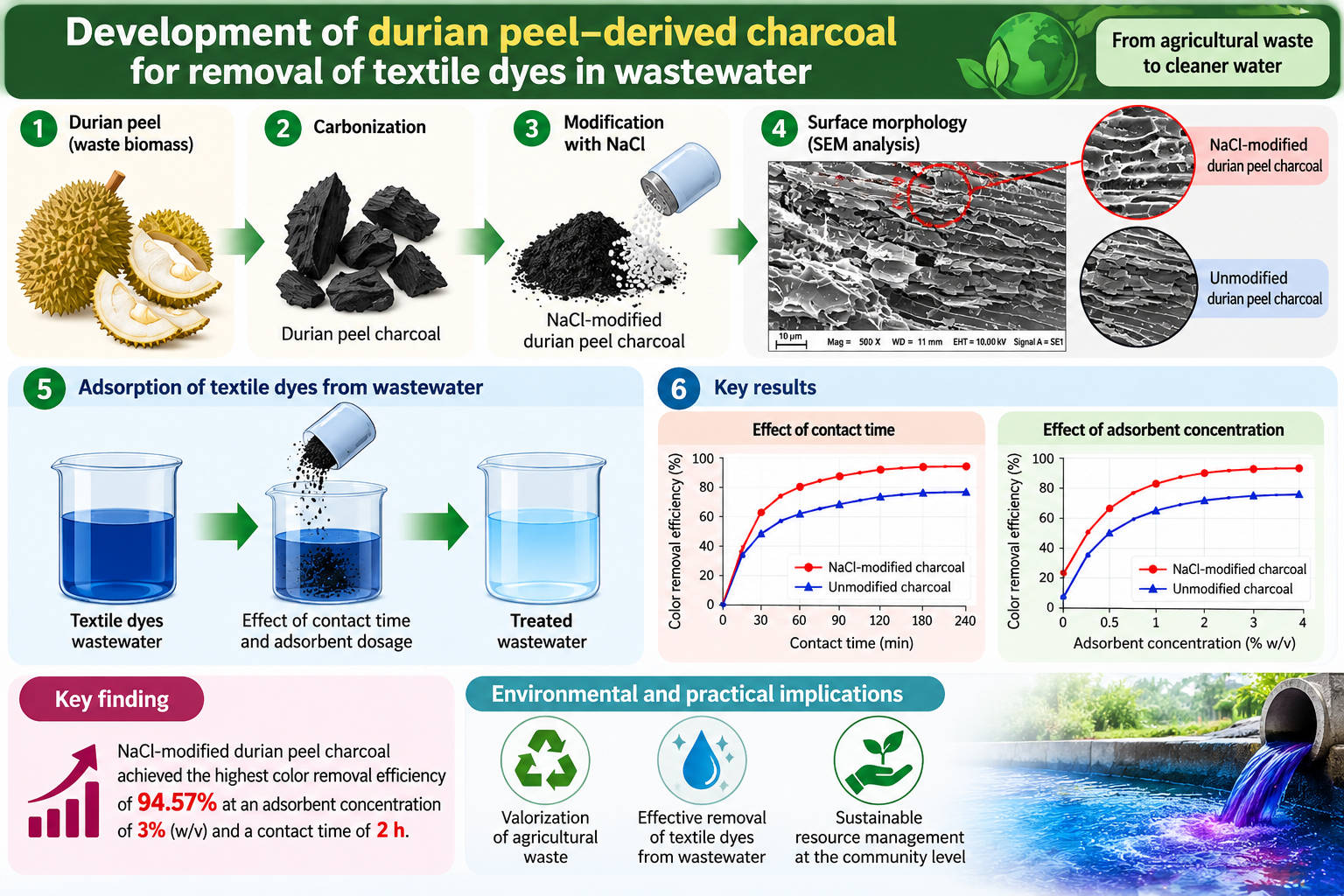
The contamination of textile dyes in wastewater from community activities and the textile industries is a significant environmental problem. This study aimed to develop durian peel charcoal as an adsorbent for the removal of textile dyes from wastewater. The color removal efficiency of unmodified and sodium chloride (NaCl)-modified durian peel charcoal was compared, and the effects of contact time and adsorbent concentration on color removal efficiency were evaluated. The results indicated that color removal efficiency increased with increasing contact time and adsorbent concentration until adsorption equilibrium was reached. Moreover, NaCl-modified durian peel charcoal exhibited higher color removal efficiency than unmodified charcoal. The modified charcoal achieved the highest color removal efficiency of 94.57% at an adsorbent concentration of 3% (w/v) and a contact time of 2 h. These findings demonstrate the potential of durian peel charcoal as an adsorbent for the removal of textile dyes from wastewater. The utilization of durian peel waste as an adsorbent can add value to agricultural residues and contribute to sustainable resource management at the community level.
Downloads
References
ธนากร คีเรียง, อาทิตย์ หูเต็ม และ ปิยรัตน์ มูลศรี. (2568). การเตรียมถ่านกัมมันต์จากเศษลำต้นกัญชงเหลือทิ้งทางการเกษตรโดยใช้กระบวนการไพโรไลซิสและการกระตุ้นด้วยคลื่นไมโครเวฟเพื่อการกำจัดสีย้อมเมทิลเรด. วารสารวิทยาศาสตร์และเทคโนโลยี มหาวิทยาลัยราชภัฏเพชรบูรณ์, 5(2). 1-12. https://so04.tci-thaijo.org/index.php/jstpcru/article/view/280101
โยธิน กัลยาเลิศ, วิชัย กองศรี, นพมาศ ประทุมสูตร และ ชุมพล บุษบก. (2566). โครงสร้างจุลภาคและองค์ประกอบธาตุของถ่านกัมมันต์จากเปลือกทุเรียน. วารสารฟิสิกส์และวิทยาศาสตร์ทั่วไป, 7(2). 1-9. http://journalpags.skru.ac.th/ojs/index.php/jpags/article/view/83
สำนักงานเศรษฐกิจการเกษตร. (2568). สถานการณ์สินค้าเกษตรที่สำคัญและแนวโน้ม ปี 2569: ทุเรียน. https://oae.go.th/uploads/files/2026/01/22/AD96BF9855DA.pdf?utm_source= chatgpt.com
Alawam, A. S., Mahgoub, S. M., Allam, A. A., Radalla, A. M., Shemy, M. H., & Mahmoud, R. (2025). Sustainable zeolite/activated carbon nanocomposite for dual-dye adsorption, kinetic and thermodynamic studies, and urea electro-oxidation applications. RSC Advances, 15(51), 43983-44006. https://doi.org/10.1039/D5RA06559C
Azfaralariff, A., Ahmad, M. I., Che Zain, M. S., & Abdul Khalil, H. P. S. (2025). Transforming agricultural waste into sustainable bioadsorbents and advanced bioaerogels from durian (Durio zibethinus) peel. Biofuels, Bioproducts and Biorefining. 19(6), 1706-1727. https://doi.org/10.1002/bbb.2771
Bharathi, K. S., & Ramesh, S. T. (2013). Removal of dyes using agricultural waste as low-cost adsorbents: A review. Applied Water Science, 3, 773-790. https://doi.org/10.1007/s13201-013-0117-y
Crini, G. (2006). Non-conventional low-cost adsorbents for dye removal: A review. Bioresource Technology, 97(9), 1061-1085. https://doi.org/10.1016/j.biortech.2005.05.001
Farqi, N. N. A. N. L. T., Abdulhameed, A. S., Surip, S. N., AlOthman, Z. A., & Jawad, A. H. (2023). Tropical fruit wastes including durian seeds and rambutan peels as a precursor for producing activated carbon using H3PO4-assisted microwave method: RSM-BBD optimization and mechanism for methylene blue dye adsorption. International Journal of Phytoremediation, 25(12), 1567-1578. https://doi.org/10.1080/15226514.2023.2175780
Forgacs, E., Cserhati, T., & Oros, G. (2004). Removal of synthetic dyes from wastewaters: A review. Environment International, 30(7), 953-971. https://doi.org/10.1016/j.envint.2004.02.001
Gupta, V. K., & Suhas. (2009). Application of low-cost adsorbents for dye removal-A review. Journal of Environmental Management, 90, 2313-2342. https://doi.org/10.1016/j.jenvman.2008.11.017
Huong, D. T., Ngan, N. N. P., Anh, D. T. T., Vinh, N. D., & Xuan, V. T. (2025). Durian peel-seed biochar for efficient methylene blue removal from water: Synthesis, characterization, and adsorption performance. RSC Advances, 15(40), 33726-33749. https://doi.org/10.1039/d5ra05313g
Kuyucu, A. E., Selcuk, A., Onal, Y., Alacabey, I., & Erol, K. (2025). Effective removal of dyes from aqueous systems by waste-derived carbon adsorbent: Physicochemical characterization and adsorption studies. Scientific Reports, 15, 28835. https://doi.org/10.1038/s41598-025-13685-x
Lee, Y. E., Jo, J. H., Kim, I. T., & Yoo, Y. S. (2018). Influence of NaCl concentration on food-waste biochar structure and templating effects. Energies, 11(9), 2341. https://doi.org/10.3390/en11092341
Tran, D. K., & Huong, D. T. G. (2021). Research on synthetic methods for activated carbon materials from durian peels to decolorize Reactive Blue 220 in textile dye wastewater. Ho Chi Minh City University of Education Journal of Science, 18(9), 1359-1367. https://vjol.info.vn/index.php/sphcm/article/view/67481
Tran, H. N. (2023). Adsorption technology for water and wastewater treatments. Water, 15(15), 2857. https://doi.org/10.3390/w15152857
Tsoutsa, E. K., Tolkou, A. K., Kyzas, G. Z., & Katsoyiannis, I. A. (2024). An update on agricultural wastes used as natural adsorbents or coagulants in single or combined systems for the removal of dyes from wastewater. Water, Air, & Soil Pollution, 235, 178. https://doi.org/10.1007/s11270-024-06979-9
Uddin, M. T., Rahman, M. A., Rukanuzzaman, M., & Islam, M. A. (2017). A potential low cost adsorbent for the removal of cationic dyes from aqueous solutions. Applied Water Science, 7(6), 2831-2842. https://doi.org/10.1007/s13201-017-0542-4
Yusop, M. F. M., Ahmad, M. A., Rosli, N. A., Gonawan, F. N., & Abdullah, S. J. (2021). Scavenging malachite green dye from aqueous solution using durian peel based activated carbon. Malaysian Journal of Fundamental and Applied Sciences, 17(1), 95-103. https://scispace.com/pdf/scavenging-malachite-green-dye-from-aqueous-solution-using-1yfukkgpnd.pdf
Zeitoun, Z., & Selem, N. Y. (2023). A comprehensive review on textile wastewater treatment by coupling TiO2 with PVDF membrane. Bulletin of the National Research Centre, 47, 153. https://bnrc.springeropen.com/articles/10.1186/s42269-023-01131-9
Downloads
Additional Files
Published
How to Cite
Issue
Section
License
Copyright (c) 2026 Science and Technology to Community

This work is licensed under a Creative Commons Attribution-NonCommercial-NoDerivatives 4.0 International License.
1. Articles, information, content, images, etc. that are published in "Science and Technology for Community Journal" is the copyright of science and Technology for Community Journal. Chiang Mai Rajabhat University. If any person or organization wants to distribute all or any part of it or do any action Must have written permission from the science and Technology for Community Journal, Chiang Mai Rajabhat University.
2. Content of articles appearing in the journal is the responsibility of the author of the article. The journal editor is not required to agree or take any responsibility.