ผลของสูตรปุ๋ยที่ใช้ในระยะติดผลต่อผลผลิต คุณภาพผลผลิต และผลตอบแทนทางเศรษฐกิจของเมล่อนพันธุ์ไทเฮา (Cucumis melo L.)
DOI:
https://doi.org/10.57260/stc.2026.2018คำสำคัญ:
เมล่อน, สูตรปุ๋ย, คุณภาพผลผลิต, ผลตอบแทนทางเศรษฐกิจบทคัดย่อ
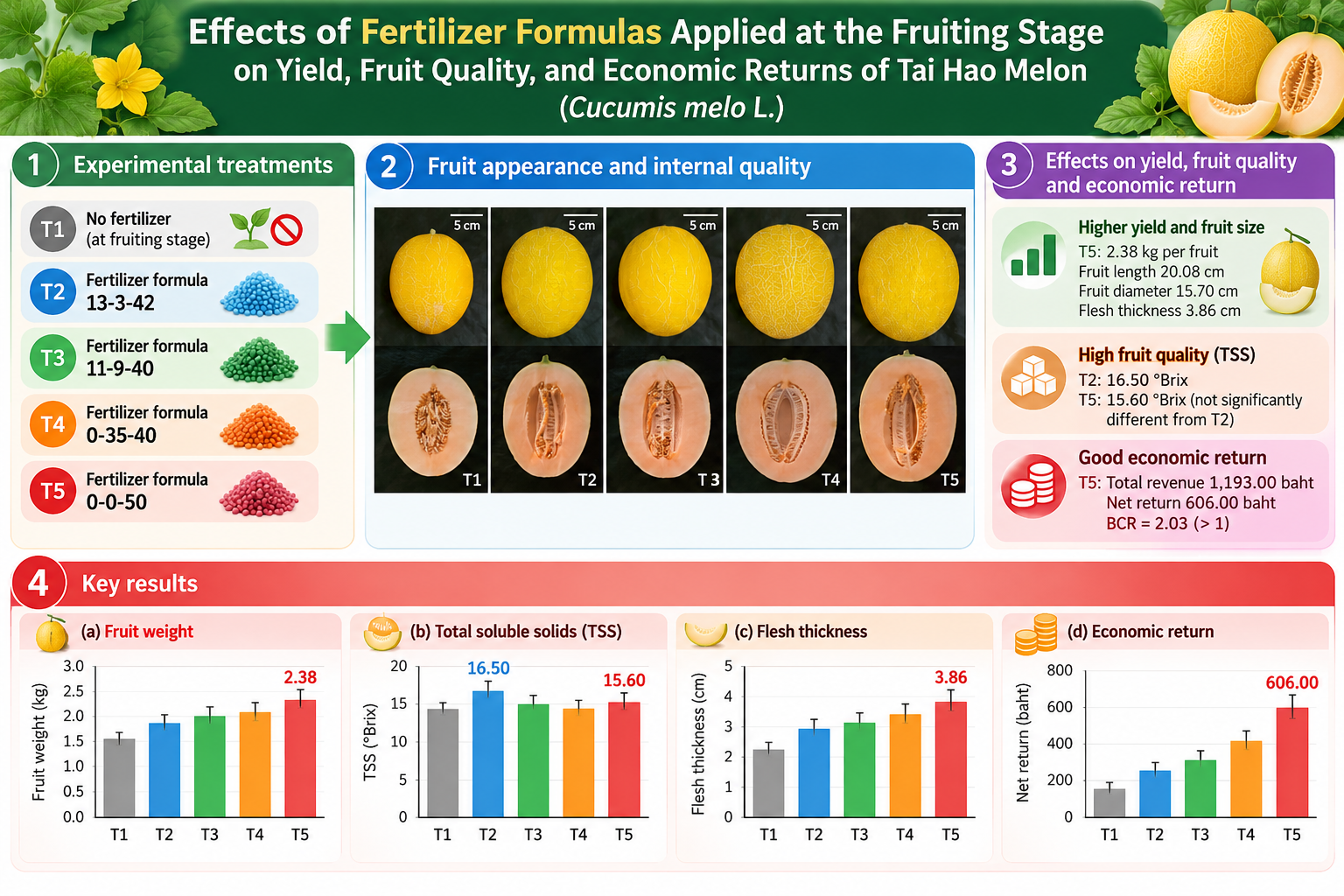
งานวิจัยนี้มีวัตถุประสงค์เพื่อศึกษาผลของสูตรปุ๋ยที่ใช้ในระยะติดผลต่อผลผลิต คุณภาพผลผลิตและผลตอบแทนทางเศรษฐกิจของเมล่อนพันธุ์ไทเฮา (Cucumis melo L.) วางแผนการทดลองแบบสุ่มสมบูรณ์ ประกอบด้วย 5 กรรมวิธี ได้แก่ ไม่ใส่ปุ๋ยในระยะติดผล (T1) ปุ๋ยสูตร 13-3-42 (T2) ปุ๋ยสูตร 11-9-40 (T3) ปุ๋ยสูตร 0-35-40 (T4) และปุ๋ยสูตร 0-0-50 (T5) ผลการศึกษาพบว่า สูตรปุ๋ยที่ใช้ในระยะติดผลมีผลต่อผลผลิตและคุณภาพผลผลิตของเมล่อนอย่างมีนัยสำคัญทางสถิติ (p<0.05) โดย T5 มีน้ำหนักผล ความยาวผล และเส้นผ่านศูนย์กลางผล เท่ากับ 2.38 กิโลกรัม 20.08 เซนติเมตร และ 15.70 เซนติเมตร ตามลำดับ และมีความหนาเนื้อ 3.86 เซนติเมตร ขณะที่ T2 มีปริมาณของแข็งที่ละลายน้ำได้ 16.50 °Brix ซึ่งไม่แตกต่างทางสถิติกับ T5 ที่มีค่า 15.60 °Brix ด้านผลตอบแทนทางเศรษฐกิจ พบว่า ทุกกรรมวิธีมีค่า BCR มากกว่า 1 โดย T5 ให้รายได้รวม กำไรสุทธิ และค่า BCR เท่ากับ 1,193.00 บาท 606.00 บาท และ 2.03 ตามลำดับ ผลการศึกษาภายใต้สภาพการทดลองนี้แสดงให้เห็นว่า การใช้ปุ๋ยสูตร 0-0-50 (T5) ในระยะติดผล มีศักยภาพในการส่งเสริมผลผลิต คุณภาพทางกายภาพของผล และผลตอบแทนทางเศรษฐกิจของเมล่อนพันธุ์ไทเฮา จึงสามารถใช้เป็นข้อมูลประกอบการจัดการปุ๋ยในระยะติดผลสำหรับการผลิตเมล่อนได้
Downloads
เอกสารอ้างอิง
เนตรนภา แววกระโทก และ กันต์กนิษฐ์ จูรัตน์. (2567). การวิเคราะห์ต้นทุนและผลตอบแทนการปลูกเมล่อน ของกลุ่ม สมาชิกเกษตรกรสหกรณ์นิคมแม่สอด อำเภอแม่สอด จังหวัดตาก. วารสารการจัดการและ การพัฒนาท้องถิ่น, 4(2). https://so11.tci-thaijo.org/index.php/jMLD/article/view/924
รักษ์สุดา คำดี, ธรรมธวัช แสงงาม, ชัยสิทธิ์ ทองจู, ศิริสุดา บุตรเพชร, อาณัติ เฮงเจริญ และ ธวัชชัย อินทร์บุญช่วย. (2565). ผลของการฉีดพ่นทางใบด้วยสารละลายแคลเซียมและโบรอนต่อคุณภาพผลผลิตของเมล่อน. วารสารผลิตกรรมการเกษตร, 4(1), 91–101. https://li01.tci-thaijo.org/index.php/japmju/article/view/252473
หนังสือพิมพ์รายปักษ์ เพื่อการปกครองส่วนท้องถิ่น. (2567). จังหวัดลพบุรี 25/12/67 ออเดอร์ล้นข้ามปีเมล่อนสายพันธุ์แสนหวานสไตล์ญี่ปุ่น. https://opt-news.com/news/47377
Akrami, M., & Arzani, A. (2019). Inheritance of fruit yield and quality in melon (Cucumis melo L.) grown under field salinity stress. Scientific Reports, 9, 7249. https://doi.org/10.1038/s41598-019-43616-6
Bouzo, C. A., Céccoli, G., & Muñoz, F. (2018). Effect of potassium and calcium upon the yield and fruit quality of Cucumis melo. Agriscientia, 35(1), 25–33. https://doi.org/10.31047/1668.298X.V1.N35.20450
Johnson, R., Vishwakarma, K., Hossen, M. S., Kumar, V., Shackira, A. M., Puthur, J. T., Abdi, G., Sarraf, M., & Hasanuzzaman, M. (2022). Potassium in plants: Growth regulation, signaling, and environmental stress tolerance. Plant Physiology and Biochemistry, 172, 56–69. https://doi.org/10.1016/j.plaphy.2022.01.001
Lester, G. E., Jifon, J. L., & Makus, D. J. (2010). Impact of potassium nutrition on postharvest fruit quality: Melon (Cucumis melo L.) case study. Plant and Soil, 335, 117–131. https://doi.org/10.1007/s11104-009-0227-3
Li, S., Zhang, Z., Zhang, J., Zheng, X., Zhang, H., Zhang, H., Zhang, Y., Bai, N., & Lv, W. (2023). Using mathematical models to study the influences of different ratios of chemical nitrogen, phosphorus, and potassium on the content of soluble protein, vitamin C, and soluble sugar in melon. International Journal of Environmental Research and Public Health, 20(1), 283. https://doi.org/10.3390/ijerph20010283
Moreira, L. C. J., Da Silva, L. D., Do Nascimento, B. M., Da Silva, A. J. B., Teixeira, A. S., & De Oliveira, M. R. R. (2022). Agronomic performance and fruit quality of yellow melon fertilized with nitrogen and potassium doses. Revista Caatinga, 35(2), 320–330. https://doi.org/10.1590/1983-21252022v35n208rc
Preciado-Rangel, P., Salas-Pérez, L., Gallegos-Robles, M. Á., Ruiz-Espinoza, F. H., Ayala-Garay, A. V., Fortis-Hernández, M., & Murillo-Amador, B. (2018). Increasing doses of potassium increases yield and quality of muskmelon fruits under greenhouse. Horticultura Brasileira, 36(2), 184–188. https://doi.org/10.1590/S0102-053620180206
Saengngam, T., Karuna, S., Bootpetch, S., Inboonchuay, T., & Pongsivapai, P. (2025). Supplementary potassium sulfate and potassium chloride fertilizers on yield and quality of Fujisawa melon (Cucumis melo L.). Asia-Pacific Journal of Science and Technology, 30(1), APST-30. https://so01.tci-thaijo.org/index.php/APST/article/view/272650
Sardans, J., & Peñuelas, J. (2021). Potassium control of plant functions: Ecological and agricultural implications. Plants, 10(2), 419. https://doi.org/10.3390/plants10020419
Sodawang, T., Kiatpathomchai, S., & Thongrak, S. (2022). Financial analysis of melon production in lower southern region of Thailand. Economics and Business Administration Journal Thaksin University, 14(1), 43–62. https://so01.tci-thaijo.org/index.php/ecbatsu/article/view/245188
Suksomboon, R., & Poosumrong, L. (2025). Performance of Recirculation Flow Roof in Wastewater Treatment Systems for Temperature Control Modeling in Floating Melon Greenhouses. Burapha Science Journal, 30(1), 1-24. https://li05.tci- thaijo.org/index.php/buuscij/article/view/583
Wiseansart, A. (2023). Factors affecting decision-making on greenhouse farming and cost-benefit analysis of greenhouse vegetable crops and melons in the northeastern region of Thailand. International Journal of Agricultural Technology, 19(4), 1939– 1952. https://www.cabidigitallibrary.org/doi/full/10.5555/20230423919
Wongsrisakulkaew, Y., Chaimongkol, J., & Buaban, N. (2019). Effects of chemical fertilizer and bio-extract on quality of melon fruit. Khon Kaen Agriculture Journal, 47(Suppl. 1), 1687–1690. https://agkaj.kku.ac.th/papers/1577/pdf
Yam, R. S. W., Fan, Y.-T., Lin, J.-T., Fan, C., & Lo, H.-F. (2020). Quality improvement of netted melon (Cucumis melo L. var. reticulatus) through precise nitrogen and potassium management in a hydroponic system. Agronomy, 10(6), 816. https://doi.org/10.3390/agronomy10060816
ดาวน์โหลด
ไฟล์ประกอบ
เผยแพร่แล้ว
รูปแบบการอ้างอิง
ฉบับ
ประเภทบทความ
สัญญาอนุญาต
ลิขสิทธิ์ (c) 2026 วารสารวิทยาศาสตร์และเทคโนโลยีสู่ชุมชน

อนุญาตภายใต้เงื่อนไข Creative Commons Attribution-NonCommercial-NoDerivatives 4.0 International License.
1. บทความ ข้อมูล เนื้อหา รูปภาพฯลฯ ที่ได้รับการตีพิมพ์ใน “วารสารวิทยาศาสตร์และเทคโนโลยีสู่ชุมชน” ถือเป็นลิขสิทธิ์ของวารสารวิทยาศาสตร์และเทคโนโลยีสู่ชุมชน มหาวิทยาลัยราชภัฏเชียงใหม่ หากบุคคลหรือหน่วยงานใดต้องการนำทั้งหมดหรือส่วนหนึ่งส่วนใดไปเผยแพร่ต่อหรือกระทำการใดๆ จะต้องได้รับอนุญาตเป็นลายลักษณ์อักษรจาก วารสารวิทยาศาสตร์และเทคโนโลยีสู่ชุมชน มหาวิทยาลัยราชภัฏเชียงใหม่
2. เนื้อหาบทความที่ปรากฏในวารสารเป็นความรับผิดชอบของผู้เขียนบทความโดยตรง ซึ่งกองบรรณาธิการวารสารไม่จำเป็นต้องเห็นด้วยหรือร่วมรับผิดชอบใดๆ