Classification and Production Management of Organic Rice Farmers in Ranot District, Songkhla Province
DOI:
https://doi.org/10.57260/stc.2026.1111Keywords:
Organic rice farmers, Organic rice farming, Organic agriculture promotion, Organic rice, Organic rice standardsAbstract
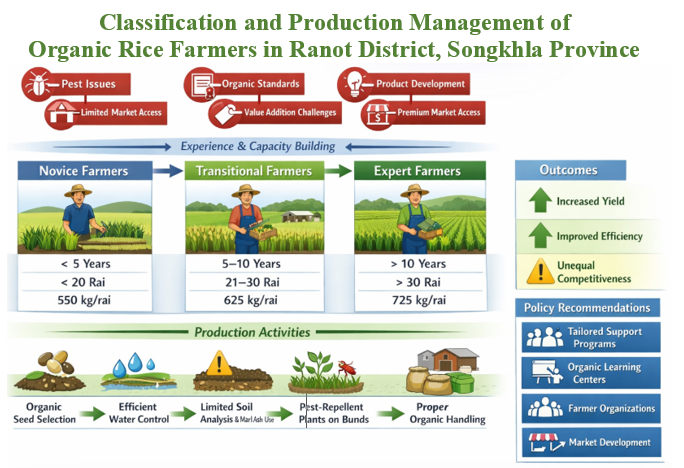
This study aimed to 1) classify organic rice farmers and 2) evaluate their production activities in Ranot District, Songkhla Province, Thailand. Data were collected from 400 sample farmers through structured interviews and analyzed using cluster analysis and descriptive statistics. The findings revealed three farmer groups. Novice farmers (94.00%) had less than five years of experience, cultivated less than 20 rai, and achieved 550 kilograms per rai yield. Transitional farmers (4.80%) had five to ten years of experience, farmed 21–30 rai, and obtained 625 kilograms per rai yield. Expert farmers (1.20%) had more than ten years of experience, cultivated over 30 rai, and produced 725 kilograms per rai yield. Each group faced distinct challenges. Novice farmers struggled with pest management and market access. Transitional farmers encountered difficulties upgrading organic standards and adding value to their products. Expert farmers were constrained by limitations in product development and accessing premium markets. Regarding production activities, most farmers followed organic farming principles, particularly in seed selection, water management, and post-harvest handling. However, improvements were needed in annual soil analysis, using marl or ash for soil improvement, and planting pest-repellent crops on field bunds. The study recommends designing support measures tailored to each farmer group's characteristics, promoting organic rice learning centers, and strengthening farmer organizations through community enterprises or cooperatives to enhance production efficiency and market competitiveness.
Downloads
References
กรมส่งเสริมการเกษตร. (2568). รายงานข้อมูลภาวะการผลิตพืช. https://shorturl.asia/y4mR9
คณะกรรมการพัฒนาเกษตรอินทรีย์แห่งชาติ. (2565). แผนปฏิบัติการด้านเกษตรอินทรีย์ พ.ศ. 2566–2570. https://www.mhesi.go.th/index.php/all-media/book/8857-2566-2570.html
ชินอิศเรศ ฐิติชาตินันท์, ปิยะ พละปัญญา, นคเรศ รังควัต และ พุฒิสรรค์ เครือคำ. (2566). ปัจจัยที่มีผลต่อการผลิตข้าวตามมาตรฐานเกษตรอินทรีย์ของเกษตรกรอำเภอเมืองพะเยา จังหวัดพะเยา. วารสารผลิตกรรมการเกษตร, 5(3), 50–57. https://li01.tci-thaijo.org/index.php/japmju/article/view/261679
โชติกา รติชลิยกุล, สุพรรณ กาญจนสุธรรม, ณรงค์ พลีรักษ์, แก้ว นวลฉวี, และอรรถวุฒิ นารถกุลพัฒน์. (2562). การวิเคราะห์พื้นที่เหมาะสมในการปลูกข้าวสังข์หยด อำเภอระโนด จังหวัดสงขลา โดยใช้ปัจจัยทางกายภาพของพื้นที่ปลูกข้าวสังข์หยด จังหวัดพัทลุง. วารสารเกษตรพระจอมเกล้า, 37(4), 719-728. https://li01.tci-thaijo.org/index.php/agritechjournal/article/view/229383
ณัฐวุฒิ จั่นทอง และ พหล ศักดิ์คะทัศน์. (2567). การยอมรับการผลิตข้าวอินทรีย์ของเกษตรกรในอำเภอเสนา จังหวัดพระนครศรีอยุธยา. วารสารผลิตกรรมการเกษตร, 6(2), 108–118. https://li01.tci-thaijo.org/index.php/japmju/article/view/257165
ธานินทร์ ศิลป์จารุ. (2555). การวิจัยและวิเคราะห์ข้อมูลทางสถิติด้วย SPSS. (พิมพ์ครั้งที่ 13). กรุงเทพฯ: เอส.อาร์. พริ้นติ้ง แมสโปรดักส์.
ประสาน ปรุงเจริญ และ ฉัตรวรัญช์ องคสิงห. (2567). วิถีของชาวนาไทยและการตื่นรู้ของชาวนาอินทรีย์ในประเทศไทย. วารสารธรรมเพื่อชีวิต, 30(4), 344–358. https://so08.tci-thaijo.org/index.php/dhammalife/article/view/3625
เผ่าพันธุ์ แย่งคุณเชาว์ และ อุดมศักดิ์ ศีลประชาวงศ์. (2563). การศึกษาความเต็มใจที่จะจ่ายของผู้บริโภคต่อผลิตภัณฑ์ข้าวอินทรีย์. วารสารพัฒนาการเศรษฐกิจปริทรรศน์, 14(2), 102–133. https://so06.tci-thaijo.org/index.php/NER/article/view/245382
ภูกาญจนกฤษฎิ์ ปุลันรัมย์ และ ก้องภพ เอี่ยมสมบูรณ์. (2567). แนวทางการพัฒนาเกษตรกรทำนาข้าวอินทรีย์ในจังหวัดอุดรธานี. วารสารการจัดการองค์กร และพัฒนาสังคม, 4(1), 1–12. https://so17.tci-thaijo.org/index.php/JOMSD/article/view/383
ยุธยา อยู่เย็น, ปิยาภรณ์ วรานุสันติกูล, สุนทร เทียนงาม, ชาญชัย ตรีเพชร และ ตระกูล รัมฉัตร. (2556). การพัฒนาการทำนาข้าวอินทรีย์ชุมชน ตำบลโคกโคเฒ่า อำเภอเมือง จังหวัดสุพรรณบุรี. วารสารวิจัย มสด. สาขาวิทยาศาสตร์และเทคโนโลยี, 6(2), 185–192. https://li01.tci-thaijo.org/index.php/sdust/article/view/29445
ศิริพร หลำวรรณะ และ สุพัตรา ศรีสุวรรณ. (2562). ความคิดเห็นของเกษตรกรต่อการผลิตข้าวตามมาตรฐานข้าวอินทรีย์อำเภอห้วยทับทัน จังหวัดศรีสะเกษ. วารสารเกษตรพระจอมเกล้า, 37(2), 394–404. https://li01.tci-thaijo.org/index.php/agritechjournal/article/view/198001
สุเนตร ทวีถาวรสวัสดิ์ และ อรวรรณ ศิริวงศ์. (2565). ความคิดเห็นของเกษตรกรต่อการยอมรับการทำนาเกษตรอินทรีย์ในอำเภอหนองฮี จังหวัดร้อยเอ็ด. วารสารมนุษยศาสตร์และสังคมศาสตร์ มหาวิทยาลัยราชภัฏบ้านสมเด็จเจ้าพระยา, 16(1), 69–85. https://so08.tci-thaijo.org/index.php/jhusocbru/article/view/493
สุพรรษา ไวอติวัฒน์ และ กุสุมา ดำพิทักษ์. (2562). การเปรียบเทียบต้นทุนและผลตอบแทนของการปลูกข้าวแบบเกษตรอินทรีย์กับเกษตรเคมี. วารสารวิชาการมหาวิทยาลัยอีสเทิร์นเอเชีย ฉบับสังคมศาสตร์และมนุษยศาสตร์, 9(1), 251–263. https://heritage.eau.ac.th/soc_journal/PDF/HeritageJournal/Heritage-13-01-62-Social-new.pdf
Bergman, C., & Pandhi, M. (2023). Organic rice production practices: effects on grain end–use quality, healthfulness, and safety. Foods, 12(1), 73. https://doi.org/10.3390/foods12010073
Ebers, A., Nguyen, T. T., & Grote, U. (2017). Production efficiency of rice farms in Thailand and Cambodia: a comparative analysis of Ubon Ratchthani and Stung Treng provinces. Paddy and Water Environment, 15, 79–92. https://doi.org/10.1007/s10333-016-0530-6
Hazra, K. K., Swain, D. K., Bohra, A., Singh, S. S., Kumar, N., & Nath, C. P. (2018). Organic rice: potential production strategies, challenges and prospects. Organic Agriculture, 8, 39–56. https://doi.org/10.1007/s13165-016-0172-4
Kerdsriserm, C., Suwanmaneepong, S., & Mankeb, P. (2016). Factors affecting adoption of organic rice farming in sustainable agricultural network, Chachoengsao province, Thailand. International Journal of Agricultural Technology, 12(7.1), 1227–1237. http://ijat-aatsea.com/pdf/v12_n7_1_16_DecemberSpecialissue/Aricultural%2012no7.1%20(1229-1240)%20(1)%201.pdf
Nunnally, J. C. (1978). Psychometric Theory. (2nd ed.). New York: McGraw–Hill.
Suwanmaneepong, S., Kerdsriserm, C., Iyapunya, K., & Wongtragoon, U. (2020). Farmers’ adoption of organic rice production in Chachoengsao province, Thailand. Journal of Agricultural Extension, 24(2), 71–79. https://doi.org/10.4314/jae.v24i2.8
Yanakittkul, P., & Aungvaravong, C. (2020). A model of farmers intentions towards organic farming: a case study on rice farming in Thailand. Heliyon, 6(1), e03039. https://doi.org/10.1016/j.heliyon.2019.e03039
Downloads
Published
How to Cite
Issue
Section
License
Copyright (c) 2026 Science and Technology to Community

This work is licensed under a Creative Commons Attribution-NonCommercial-NoDerivatives 4.0 International License.
1. Articles, information, content, images, etc. that are published in "Science and Technology for Community Journal" is the copyright of science and Technology for Community Journal. Chiang Mai Rajabhat University. If any person or organization wants to distribute all or any part of it or do any action Must have written permission from the science and Technology for Community Journal, Chiang Mai Rajabhat University.
2. Content of articles appearing in the journal is the responsibility of the author of the article. The journal editor is not required to agree or take any responsibility.