Efficiency of a Biological Process Combined Using a Co-immobilized Cross-Flow System for Ammonia Gas Removal in a Semi-Closed Chicken Farm
DOI:
https://doi.org/10.57260/stc.2026.1124Keywords:
Biological process, Ammonia gas, Chicken farm, Cross flow mediaAbstract
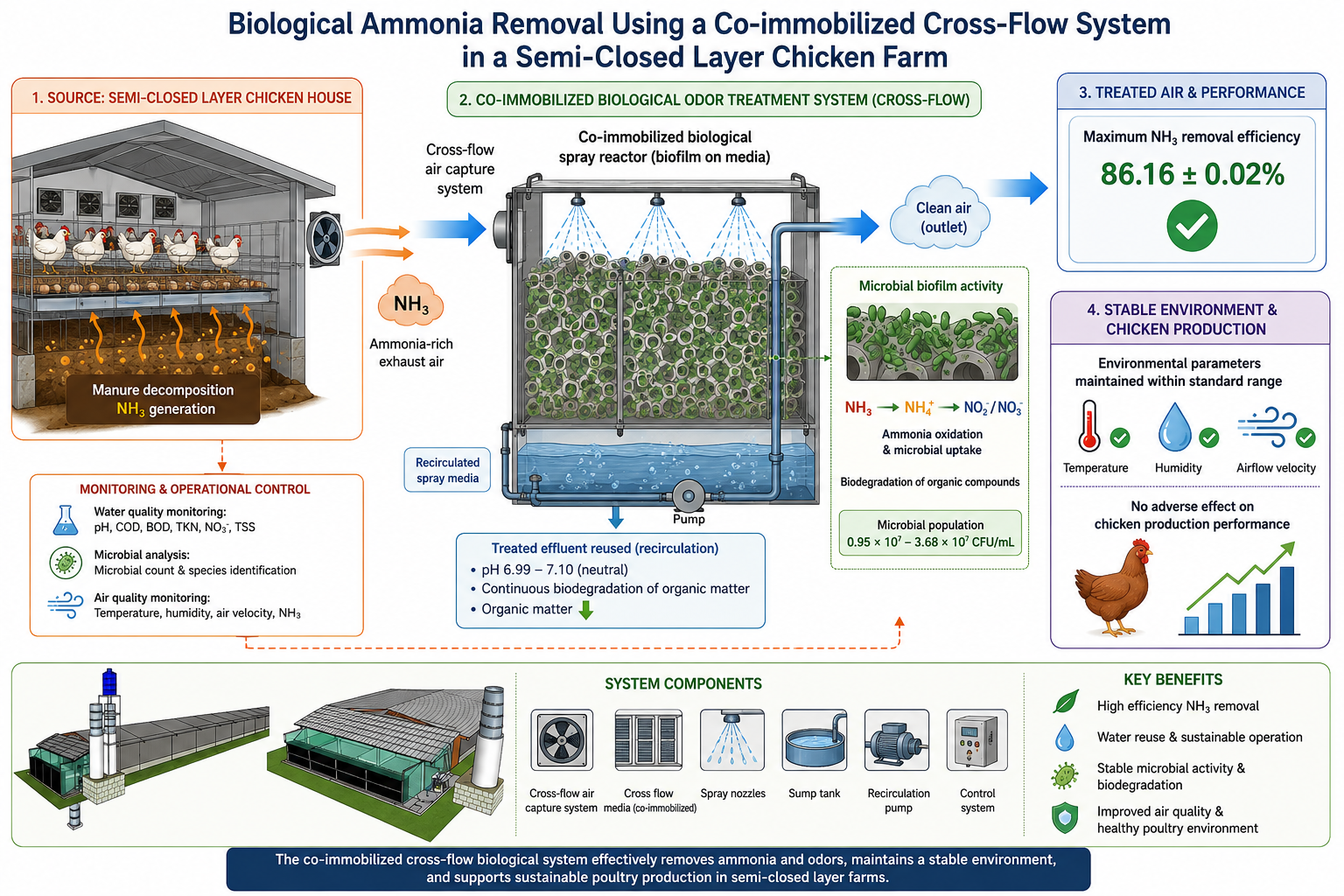
This research aimed to investigate the removal efficiency of ammonia gas using a biological odor treatment system in layer chicken farms. The study considered the suitability of installation area, system design, and operational factors related to the farm application. The results indicated that after the system installation, the temperature, humidity, and airflow velocity inside the poultry house remained within the standard ranges and did not adversely affect the performance of chicken production. Regarding to the wastewater quality in the spray media system, the organic matter showed a continuous decreasing trend, indicating the effective biodegradation of organic compounds by aerobic microorganisms. The treated effluent could be recirculated for reuse, with the pH values ranging from 6.99±0.03–7.10±0.00. Besides, the microbial population in the system ranged from 0.95x10⁷-3.68x10⁷ CFU/mL. In addition to the efficiency of odor removal, the system achieved a maximum ammonia gas removal efficiency of 86.16±0.02%. These findings demonstrate that the biological odor treatment system has strong potential for efficient application in layer chicken farms.
Downloads
References
กองแผนงาน กรมปศุสัตว์ กระทรวงเกษตรและสหกรณ์. (2566). ร่างยุทธศาสตร์ไก่ไข่ พ.ศ. 2562-2566. https://planning.dld.go.th/index.php/th/yuththsastr-ray-chnid-satw/yuththsastr-ki-phun-meuxng-3
ณัฎฐามนี พรมใบเงิน. (2566). การจัดการกลิ่นเหม็นในฟาร์มปศุสัตว์. กลุ่มมาตรฐานสิ่งแวดล้อมด้านการปศุสัตว์ สำนักพัฒนาระบบและรับรองมาตรฐานสินค้าปศุสัตว์ กรมปศุสัตว์. https://certify.dld.go.th/images/training%20documents/2566/data-b/651206b1.pdf
ธนเดช ธีระสุนทรกุล และครรชิต เงินคำคง. (2562). การเพิ่มประสิทธิภาพการใช้ประโยชน์ระบบก๊าซชีวภาพ โดยการปรับปรุงบคุณภาพก๊าซด้วยวิธีทางชีวภาพและปรับปรุงระบบบำบัดขั้นหลังเพื่อลดค่าใช้จ่ายและลดผลกระทบสิ่งแวดล้อม. โปรแกรมสนับสนุนการพัฒนาเทคโนโลยีและนวัตกรรม (ITAP) สำนักงานพัฒนาวิทยาศาสตร์และเทคโนโลยีแห่งชาติ (สวทช).
ประพันธ์ พงษ์เกียรติกุล และ สาณท ทองสุจริตพันธ์. (2558). การกำจัดกลิ่นแอมโมเนียในอากาศด้วยกระบวนการกรองชีวภาพ. วารสารวิศวกรรมฟาร์มและเทคโนโลยีการควบคุมอัตโนมัติ, 1(1), 9-14. https://ph02.tci-thaijo.org/index.php/featkku/article/view/175987
พรชนก วงศ์ผดุงเกียรติ และ ภัชราภรณ์ สุวรรณวิทยา. (2554). จุลินทรีย์ทางการค้าในกระบวนการบำบัดน้ำเสียโรงงานปลาป่น. วิศวกรรมสาร มก, 24 (77), 24-33. https://kukr.lib.ku.ac.th/BKN/Detail/info/203049
มนัสนันท์ นพรัตน์ไมตรี, อณัญญา ปานทอง และ วรางคณา กิจพิพิธ. (2556). ผลของการจัดการสภาพแวดล้อมภายในโรงเรือนแบบปิดต่อสมรรถนะการผลิตของไก่ไข่รุ่น. การประชุมวิชาการมหาวิทยาลัยเทคโนโลยีราชมงคล.
มานิตย์ เทวรักษ์พิทักษ์. (2536). การจัดการฟาร์มสัตว์ปีก. พิมพ์ครั้งที่ 4. ดาวคอมพิวกราฟฟิก เชียงใหม่.
ลดาวัลย์ วัฒนะจีระ. (2558). คู่มือปฏิบัติการตรวจวิเคราะห์ทางจุลชีวิทยาสำหรับสิ่งแวดล้อม : น้ำและของเสีย. คณะวิศวกรรมศาสตร์ มหาวิทยาลัยเทคโนโลยีราชมงคลล้านนา เชียงใหม่.
ศิราภรณ์ ชื่นบาล. (2560). จุลินทรีย์ช่วยย่อยลดกลิ่นเหม็นจากฟาร์มสัตว์ (สวทช. ภาคเหนือ). คณะวิทยาศาสตร์ มหาวิทยาลัยแม่โจ้.
เสาวลักษณ์ ภู่นภาอำพร. (2551). ประสิทธิภาพการกำจัดก๊าซแอมโมเนียโดยเครื่องกรองชีวภาพ. (วิทยานิพนธ์วิศวกรรมศาสตร์มหาบัณฑิต สาขาวิชาวิศวกรรมสิ่งแวดล้อม ภาควิชาวิศวกรรมสิ่งแวดล้อม คณะวิศวกรรมศาสตร์ จุฬาลงกรณ์มหาวิทยาลัย).
Alltech. (2566). วิธีควบคุมระดับแอมโมเนียในเล้าสัตว์ปีก. https://www.alltech.com/th/featureslog/withiikhwbkhumradabaexmomeniiyinelasatwpiik
American Public Health Association (APHA), The American Water works Association (AWWA), The Water Environment Federation (WEF). (2007). Standard Methods for extermination of water and wastewater. (21st ed.). USA: Washington, DC.
Chen, Y. X., Yin, J., & Wang, K. W. (2005). Logn-term operation of biofilters for biological removal of ammonia. Journal of chemosphere, 58(8), 1023-1030. https://doi.org/10.1016/j.chemosphere.2004.09.052
Cont,i A., Costantine, M., Fusi, A., Manzando, A., Guarino, M., & Bacenetti, J. (2021). Environmental Impact of pig production affected by wet acid scrubber as mitigation technology. Sustainable Production and Consumption, 28, 580-890. https://doi.org/10.1016/j.spc.2021.06.024
David, S. P., & Dawson, C. J. (2021). Use of ammonium sulphate as a Sulphur fertilizer: Implications for ammonia volatilization. Soil use and Management, 38(1), 662-534. https://doi.org/10.1111/sum.12733
Deviny, J., Deshusses, M., & Webster, T. (1999). Biofiltration for Air Pollution Control. USA: CRC Press.
Henze, M., Harrenoes, P., Jansen, J., & Arvin, E. (2002). Wastewater Treatment Biological and Chemical Processes. (3rd ed.). Germany Berlin: Springer-Verlag.
Hong, J. H., & Park, K. J. (2005). Compost biofiltration of ammonia gas from bin composting. Journal of bioresource technology, 96(6), 741-745. https://doi.org/10.1016/j.biortech.2004.10.008
Lang, W. (2011). Environmental microbiology. (2nd ed.). Bangkok: Kasetsart University Press.
Madigan, M. T., Martinko, J. M., Bender, K. S., Buckley, D. H., & Stahl, D. A. (2019). Brock Biology of Microorganisms. (15th ed.). UK: Pearson.
McGahan, E., Kolominskas, C., Bawden, K., & Ormerod, R. (2002). Strategies to reduce odor emissions from meat chicken farm, Proceeding 2002 Poultry Information Exchange, Pacifi Air & Environmental, p27-39.
Potivichayanon, S. (2005). Removal of hydrogen sulfide by fixed-film bio scrubber. (Ph.D. Thesis Faculty of Science Mahidol University Bangkok).
Prosser, J. I. (1986). Nitrification. UK: IRL Press. Oxford.
Shareefdeen, Z., & Singh, A. (2008). Biotechnology for odor and air pollution control. Canada: Biorem Technol Inc.
Sirianuntapiboon, S., & Chuamkaew, C. (2007). Packed cage rotating biological contactor system for treatment of cyanide wastewater. Bioresource Technol, 98(2), 266-272. https://doi.org/10.1016/j.biortech.2006.01.014
Smith, A. P., Johnson, I. R., Schwenke, G., Lam, S. K., Suter, H. C., & Eckard, R. J. (2020). Predicting ammonia volatilization from fertilized used for grazing. Agricultural and Forest Meteorology, 287, 107952. https://doi.org/10.1016/j.agrformet.2020.107952
Taghipour, H., Shahmansoury, M. R., Bina, B., & Movahdian, H. (2008). Operational parameters in biofiltration of ammonia-contaminated air streams using compost-pieces of hard Plastics filter media. Chemical Engineering Journal, 137(2), 198-204. https://doi.org/10.1016/j.cej.2007.04.015
Ward, B. B., Arp D. J., & Klotz, M. G. (2011). Nitrification. New York: ASM Press. Princeton University, Princeton, USA.
Zhang, L., Dong, H., Zeng, S., Hu, Z., Hussain, S., & Zhang, X. (2021). An Overview of Ammonia Separation by Ionic Liquids. Industrial & Engineering Chemistry Research, 60(19), 6908-6924. https://doi.org/10.1021/acs.iecr.1c00780
Downloads
Published
How to Cite
Issue
Section
License
Copyright (c) 2026 Science and Technology to Community

This work is licensed under a Creative Commons Attribution-NonCommercial-NoDerivatives 4.0 International License.
1. Articles, information, content, images, etc. that are published in "Science and Technology for Community Journal" is the copyright of science and Technology for Community Journal. Chiang Mai Rajabhat University. If any person or organization wants to distribute all or any part of it or do any action Must have written permission from the science and Technology for Community Journal, Chiang Mai Rajabhat University.
2. Content of articles appearing in the journal is the responsibility of the author of the article. The journal editor is not required to agree or take any responsibility.