การประเมินปริมาณคาร์บอนอินทรีย์ในดินจากค่าความสว่างด้วยเซนเซอร์วัดสีแบบประหยัด
DOI:
https://doi.org/10.57260/stc.2026.1239คำสำคัญ:
คาร์บอนอินทรีย์ , เซนเซอร์วัดสี , ไมโครคอนโทรลเลอร์, ตัวอย่างดินบทคัดย่อ
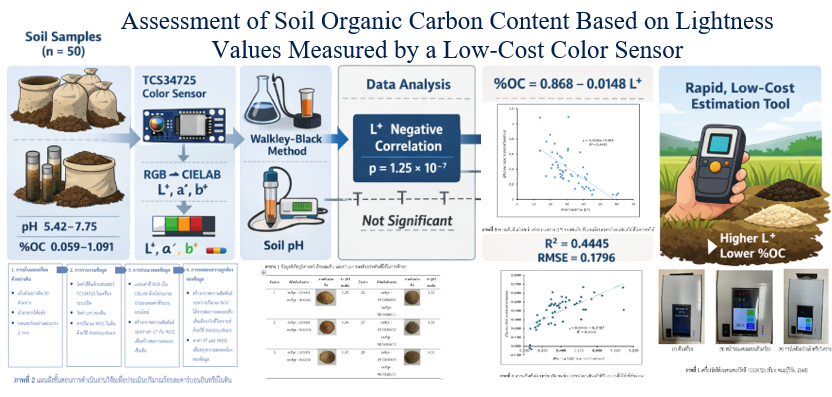
การศึกษาครั้งนี้มีวัตถุประสงค์เพื่อศึกษาความสัมพันธ์ระหว่างค่าสีของดินกับปริมาณร้อยละคาร์บอนอินทรีย์ (%OC) โดยใช้เซนเซอร์วัดสี TCS34725 ที่มีราคาประหยัดร่วมกับไมโครคอนโทรลเลอร์ ESP32 ได้เก็บดินจำนวน 50 ตัวอย่างนำมาวิเคราะห์ค่าสีในระบบ RGB และแปลงเป็นระบบ CIELAB พร้อมทั้งวัดปริมาณร้อยละคาร์บอนอินทรีย์ด้วยวิธี Walkley-Black นอกจากนี้ได้วัดค่า pH ของดินเพื่อประกอบการวิเคราะห์ ตัวอย่างดินมีค่า pH เฉลี่ย 6.6 (ช่วง 5.42-7.75) ซึ่งอยู่ในระดับกรดอ่อนถึงเป็นกลาง และมีปริมาณร้อยละคาร์บอนอินทรีย์ในช่วง 0.059-1.091%OC ผลการศึกษาพบว่าค่าความสว่าง (L*) ในระบบ CIELAB มีความสัมพันธ์เชิงลบกับ %OC อย่างมีนัยสำคัญทางสถิติ (p-value = 1.25 × 10⁻⁷) และสร้างสมการถดถอยเชิงเส้น %OC = 0.868 – 0.0148L*เพื่อประเมิน %OC โดยแบบจำลองนี้มีค่า R² และ RMSE เท่ากับ 0.4445 และ 0.1796 ตามลำดับ แสดงให้เห็นว่าเซนเซอร์วัดสีสามารถใช้เป็นเครื่องมือเบื้องต้นสำหรับประเมินคาร์บอนอินทรีย์ในดินได้อย่างรวดเร็วและประหยัด อย่างไรก็ตาม ค่าสีอื่นในระบบ CIELAB (a*, b*) และค่าผลคูณ R×G×B ไม่แสดงความสัมพันธ์กับ %OC อย่างมีนัยสำคัญทางสถิติ การวิเคราะห์ความสัมพันธ์ระหว่าง pH กับค่าสีและ %OC พบว่าไม่มีความสัมพันธ์ทางสถิติที่ชัดเจน แสดงว่าค่า pH ไม่ใช่ปัจจัยหลักที่ส่งผลต่อสีของดินในการศึกษานี้
Downloads
เอกสารอ้างอิง
สุทธิ์เดชา ขุนทอง, จิราพร สวยสม, สุรเชษฐ์ นาราภัทร์, กมรินทร์ นิ่มนวลรัตน์ และ ชัยสิทธิ์ วัฒนาวังจงสุข. (2562). ปริมาณอินทรีย์คาร์บอนที่ถูกออกซิไดซ์จากการใช้วิธีวอล์คเลย์-แบลคหาอินทรีย์คาร์บอนในดินประเทศไทย. แก่นเกษตร, 47(4), 797–808. https://doi.org/10.14456/kaj.2019.75
Aspose. (2025). Aspose Color Converter. https://products.aspose.app/svg/color-converter
Bahadori, M., & Tofighi, H. (2016). A modified Walkley-Black method based on spectrophotometric procedure. Communications in Soil Science and Plant Analysis, 47(2), 213–220. https://doi.org/10.1080/00103624.2015.1118118
Comejina, P., Kanna, M., & Somnam, S. (2024). Development of an ESP32 microcontroller-based colorimeter with an Android app for the verification of roasting degree of coffee beans. Chiang Mai Journal of Science, 51(5), e2024079. https://doi.org/10.12982/CMJS.2024.079
Fan, Z., Herrick, J. E., Saltzman, R., Matteis, C., Yudina, A., Nocella, N., Crawford, E., Parker, R., & Van, Z. J. (2017). Measurement of soil color: A comparison between smartphone camera and the Munsell color charts. Soil Science Society of America Journal, 81(5), 1139–1146. https://doi.org/10.2136/sssaj2017.01.0009
FAO. (2020). Soil testing methods – Global Soil Doctors Programme: A farmer-to-farmer training programme. FAO. https://doi.org/10.4060/ca2796en
Gou, F., Liang, W., Yan, J., Sun, S., Chen,Z., Zhang, W., Ji, Q., & Wang, F. (2022). Decrease in erosion-induced soil organic carbons a result of vegetation restoration in the Loess Plateau, China. Journal of Geophysical Research: Biogeosciences, 127(8). https://doi.org/10.1029/2022JG006917
Jorge, N. F., Clark, J., Cárdenas, M. L., Geoghegan, H., & Shannon, V. (2021). Measuring soil colour to estimate soil organic ca×on using a large-scale citizen science-based approach. Sustainability, 13(19), 11029. https://doi.org/10.3390/su131911029
Kirillova, N. P., Grauer-Gray, J., Hartemink, A. E., Sileova, T. M., Artemyeva, Z. S., & Burova, E. K. (2018). New perspectives to use Munsell color charts with electronic devices. Computers and Electronics in Agriculture, 155, 378–385. https://doi.org/10.1016/j.compag.2018.10.028
Mansur, N., & Abbod, M. (2026). Machine learning-based estimation of soil organic matter using RGB values. DYSONA - Applied Science, 7, 73-81. https://doi.org/10.30493/DAS.2025.539371
Nodi, S. S., Paul, M., Robinson, N., Wang, L., & Rehman, S. U. (2023). Determination of Munsell soil colour using smartphones. Sensors, 23(6), 3181. https://doi.org/10.3390/s23063181
Stiglitz, R. D., Mikhailova, E. A., Post, C. J., Schlautman, M. A., & Sharp, J. L. (2016). Evaluation of an inexpensive sensor to measure soil color. Computers and Electronics in Agriculture, 121, 141–148. https://doi.org/10.1016/j.compag.2015.11.014
Vargas-Rojas, R., Cuevas-Corona, R., Yigini, Y., Tong, Y., Bazza, Z., & Wiese, L. (2019). Unlocking the potential of soil organic carbon: A feasible way forward. In H. Ginzky, E. Dooley, I. Heuser, E. Kasimbazi, T. Markus, & T. Qin (Eds.), International yearbook of soil law and policy 2018. (pp. 373-395). Springer. https://doi.org/10.1007/978-3-030-00758-4_18
Viscarra Rossel, R. A., Walvoort, D. J. J., McBratney, A. B., Janik, L. J., & Skjemstad, J. O. (2006). Visible, near infrared, mid infrared or combined diffuse reflectance spectroscopy for simultaneous assessment of various soil properties. Geoderma, 131(1-2), 59-75. https://doi.org/10.1016/j.geoderma.2005.03.007
Wright, A. F., & Bailey, J. S. (2001). Organic carbon, total carbon, and total nitrogen determinations in soils of variable calcium carbonate contents using a Leco CN-2000 dry combustion analyzer. Communications in Soil Science and Plant Analysis, 32(19–20), 3243–3258. https://doi.org/10.1081/CSS-120001118
ดาวน์โหลด
เผยแพร่แล้ว
รูปแบบการอ้างอิง
ฉบับ
ประเภทบทความ
สัญญาอนุญาต
ลิขสิทธิ์ (c) 2026 วารสารวิทยาศาสตร์และเทคโนโลยีสู่ชุมชน

อนุญาตภายใต้เงื่อนไข Creative Commons Attribution-NonCommercial-NoDerivatives 4.0 International License.
1. บทความ ข้อมูล เนื้อหา รูปภาพฯลฯ ที่ได้รับการตีพิมพ์ใน “วารสารวิทยาศาสตร์และเทคโนโลยีสู่ชุมชน” ถือเป็นลิขสิทธิ์ของวารสารวิทยาศาสตร์และเทคโนโลยีสู่ชุมชน มหาวิทยาลัยราชภัฏเชียงใหม่ หากบุคคลหรือหน่วยงานใดต้องการนำทั้งหมดหรือส่วนหนึ่งส่วนใดไปเผยแพร่ต่อหรือกระทำการใดๆ จะต้องได้รับอนุญาตเป็นลายลักษณ์อักษรจาก วารสารวิทยาศาสตร์และเทคโนโลยีสู่ชุมชน มหาวิทยาลัยราชภัฏเชียงใหม่
2. เนื้อหาบทความที่ปรากฏในวารสารเป็นความรับผิดชอบของผู้เขียนบทความโดยตรง ซึ่งกองบรรณาธิการวารสารไม่จำเป็นต้องเห็นด้วยหรือร่วมรับผิดชอบใดๆ