Artificial Intelligence (AI) Literacy in Practice of Agricultural Academics, Rice Department
DOI:
https://doi.org/10.57260/stc.2026.1288Keywords:
AI literacy, Artificial intelligence, Agricultural academicsAbstract
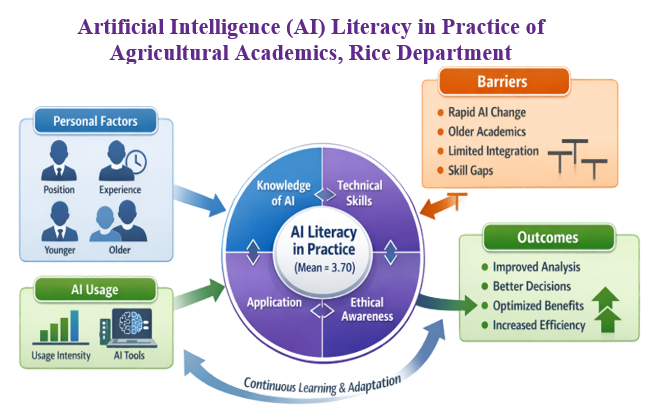
This study aims to investigate agricultural academics' artificial intelligence (AI) literacy in practice of agricultural academics, and compare AI literacy across four dimensions based on personal characteristics and AI usage patterns. The sample comprised 131 of agricultural academics’ officers from 32 rice seed centers under the Rice Department, both central and regional offices, selected by simple random sampling. Data were collected by using questionnaires. Descriptive statistics included frequency, percentage, and standard deviation, while inferential statistics involved t-tests, F-tests, and Least Significant Difference (LSD) for pairwise comparisons.
The results indicated that the overall level of AI literacy in practice of agricultural academics was moderate (mean = 3.70). Hypothesis testing revealed significant differences in AI literacy at the 0.05 level among agricultural based on job position, work experience, and AI usage frequency. The main issue identified was that the use and application of AI remained at a moderate level. Rapid technological advancements in AI posed challenges, particularly for older academics, resulting in inefficient utilization of AI technologies. Therefore, agricultural academics should continuously monitor AI developments and maintain ethical awareness in AI utilization, enabling them to develop and adapt effectively for maximum benefit.
Downloads
References
กนกรัตน์ นันทะเสน และ วรทัศน์ อินทรัคคัมพร. (2561). ความรู้และความสามารถในการใช้เทคโนโลยีสารสนเทศและคอมพิวเตอร์ ของนักวิชาการส่งเสริมการเกษตร สำนักงานเกษตรจังหวัดเชียงราย. วารสารเกษตร, 34(22), 89-99. https://li01.tci-thaijo.org/index.php/joacmu/article/view/176742
กระทรวงอุดมศึกษา วิทยาศาสตร์ วิจัย และนวัตกรรม และกระทรวงดิจิทัลเพื่อเศรษฐกิจและสังคม. (2565). แผนปฏิบัติการด้านปัญญาประดิษฐ์แห่งชาติเพื่อการพัฒนาประเทศไทย พ.ศ. 2565-2570. https://www.ai.in.th/wp-content/uploads/2022/12/20220726-AI.pdf
ณัฐพล บัวอุไร, พิมพ์เพ็ญ เธียรสิทธิพงศ์ และ ชุดา วิมุกตายน. (2568). การพัฒนาแบบประเมินความฉลาดรู้ด้านปัญญาประดิษฐ์สำหรับครูผู้สอนระดับมัธยมศึกษา. วารสารการบริหารและความเป็นผู้นำทางการศึกษา มหาวิทยาลัยรามคำแหง, 2(2), 1645. https://so15.tci-thaijo.org/index.php/LEAD/article/view/1645
เต็มศิริ วันล้วน, ภรณี หลาวทอง, สุรเกียรติ ปริชาตินนท์ และ ชินจิรัฎฐ์ จรัญศิริไพศาล. (2568). การยอมรับเทคโนโลยีปัญญาประดิษฐ์ที่ส่งผลต่อประสิทธิภาพการปฏิบัติงานของหน่วยงานภาครัฐในจังหวัดสุรินทร์. วารสารการบริหารการปกครองและนวตกรรมท้องถิ่น, 9(2), 393-480. https://so03.tci-thaijo.org/index.php/JLGISRRU/article/view/289275
ธัญญรักษ์ บุญตามหนุน. (2562). ปัจจัยที่ส่งผลต่อการยอมรับการใช้เทคโนโลยี AI (Machine Learning) ในการทำงานในอุตสาหกรรมลิสซิ่งกรณีศึกษาบริษัทเอกชนแห่งหนึ่ง ในเขตกรุงเทพมหานคร. (วิทยานิพนธ์บริหารธุรกิจมหาบัณฑิต บัณฑิตวิทยาลัย มหาวิทยาลัยธรรมศาสตร์).
ธัญมาศ ทองมูลเล็ก และ ปรีชา วิจิตรธรรมรส. (2560). การศึกษาปัจจัยที่มีผลต่อการยอมรับและการใช้งานเครือข่ายสังคมออนไลน์ในสังคมไทย. วารสารวิชาการนวัตกรรมสื่อสารสังคม, 5(2), 114-124. https://so06.tci-thaijo.org/index.php/jcosci/article/view/111536
มารุต โจมแก้ว และ สุกัญญา เชิญขวัญ. (2568).ความรู้และการใช้เทคโนโลยีดิจิทัลของนักวิชาการส่งเสริมการเกษตรระดับตำบลในจังหวัด ขอนแก่น.วารสารแก่นเกษตร, 53(2), 280-301. https://li01.tci-thaijo.org/index.php/agkasetkaj/article/view/263077
เรวัต แก้วเลิศตระกูล, พุฒิสรรค์ เครือคำ, พหล ศักดิ์คะทัศน์ และ นพพร บุญปลอด. (2562). การปฏิบัติในระบบการส่งเสริมการเกษตรมิติใหม่ (MRCF SYSTEM) ของนักส่งเสริมการเกษตรในจังหวัดเชียงใหม่. วารสารส่งเสริมและวิจัยการเกษตร, 6(3), 114-125. https://li01.tci-thaijo.org/index.php/MJUJN/article/view/232979
วัชราภรณ์ ประทุมโพธิ์, พิชัย ทองดีเลิศ และ พัชราวดี ศรีบุญเรือง. (2568). อัจฉริยภาพทางดิจิทัลในการปฏิบัติงานของนักวิชาการเกษตรในเขตภาค กลาง. วารสารเกษตรพระจอมเกล้า, 43(1), 63-72. https://li01.tci-thaijo.org/index.php/agritechjournal/article/view/260951
ศูนย์เทคโนโลยีสารสนเทศและการสื่อสาร. (2566). แผนปฏิบัติการดิจิทัลของกรมการข้าว ปี 2566 - 2570. https://ictc.ricethailand.go.th/page/9842
สุรินทร์ นิยมางกูร. (2556). ระเบียบวิธีวิจัยทางสังคมศาสตร์และสถิติที่ใช้. กรุงเทพมหานคร: บุ๊คส์ ทู ยู.
สำนักงานพัฒนารัฐบาลดิจิทัล. (2563). นโยบายและแผนระดับชาติว่าด้วยการพัฒนาดิจิทัลเพื่อเศรษฐกิจ และสังคม พ.ศ. 2561–2580. สำนักงานพัฒนารัฐบาลดิจิทัล. https://www.dga.or.th/wp content/uploads/2019/12/file_a4896b965af230086779f7fc85041235.pdf
Brynjolfsson, E. and Mitchell, T. (2017) What Can Machine Learning Do? Workforce Implications. Science, 358, 1530-1534. https://doi.org/10.1126/science.aap8062
Chatwal, M., Garg, V., & Rajput, N. (2023). Role of AI in the education. Lloyd Business Review, 2(1), 1–7. https://lloydbusinessreview.com/index.php/lbr/article/view/11
Jayasuriya R, Selvanayaki S, Murugananthi D, Deepa N, Kalpana M. (2025). Assessing the impact of AI on the academic learning of agricultural students. Plant Science Today, 12(1), 1-6. https://doi.org/10.14719/pst.10001
Kohnke, L., Moorhouse, B. L., & Zou, D. (2023). ChatGPT for language teaching and learning. RELC Journal, 54(2), 537-550. https://doi.org/10.1177/003368822311628
Krejcie, R. V., & Morgan, D. W. (1970). Determining sample size for research activities. Educational and Psychological Measurement, 30(3), 607-610. https://doi.org/10.1177/001316447003000308
Mishra, P., Warr, M., & Islam, R. (2023). TPACK in the age of ChatGPT and Generative AI. Journal of Digital Learning in Teacher Education, 39(4), 235-251. https://doi.org/10.1080/21532974.2023.2247480
Ward, M.J.M., Degazio, T. & Bowman, J. (2025). Great Lakes coastal wetland plant biodiversity increases following the manual removal of invasive Phragmites australis. Wetlands Ecol Manage, 33, 2. https://doi.org/10.1007/s11273-024-10021-4
Downloads
Published
How to Cite
Issue
Section
License
Copyright (c) 2026 Science and Technology to Community

This work is licensed under a Creative Commons Attribution-NonCommercial-NoDerivatives 4.0 International License.
1. Articles, information, content, images, etc. that are published in "Science and Technology for Community Journal" is the copyright of science and Technology for Community Journal. Chiang Mai Rajabhat University. If any person or organization wants to distribute all or any part of it or do any action Must have written permission from the science and Technology for Community Journal, Chiang Mai Rajabhat University.
2. Content of articles appearing in the journal is the responsibility of the author of the article. The journal editor is not required to agree or take any responsibility.