Development of Educational Game for Promote Waste Management Awareness at Pha Taem National Park
DOI:
https://doi.org/10.57260/stc.2026.1296Keywords:
Educational game, Waste separation, Community technologyAbstract
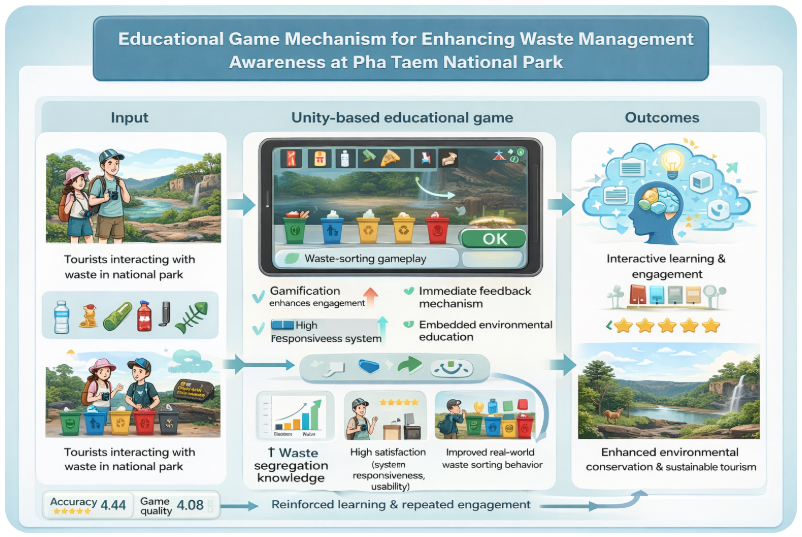
The research aimed to 1) develop an educational game to promote waste management at Pha Taem National Park; 2) evaluate the game’s efficiency; and 3) assess user satisfaction while comparing waste-sorting knowledge before and after gameplay. The study focused on fostering correct waste segregation practices and promoting tourism within the park. The methodology began with a comprehensive literature review of waste types and the geography of Pha Taem National Park. Field data were subsequently collected through interviews with park officials and tourists to inform the game design. The game was developed using the Unity engine, with graphical assets created via Krita. The research instruments included: 1) a web-based game application; 2) an efficiency evaluation form for experts; and 3) a knowledge and satisfaction assessment form for users.
The findings revealed that the five experts rated the accuracy at the highest level (mean = 4.44), followed by game quality (mean = 4.08) and content appropriateness (mean = 4.00). Satisfaction assessments from 67 participants indicated an overall high level of satisfaction (mean = 4.42). The highest-rated aspect was system responsiveness (mean = 4.52). The three most highly-rated aspects (mean = 4.58) were: 1) consistency between game format and objectives; 2) immediate command responsiveness; and 3) rapid visual and audio rendering. Furthermore, a comparison of pre- and post-test scores demonstrated a statistically significant increase in participants' waste segregation knowledge. These results confirm that the developed game is an effective tool for enhancing waste management awareness.
Downloads
References
กรมควบคุมมลพิษ. (2551). คู่มือ แนวทางการลด คัดแยกและใช้ประโยชน์ขยะมูลฝอย สำหรับอาสาสมัครพิทักษ์ทรัพยากรธรรมชาติและสิ่งแวดล้อมหมู่บ้าน. กรุงเทพมหานคร: รุ่งศิลป์การพิมพ์ (1997) จำกัด.
กรมควบคุมมลพิษ. (2568). ระบบสารสนเทศด้านการจัดการขยะมูลฝอยขุมชน. https://thaimsw.pcd.go.th/report1.php?year=2567
กองจัดการกากของเสียและสารอันตราย กรมควบคุมมลพิษ. (2567). แผนปฏิบัติการด้านการจัดการขยะของประเทศ ฉบับที่ 2 (พ.ศ.2565 – 2570). https://www.pcd.go.th/wp-content/uploads/2023/02/pcdnew-2023-02-20_06-35-59_190336.pdf
การท่องเที่ยวแห่งประเทศไทย (ททท.). (2566). อุทยานแห่งชาติผาแต้ม. https://thai.tourismthailand.org/Attraction/อุทยานแห่งชาติผาแต้ม
คุณานันต์ ปัญญาโรจนานนท์, เกษมณี มิตรมูลพิทักษ์, ณรัฐกรณ์ ยินดีฉาย, วินิต ยืนยิ่ง และ ปฏิวัติ ยะสะกะ. (2566). การพัฒนาเกมเพื่อส่งเสริมคัดแยกขยะมูลฝอยอย่างถูกต้อง. วารสารคอมพิวเตอร์และเทคโนโลยีสร้างสรรค์, 1(2), 15-22. https://so13.tci-thaijo.org/index.php/jcct/article/view/437
จารุณี ทองอร่าม, วัชรี เพ็ชรวงษ์, กนกวรรณ ดีภักตร์น้อย และ เพ็ญสิริ ทิพย์เรือนทอง. (2563). การพัฒนาเกมเพื่อส่งเสริมการรับรู้อัตลักษณ์จังหวัดชัยนาทบทสมาร์ทโฟน. https://research.rmutsb.ac.th/fullpaper/2563/research.rmutsb-2563-20200813112419402.pdf
ชูติวรรณ บุญอาชาทอง, สายสุดา ปั้นตระกูล และ ภูริพจน์ แก้วย่อง. (2567). การปลูกฝังพฤติกรรมในการแยกแยะขยะในเด็ก. วารสารมนุษยศาสตร์และสังคมศาสตร์ร่มพฤกษ์, 42(1), 204-222. https://so05.tci-thaijo.org/index.php/romphruekj/article/view/263661
ณัฐกมล ถุงสุวรรณ และ ศุภกรณ์ ดิษฐพันธ์. (2564). การพัฒนาเกมเพื่อการท่องเที่ยวเชิงวัฒนธรรม โดยใช้แนวคิดเกมิฟิเคชัน กรณีศึกษาจังหวัดน่าน, วารสารศิลปกรรมศาสตร์ จุฬาลงกรณ์มหาวิทยาลัย, 8(2), 26-42. https://so02.tci-thaijo.org/index.php/faa/article/view/239947
วรินทร์พิพัชร วัชรพงษ์เกษม, ณัฐพัฒน์ วิเศษทรานนท์ และ อิทธิพล สมเสมอ. (2567). การพัฒนาเกม 2 มิติ อิงพิกัดระบบภูมิศาสตร์ เพื่อส่งเสริมการท่องเที่ยว อำเภอเมือง จังหวัดบุรีรัมย์. วารสารวิทยาศาสตร์และเทคโนโลยี มหาวิทยาลัยราชภัฏบุรีรัมย์, 8(2), 51-62. https://ph02.tci-thaijo.org/index.php/scibru/article/view/254737
วสันต์ ดอนแก้ว, ดุลยฤทธิ์ วงค์ชัย และ เศรษฐชัย ใจฮึก. (2567). การผลิตสื่อประชาสัมพันธ์การท่องเที่ยวเชิงอนุรักษ์เชียงรายด้วยเกม 2 มิติ. วารสารร่มยูงทอง, 2(1), 30-44. https://so08.tci-thaijo.org/index.php/romyoongthong/article/view/2816
วุฒิกานต์ หงส์เวียงจันทร์, พรศักดิ์ ปรีเลขา และ จักรพันธ์ จิตรพงษ์. (2568). การพัฒนาเกมเพื่อสนับสนุนการเรียนรู้ด้านเทคโนโลยีสารสนเทศ. วารสารวิชาการการประยุกต์ใช้เทคโนโลยีสารสนเทศ, 11(2), 7-17. https://ph02.tci-thaijo.org/index.php/project-journal/article/view/258558
สุรเชษฐ์ มีฤทธิ์, จริยา วิชัยดิษฐ์, รวยทรัพย์ เดชชัยศรี และ หทัยรัก ตุงคะแสน. (2566). การออกแบบเกมดิจิทัลเพื่อการเรียนรู้. วารสารครุศาสตร์ มหาวิทยาลัยราชภัฏบ้านสมเด็จเจ้าพระยา, 17(2), 17-31. https://so17.tci-thaijo.org/index.php/EduBSRU/article/view/172
ไหมคำ ตันติปทุม. (2568). การออกแบบและพัฒนาระบบสารสนเทศเพื่อเผยแพร่ข้อมูลอาหารท้องถิ่นในเขตภาคตะวันออกเฉียงเหนือตอนบน 1. วารสารเทคโนโลยีภาคใต้, 18(1), 126-145. https://so04.tci-thaijo.org/index.php/journal_sct/article/view/272521
อนุรักษ์ พาสวรรค์, ไพรสันต์ สุวรรณศรี และ พิมพ์ชนก สุวรรณศรี. (2567). การพัฒนาเกมสถานการณ์จำลองท่องเที่ยววิถีช้าง. วารสารวิทยาศาสตร์และเทคโนโลยีสู่ชุมชน, 2(4), 17–29. https://doi.org/10.57260/stc.2024.785
Hamdi, L. F., Hantono, B. S., & Permanasari, A. E. (2022). Gamification Methods of Game‐Based Learning Applications in Medical Competence: A Systematic Literature Review. International Symposium on Information Technology and Digital Innovation (ISITDI 2022), Padang, Indonesia, pp. 50-54. https://doi.org/10.1109/ISITDI55734.2022.9944535
Zhang, Z., Niu, P., Li, C., & Feng, Y. (2024). Does using a green gaming system make people more environmentally friendly?. Computers in Human Behavior, 161, 108392. https://doi.org/10.1016/j.chb.2024.108392
Downloads
Published
How to Cite
Issue
Section
License
Copyright (c) 2026 Science and Technology to Community

This work is licensed under a Creative Commons Attribution-NonCommercial-NoDerivatives 4.0 International License.
1. Articles, information, content, images, etc. that are published in "Science and Technology for Community Journal" is the copyright of science and Technology for Community Journal. Chiang Mai Rajabhat University. If any person or organization wants to distribute all or any part of it or do any action Must have written permission from the science and Technology for Community Journal, Chiang Mai Rajabhat University.
2. Content of articles appearing in the journal is the responsibility of the author of the article. The journal editor is not required to agree or take any responsibility.