Development of Ethnic textile products through Creative Design Innovation: A Case Study of the Hmong Community, Pong Yaeng Sub-district, Mae Rim District, Chiang Mai Province
DOI:
https://doi.org/10.57260/stc.2026.1297Keywords:
Textile products, Ethnicity, Innovation, , CreativeAbstract
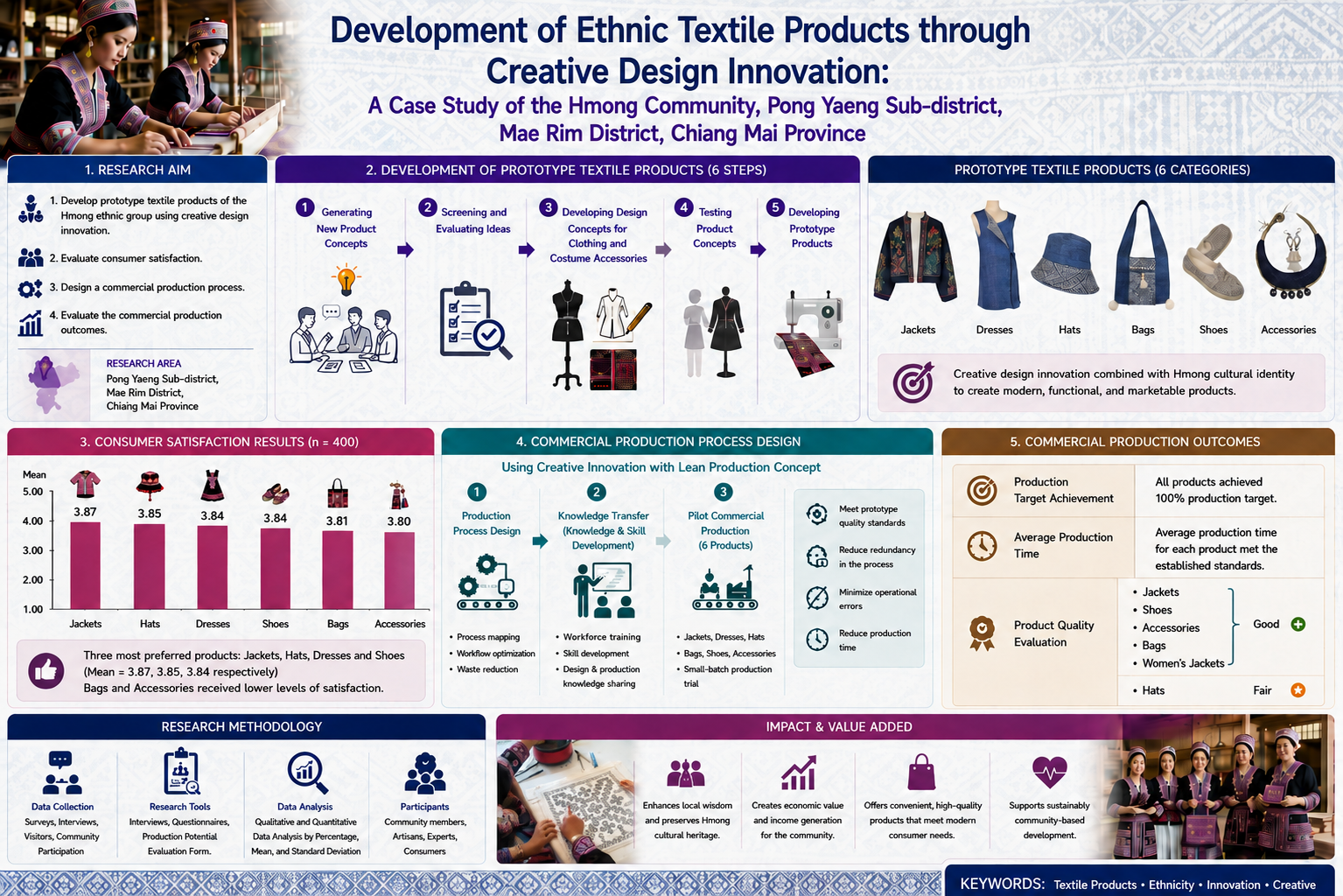
Chiang Mai province possesses ethnic textile cultural capital with potential for economic value enhancement. This research aims to: 1) develop prototype textile products of the Hmong ethnic group using creative design innovation in Pong Yaeng Sub-district, Mae Rim District, Chiang Mai Province; 2) evaluate consumer satisfaction; 3) design a commercial production process; and 4) evaluate the commercial production outcomes of Hmong textile products. The research tools included interviews, questionnaires, and production potential evaluation forms. Data were collected through surveys, interviews, inquiries, and community participation processes. Qualitative and quantitative data were analyzed using percentage, mean, and standard deviation. The results of the research are as follows:
The development of prototype textile products was divided into 5 steps: 1) generating new product concepts, 2) screening and evaluating ideas, 3) developing design concepts for clothing and costume accessories, 4) testing product concepts, and 5) developing prototype products. Consumer satisfaction assessment revealed that the three most preferred products were jackets, hats, dresses and shoes at the same level, while bags and accessories received lower levels of satisfaction. Results of commercial production process design using creative innovation with the Lean production concept was divided into 3 steps: 1) production process design, 2) knowledge transfer regarding products and production processes through knowledge and skill development, and 3) pilot commercial production of six products, including jackets, dresses, hats, bags, shoes, and accessories. The products met the prototype quality standards, reduced redundancy in the production process, minimized operational errors, and reduced production time. The production evaluation revealed that all products achieved a 100% production target. The average production time for each product met the established standards. Regarding product quality, dresses, shoes, accessories, bags, and jackets were rated as good, while hats were rated as fair.
Downloads
References
กรมพัฒนาธุรกิจการค้า. (2568). ธุรกิจผ้าไทย ภูมิปัญญาไทยที่มีมูลค่าทางเศรษฐกิจ สู่แฟชั่นระดับโลก ปี 68 โตแรง! จดทะเบียนตั้งใหม่เพิ่มขึ้นกว่า 4 เท่า มูลค่าทุน 684 ล้านบาท. ข่าวกรม (Press Release). https://www.dbd.go.th/news/1924102568
กลุ่มวิสาหกิจชุมชนดาวม่าง. (2565). ดาวม่าง งานผ้าใยกัญชง. https://www.facebook.com/Daomang.Hemp/photos/
กัลยา วาริชย์บัญชา. (2538). หลักสถิติ. กรุงเทพมหานคร: โรงพิมพ์จุฬาลงกรณ์มหาวิทยาลัย.
จุฑามาศ ดอนอ่อนเบ้า และ จิรวัฒน์ พิราสันต์. (2563). นวัตกรรมการพัฒนาผ้าฝ้ายทอมืออัตลักษณ์ท้องถิ่นจังหวัดเลย. วารสารศิลปกรรมศาสตร์ มหาวิทยาลัยขอนเก่น, 12(2), 22-42. https://so02.tci-thaijo.org/index.php/fakku/article/view/220286
ทองเจือ เขียดทอง. (2558). ผลิตภัณฑ์ผ้าปักม้ง: การออกแบบเชิงเศรษฐกิจสร้างสรรค์. วารสารศิลปกรรมศาสตร์วิชาการ วิจัยและงานสร้างสรรค์, 2(1), 55–79. http://www.repository.rmutt.ac.th/dspace/handle/123456789/2283
นรชัย รัตนสมบูรณ์. (2547). การศึกษาแนวทางการออกแบบเลขนศิลป์บนบรรจุภัณฑ์สินค้าชาวเขา เผ่าม้ง. (วิทยานิพนธ์ปริญญาศิลปศาสตรมหาบัณฑิต, สาขาการออกแบบนิเทศศิลป์, มหาวิทยาลัยศิลปากร).
นุชจรีย์ โพธิ์นิยม. (2563). เชียงใหม่ คราฟต์ : เสน่ห์งานฝีมือจากท้องถิ่นเมืองสร้างสรรค์. สำนักข่าวอ่างแก้ว.
https://angkaewnews.com/content/เชียงใหม่-คราฟต์--เสน่ห์งานฝีมือจากท้องถิ่นเมืองสร้างสรรค์
ประสิทธิ์ ลีปรีชา. (2548). ม้ง หลากหลายชีวิตจากขุนเขาสู่เมือง. เชียงใหม่: สถาบันวิจัยสังคม มหาวิทยาลัยเชียงใหม่.
ปรีดา ศรีสุวรรณ์. (2561). นวัตกรรมแฟชั่นเพื่อความยั่งยืน. (วิทยานิพนธ์ปริญญาศิลปกรรมศาสตรมหาบัณฑิต, คณะศิลปกรรมศาสตร์, จุฬาลงกรณ์มหาวิทยาลัย).
ยุภาภรณ์ เทพจันทร์, บุญฑวรรณ วิงวอน, ขวัญวิมาน หวานดี และ กรองใจ อินภิบาล. (2563). รูปแบบและแนวทางการปรับปรุงประสิทธิภาพในกระบวนการผลิตของวิสาหกิจชุมชนของสิ่งทอในจังหวัดลำพูนโดยใช้การวิเคราะห์แผนผังสายธารคุณค่า. (รายงานวิจัยฉบับสมบูรณ์). สำนักงานคณะกรรมการส่งเสริมวิทยาศาสตร์ วิจัยและนวัตกรรม (สกสว.)
วรปภา อารีราษฎร์ และ ธรัช อารีราษฎร์. (2562). นวัตกรรมกระบวนการพัฒนาทักษะกลุ่มแรงงานตัดเย็บเสื้อผ้าโรงงานสู่การเป็นช่างฝีมือตัดเย็บเสื้อผ้าพื้นเมืองสถานประกอบการในชุมชนจังหวัดสารคาม. วารสารการจัดการเทคโนโลยีสารสนเทศและนวัตกรรม, 6(1), 201-212. https://ph02.tci-thaijo.org/index.php/itm-journal/article/view/199481
สิรกร ภูมาศ. (2564). การวิจัยและพัฒนานวัตกรรมผ้าทอมือด้วยแนวคิด Zero-Wast สู่การออกแบบเครื่องแต่งกายแฟชั่น. (ปริญญานิพนธ์ศิลปกรรมศาสตรมหาบัณฑิต, สาขาวิชานวัตกรรมการออกแบบ, วิทยาลัยอุตสาหกรรมสร้างสรรค์ มหาวิทยาลัยศรีนครินทรวิโรฒ). https://hdl.handle.net/20.500.14740/55113
สำนักงานจังหวัดเชียงใหม่ กลุ่มงานยุทธศาสตร์และข้อมูลเพื่อการพัฒนาจังหวัด. (2565). บรรยายสรุปจังหวัดเชียงใหม่. https://chiangmai.go.th/managing/public/D8/8D17Jan2022133138.pdf
Enarevba, D. R., & Haapala, K. R. (2024). The Emerging Hemp Industry: A Review of Industrial Hemp Materials and Product Manufacturing. AgriEngineering, 6(3), 2891-2925. https://doi.org/10.3390/agriengineering6030167 DOI: https://doi.org/10.3390/agriengineering6030167
Jingjing, G., & Onkam, I. (2021). Way of Life of Hmong Ethnic Group :The case study of Ban Mae Sa Mai. Academic and Research Journal of Liberal Arts, 16(1), 27-44. https://so04.tci-thaijo.org/index.php/larhcu/article/view/247267/
Wongvilarat, S. (2025). Developing Innovations Leveraging the Cultural Capital of the Hmong Ethnic Group in Phop Phra District Tak Province. Journal of Posthumanism, 5(7), 2428-2439. https://doi.org/10.63332/joph.v5i7.3067 DOI: https://doi.org/10.63332/joph.v5i7.3067
Young, A. P. (2020). Hemp Fibers and Fabrics. Information about the Kentucky State University Cooperative Extension Program. https://www.kysu.edu/documents/school-of-agriculture-communities-and-the-environment/fcs_hempfibersandfabrics_fs20_accessible.pdf
Downloads
Additional Files
Published
How to Cite
Issue
Section
License
Copyright (c) 2026 Science and Technology to Community

This work is licensed under a Creative Commons Attribution-NonCommercial-NoDerivatives 4.0 International License.
1. Articles, information, content, images, etc. that are published in "Science and Technology for Community Journal" is the copyright of science and Technology for Community Journal. Chiang Mai Rajabhat University. If any person or organization wants to distribute all or any part of it or do any action Must have written permission from the science and Technology for Community Journal, Chiang Mai Rajabhat University.
2. Content of articles appearing in the journal is the responsibility of the author of the article. The journal editor is not required to agree or take any responsibility.