Effects of Interactive Computer Assembly Simulations on Academic Achievement and Process Skills of University Students in Computer-related Fields
DOI:
https://doi.org/10.57260/stc.2026.1425Keywords:
Interactive learning media, Simulation-based learning, Procedural skills, Learning achievement, Higher educationAbstract
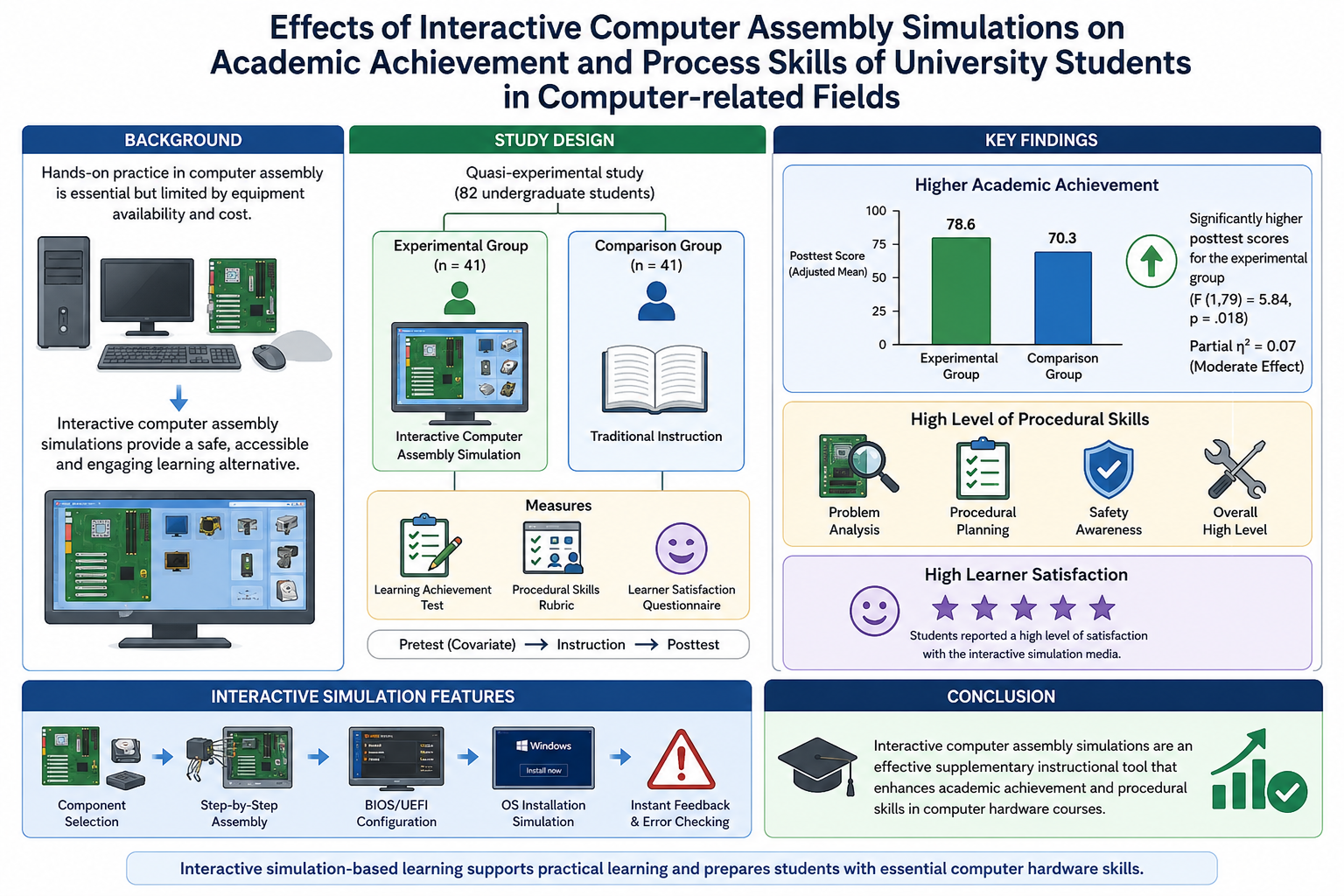
This study aimed to investigate the effects of interactive computer assembly simulation media on learning achievement and procedural skills among undergraduate students in computer-related fields. A quasi-experimental research design was employed with a sample of 82 students divided into an experimental group and a comparison group. The research instruments included a learning achievement test, a rubric-based procedural skills assessment, and a learner satisfaction questionnaire. Data were analyzed using analysis of covariance (ANCOVA), with pretest scores treated as a covariate.
The findings revealed that the experimental group achieved significantly higher posttest scores than the comparison group (F (1,79) = 5.84, p = .018), with a moderate effect size (partial η² = 0.07). In addition, students demonstrated a high overall level of procedural skills, particularly in problem analysis, procedural planning, and safety awareness. Learners also reported a high level of satisfaction with the interactive simulation media. The results suggest that interactive simulation-based learning can serve as an effective supplementary instructional tool for supporting practical learning and enhancing computer hardware skills in higher education.
Downloads
References
Brookhart, S. M. (2023). How to create and use rubrics for formative assessment and grading. (2nd ed.). ASCD.
De Jong, T., Linn, M. C., & Zacharia, Z. C. (2013). Physical and virtual laboratories in science and engineering education. Science, 340(6130), 305–308. https://doi.org/10.1126/science.1230579
Jonsson, A., & Svingby, G. (2007). The use of scoring rubrics: Reliability, validity and educational consequences. Educational Research Review, 2(2), 130–144. https://doi.org/10.1016/j.edurev.2007.05.002
Klinhom, N., Sudsanguan, N., Sudseechang, P., & Jattukul, W. (2022). Development of knowledge management infographic videos about online learning problems. Journal of Science and Technology, 2(2), 12–24. https://ph02.tci-thaijo.org/index.php/JSCI/article/view/247102
Koocharoenspaisal, N., Jongpoo, S., & Chaykaew, I. (2023). Development of multimedia to enhance learning on using scientific equipment for 7th grade students. Journal of Industrial Education, 22(1), 12–24. https://ph01.tci-thaijo.org/index.php/JIE/article/view/250714
Meesuwan, W. (2018). Research in educational technology. Naresuan University Press. Naresuan University Institutional Repository. https://nuir.lib.nu.ac.th/dspace/bitstream/123456789/3964/1/WiwatMeesuwan.pdf
Pholsalee, P. (2018). Development of infographic media based on transfer of learning on the topic of saving for the future of primary 6 students. (Master’s thesis, Rajamangala University of Technology Thanyaburi). http://www.repository.rmutt.ac.th/dspace/bitstream/123456789/3441/1/RMUTT-160341.pdf
Radianti, J., Majchrzak, T. A., Fromm, J., & Wohlgenannt, I. (2020). A systematic review of immersive virtual reality applications for higher education: Design elements, lessons learned, and research agenda. Computers & Education, 147, 103778. https://doi.org/10.1016/j.compedu.2019.103778
Suwansil, P. (2023). The development of learning achievement through learning unit of processes change inside the earth of grade 12 students by learning from creating infographics. Journal of Legal Entity Management and Local Innovation, 9(1), 151–162. https://so04.tci-thaijo.org/index.php/jsa-journal/article/view/257990
Wongjinda, W., & Mekpayom, A. (2022). The development of infographics in the design of online lessons for the industrial teacher students. Interdisciplinary Academic and Research Journal, 2(5), 155–166. https://so03.tci-thaijo.org/index.php/IARJ/article/view/263178
Downloads
Published
How to Cite
Issue
Section
License
Copyright (c) 2026 Science and Technology to Community

This work is licensed under a Creative Commons Attribution-NonCommercial-NoDerivatives 4.0 International License.
1. Articles, information, content, images, etc. that are published in "Science and Technology for Community Journal" is the copyright of science and Technology for Community Journal. Chiang Mai Rajabhat University. If any person or organization wants to distribute all or any part of it or do any action Must have written permission from the science and Technology for Community Journal, Chiang Mai Rajabhat University.
2. Content of articles appearing in the journal is the responsibility of the author of the article. The journal editor is not required to agree or take any responsibility.