Climatic factors associated with dengue incidence in Chiang Mai Province, Thailand
DOI:
https://doi.org/10.57260/stc.2026.1452Keywords:
Dengue fever, Climatic factors, Incidence rate ratio, Generalized linear models, Chiang MaiAbstract
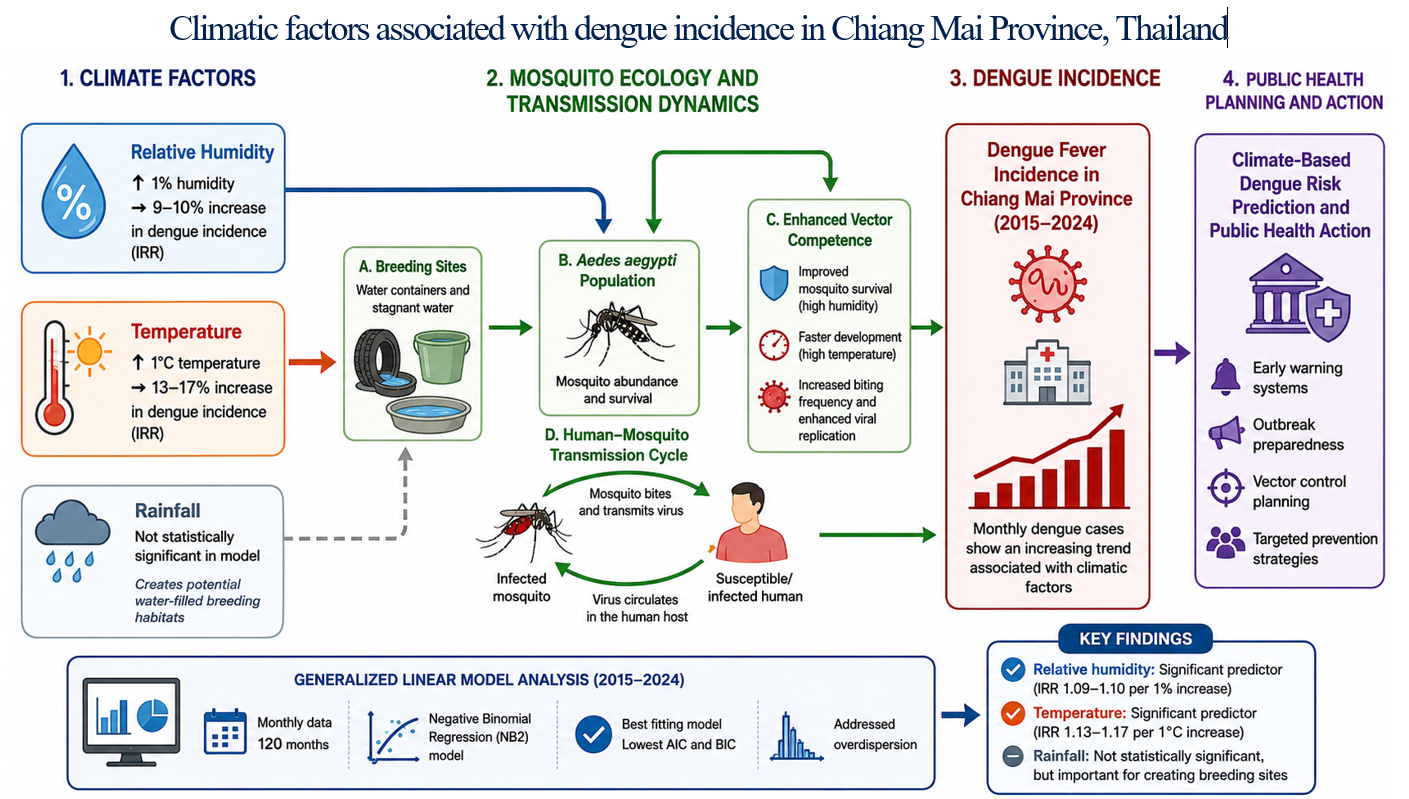
This study aimed to analyze the relationship between climatic factors, including rainfall, relative humidity, and temperature, and the monthly incidence of dengue fever in Chiang Mai Province. Secondary monthly data covering 120 months (2015–2024) were used. Generalized Linear Model (GLM) were applied to estimate the Incidence Rate Ratio (IRR). The results indicated that the Negative Binomial regression with two independent variables (NB2) model was the most appropriate, as it effectively addressed overdispersion and yielded the lowest Akaike Information Criterion (AIC) and Bayesian Information Criterion (BIC) values. The IRR analysis revealed that relative humidity and temperature were significant predictors of dengue incidence. A 1% increase in relative humidity was associated with a 9–10% increase in dengue cases, while a 1 °C rise in temperature was associated with a 13–17% increase. While rainfall was not found to be statistically significant, it plays a role in creating breeding sites for Aedes aegypti mosquitoes. These findings highlight the importance of incorporating climatic data into risk prediction and public health planning to prevent and control dengue outbreaks in vulnerable regions.
Downloads
References
กองระบาดวิทยา กรมควบคุมโรค กระทรวงสาธารณสุข. (2569). ระบบรายงานการเฝ้าระวังโรค 506. http://doe1.moph.go.th/surdata/index.php
กรมควบคุมโรค. (2562). รายงานพยากรณ์ โรคไข้เลือดออก ปี 2562. https://ddc.moph.go.th/uploads/publish/1026720200625043825.pdf
พิมลกัลย์ เดชะชัย. (2568). สสจ. เชียงใหม่ เตือน ประชาชน ระมัดระวังและป้องกันตนเองจากโรคติดต่อที่มียุงลายเป็นพาหะ ในระยะนี้. สถานีวิทยุกระจายเสียงแห่งประเทศไทย จังหวัดเชียงใหม่. https://radiochiangmai.prd.go.th/th/content/category/detail/id/57/iid/413283
สำนักงานพัฒนาวิทยาศาสตร์และเทคโนโลยีแห่งชาติ (สวทช.). (2569). แบบตรวจกิจกรรม/งานวิจัยเข้าข่ายการวิจัยในมนุษย์. https://waa.inter.nstda.or.th/stks/pub/ori/docs/20200402-the-scientific-purposes-of-research-and-testing-in-human-inspection-form.pdf
Abu, A. E. I, Becker, M., Accoti, A., Sylla, M., & Dickson, L. B. (2024). Low humidity enhances Zika virus infection and dissemination in Aedes aegypti mosquitoes. mSphere, 9(8), 576075. https://doi.org/10.1101/2024.01.17.576075
Alam, K. E., Ahmed, M. J., Chalise, R., Rahman, M. A., Mathin, T. T., Bhuiyan, M. I. H., Bhandari, P., & Hossain, D. (2025). Time series analysis of dengue incidence and its association with meteorological risk factors in Bangladesh. PLOS ONE, 20(8), 0323238. https://doi.org/10.1371/journal.pone.0323238
Carrington, L. B., Armijos, M. V., Lambrechts, L., & Scott, T. W. (2013). Fluctuations at a low mean temperature accelerate dengue virus transmission by Aedes aegypti. PLoS Neglected Tropical Diseases, 7(4), 2190. https://doi.org/10.1371/journal.pntd.0002190
Doeurk, B., Leng, S., Long, Z., Maquart, P. O., & Boyer, S. (2025). Impact of temperature on survival, development and longevity of Aedes aegypti and Aedes albopictus (Diptera: Culicidae) in Phnom Penh, Cambodia. Parasites & Vectors, 18(1), 362. https://doi.org/10.1186/s13071-025-06892-y
Gallucci, M. (2019). GAMLj: General analyses for linear models. [jamovi module]. https://gamlj.github.io/
Hair, J. F., Black, W. C., Babin, B. J., & Anderson, R. E. (2010). Multivariate data analysis. (7th ed.). Pearson Prentice Hall.
Hilbe, J. M. (2014). Modeling Count Data. Cambridge University Press.
Hossain, S. (2023). Generalized Linear Regression Model to Determine the Threshold Effects of Climate Variables on Dengue Fever: A Case Study on Bangladesh. Canadian Journal of Infectious Diseases and Medical Microbiology, 1, 2131801. https://doi.org/10.1155/2023/2131801
Kaewhan, S., Junpha, J., & Pimpeach, W. (2025). The regional distribution of dengue fever in Thailand and other emerging countries in Southeast Asia: A literature review. Toxicology and Environmental Health Sciences, 17, 327–334. https://doi.org/10.1007/s13530-025-00251-1
National Aeronautics and Space Administration (NASA). (2026). POWER Data Access Viewer: Monthly climatology for Chiang Mai, Thailand (Lat 18.79, Lon 98.98) from 2015 to 2024 [Data set]. NASA Langley Research Center. https://power.larc.nasa.gov/data-access-viewer/
R Core Team. (2026). R: A language and environment for statistical computing. R Foundation for Statistical Computing. https://www.R-project.org/
Rothman, K. J., Greenland, S., & Lash, T. L. (2008). Modern epidemiology. (3rd ed.). Lippincott Williams & Wilkins.
Sheng, L. J., Rahman, H. A. (2025). Generalized Linear Model Approach on Dengue Incidence in Selangor. In: Embong, A.F., Zainuddin, Z.M., Shabri, A., Yussof, F.N.M. (eds) Mathematics for Sustainable Industry. ISMI 2024. Springer Proceedings in Mathematics & Statistics, vol 496. Springer, Cham. https://doi.org/10.1007/978-3-031-85926-7_16
Singh, P. S., & Chaturvedi, H. K. (2022). A retrospective study of environmental predictors of dengue in Delhi from 2015 to 2018 using the generalized linear model. Sci Rep, 12(1), 8109. https://doi.org/10.1038/s41598-022-12164-x
Singh, S., Lai, C. H., Sulaiman, L. H., Wong, S. F., Jelip, J., Mokhtar, N., Harpham, Q., Tsarouchi, G., & Gill, B. S. (2022). The effects of meteorological factors on dengue cases in Malaysia. International Journal of Environmental Research and Public Health, 19(11), 6449. https://doi.org/10.3390/ijerph19116449
The jamovi project. (2024). jamovi (Version 2.5) [Computer software]. https://www.jamovi.org
Venables, W. N., & Ripley, B. D. (2002). Modern applied statistics with S. (4th ed.). Springer.
Zeileis, A., Kleiber, C., & Jackman, S. (2008). Regression models for count data in R. Journal of Statistical Software, 27(8), 1–25. https://doi.org/10.18637/jss.v027.i08
Downloads
Published
How to Cite
Issue
Section
License
Copyright (c) 2026 Science and Technology to Community

This work is licensed under a Creative Commons Attribution-NonCommercial-NoDerivatives 4.0 International License.
1. Articles, information, content, images, etc. that are published in "Science and Technology for Community Journal" is the copyright of science and Technology for Community Journal. Chiang Mai Rajabhat University. If any person or organization wants to distribute all or any part of it or do any action Must have written permission from the science and Technology for Community Journal, Chiang Mai Rajabhat University.
2. Content of articles appearing in the journal is the responsibility of the author of the article. The journal editor is not required to agree or take any responsibility.