Environmental Condition Control and Hatching Performance Analysis of Native and Layer Chickens Using Eggs Incubator in Ban Bung Mai Community, Ubon Ratchathani Province
DOI:
https://doi.org/10.57260/stc.2026.1793Keywords:
Automated incubator, IoT environmental control, HatchabilityAbstract
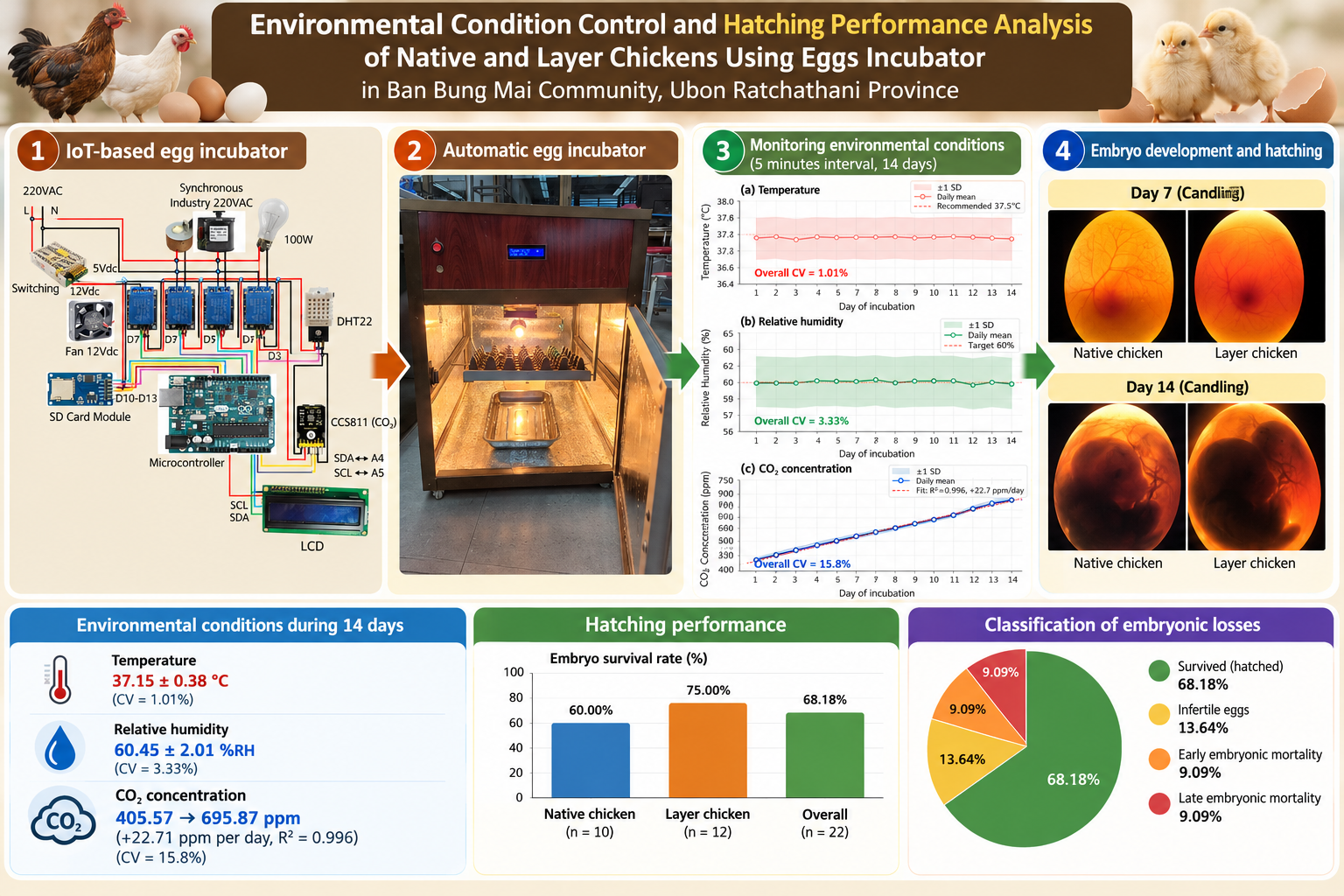
This study aimed to: 1) analyze and report the environmental conditions inside an IoT-based automatic egg incubator over a 14-day period, with particular emphasis on CO2 accumulation trends; 2) compare embryo survival rates between native indigenous chickens and layer chickens during the first 14 days of incubation; and 3) classify the stages and patterns of embryonic mortality throughout the incubation period. The developed incubator was controlled by a microcontroller and continuously recorded five environmental variables, including temperature, relative humidity, CO2 concentration, egg-turning angle, and fan speed, at 5-minute intervals over 14 days, yielding a total of 4,032 records. A total of 22 eggs were incubated, comprising 10 indigenous chicken eggs and 12-layer chicken eggs. Embryonic development was assessed through candling on days 7 and 14. The results revealed that the mean incubation temperature was 37.15 ± 0.38 °C (CV = 1.01%), while the mean relative humidity was 60.45 ± 2.01 %RH. CO2 concentration exhibited a linear increase from 405.57 ppm to 695.87 ppm, at a rate of 22.71 ppm per day (R² = 0.996). The overall embryo survival rate throughout the incubation period was 68.18%, with layer chickens exhibiting a higher survival rate (75.00%) than indigenous chickens (60.00%). Classification of embryonic losses indicated that 13.64% of eggs were infertile, 9.09% experienced early embryonic mortality, and 9.09% resulted in late embryonic mortality. These findings demonstrate that the developed IoT-based automatic egg incubator can maintain stable environmental conditions.
Downloads
References
กฤษฎา ภาณุมนต์วาที, นิกร ปรีชา และ สิทธิชัย ชูสำโรง. (2565). ระบบติดตามอุณหภูมิและความชื้นในการฟักไข่ไก่พื้นเมืองตู้ฟักไฟฟ้าด้วยเทคโนโลยีอินเทอร์เน็ตของสรรพสิ่ง. Journal of Applied Research on Science and Technology (JARST), 21(2), 79–88. https://ph01.tci-thaijo.org/index.php/rmutt-journal/article/view/249343
เจษฎา สาททอง, สัญญา ควรคิด, อดิศร แก้วภักดี และ ขนิษฐา แซ่ลิ้ม. (2567). เครื่องฟักไข่แบบสมาร์ทและการตรวจสอบไข่ด้วยเทคโนโลยีใยแก้วนำแสง. วารสารวิชาการเทคโนโลยีอุตสาหกรรม มหาวิทยาลัยสวนสุนันทา, 12(2), 96-106. https://ph01.tci-thaijo.org/index.php/fit-ssru/article/view/257892
ณนณ วทัญญูเลิศสกุล และสาโรจน์ บุญศักดิ์ดี. (2567). การพัฒนาเครื่องฟักไข่อัตโนมัติโดยใช้เทคนิคการ ประมวลผลภาพแบบเรียลไทม์. วารสารนวัตกรรมการเรียนรู้และเทคโนโลยี, 6(1), 62-73. https://so06.tci-thaijo.org/index.php/JLIT/article/view/290356
รวิศ คำหาญพล, ศักดิ์รพี ขุนเพ็ชร, วิชิต มาลาเวช, ชัญญาภัค ไชยพรรณ และ กรีฑา แก้วคงธรรม. (2568). การออกแบบและพัฒนาเครื่องฟักไข่อัตโนมัติสำหรับสายพันธุ์ไก่แจ้บ้านวังนาคพื้นที่จังหวัดนครศรีธรรมราช ภาคใต้ของประเทศไทย. วารสารวิทยาศาสตร์และเทคโนโลยี มหาวิทยาลัยมหาสารคาม, 44(1), 80-87. https://li01.tci-thaijo.org/index.php/scimsujournal/article/view/261241
Chidiebere, M. E., Francis, I. S., & Ikechukwu, N. (2025). Design and Implementation of an Enhanced Neuro-Fuzzy-Based Smart System for Poultry Incubators. Communication In Physical Sciences, 12(5), 1583-1599. https://journalcps.com/index.php/volumes/article/view/611
Decuypere, E., & Bruggeman, V. (2007). The endocrine interface of environmental and egg factors affecting chick quality. Poultry Science, 86(5), 1037–1042. https://doi.org/10.1093/ps/86.5.1037
Decuypere, E., Tona, K., Bruggeman, V., & Bamelis, F. (2001). The day-old chick: A crucial hinge between breeders and broilers. World's Poultry Science Journal, 57(2), 127–138. http://dx.doi.org/10.1079/WPS20010010
Elibol, O., & Brake, J. (2006). Effect of egg turning angle and frequency during incubation on hatchability and incidence of unhatched broiler embryos with head in the small end of the egg. Poultry Science, 85(8), 1433–1437. https://doi.org/10.1093/ps/85.8.1433
Elibol, O., Peak, S. D., & Brake, J. (2002). Effect of flock age, length of egg storage, and frequency of turning during storage on hatchability of broiler hatching eggs. Poultry Science, 81(7), 945–950. https://doi.org/10.1093/ps/81.7.945
Fathi, M., Abou-Emera, O., Al-Homidan, I., Galal, A., & Rayan, G. (2022). Effect of genotype and egg weight on hatchability properties and embryonic mortality pattern of native chicken populations. Poultry Science, 101(11), 102129. https://doi.org/10.1016/j.psj.2022.102129
Giri, A., Das, S. R., Joy, A. Z. M. J. U., Akib, A. A. S., Misat, M. M. H., Khadgi, M., & Shahi, B. (2025). Smart IoT egg incubator system with machine learning for damaged egg detection. In International conference on WorldS4 (pp. 236-245). Cham: Springer Nature Switzerland. https://doi.org/10.1007/978-3-032-11512-6_20
Khalil, M. H., Shebl, M. K., Kosba, M. A., El-Sabrout, K., & Zaki, N. (2016). Estimate the contribution of incubation parameters influence egg hatchability using multiple linear regression analysis. Veterinary World, 9(8), 806. https://doi.org/10.14202/vetworld.2016.806-810
Kumar, J., Jamwal, K. I. R. T. I., Bhardwaj, N. I. T. I. N., Sankhyan, V. A. R. U. N., Dinesh, K. R. I. S. H. A. N. E. N. D. E. R., & Katoch, S. H. I. V. A. N. I. (2024). Effects of egg size on hatchability parameters and chick quality in native chicken. Indian Journal of Poultry Science, 59(2), 193-198. https://doi.org/10.5958/0974-8180.2024.00031.X
Liu, C., Zheng, W., Zhu, L., Tong, Q., & Li, D. (2022). Effect of elevated carbon dioxide on chicken eggs during the early and late incubation periods. Animal, 16(4), 100499. https://doi.org/10.1016/j.animal.2022.100499
Oliveira, G. D. S., Dos Santos, V. M., Rodrigues, J. C., & Nascimento, S. T. (2020). Effects of different egg turning frequencies on incubation efficiency parameters. Poultry Science, 99(9), 4417–4420. https://doi.org/10.1016/j.psj.2020.05.045
Prabowo, M. C. A., Sayekti, I., Astuti, S., Nursaputro, S. T., & Supriyati, S. (2024). Development of an IoT-based egg incubator with PID control system and web application. JOIV: International Journal on Informatics Visualization, 8(1), 465–472. http://dx.doi.org/10.62527/joiv.8.1.2044
Downloads
Additional Files
Published
How to Cite
Issue
Section
License
Copyright (c) 2026 Science and Technology to Community

This work is licensed under a Creative Commons Attribution-NonCommercial-NoDerivatives 4.0 International License.
1. Articles, information, content, images, etc. that are published in "Science and Technology for Community Journal" is the copyright of science and Technology for Community Journal. Chiang Mai Rajabhat University. If any person or organization wants to distribute all or any part of it or do any action Must have written permission from the science and Technology for Community Journal, Chiang Mai Rajabhat University.
2. Content of articles appearing in the journal is the responsibility of the author of the article. The journal editor is not required to agree or take any responsibility.