Microliter-Scale Colorimetry Using a Low-Cost Digital Microscope for the Determination of Phosphorus and Iron
DOI:
https://doi.org/10.57260/stc.2026.1816Keywords:
Digital microscope, Digital image colorimetry, Phosphorus, Iron, Green analytical chemistryAbstract
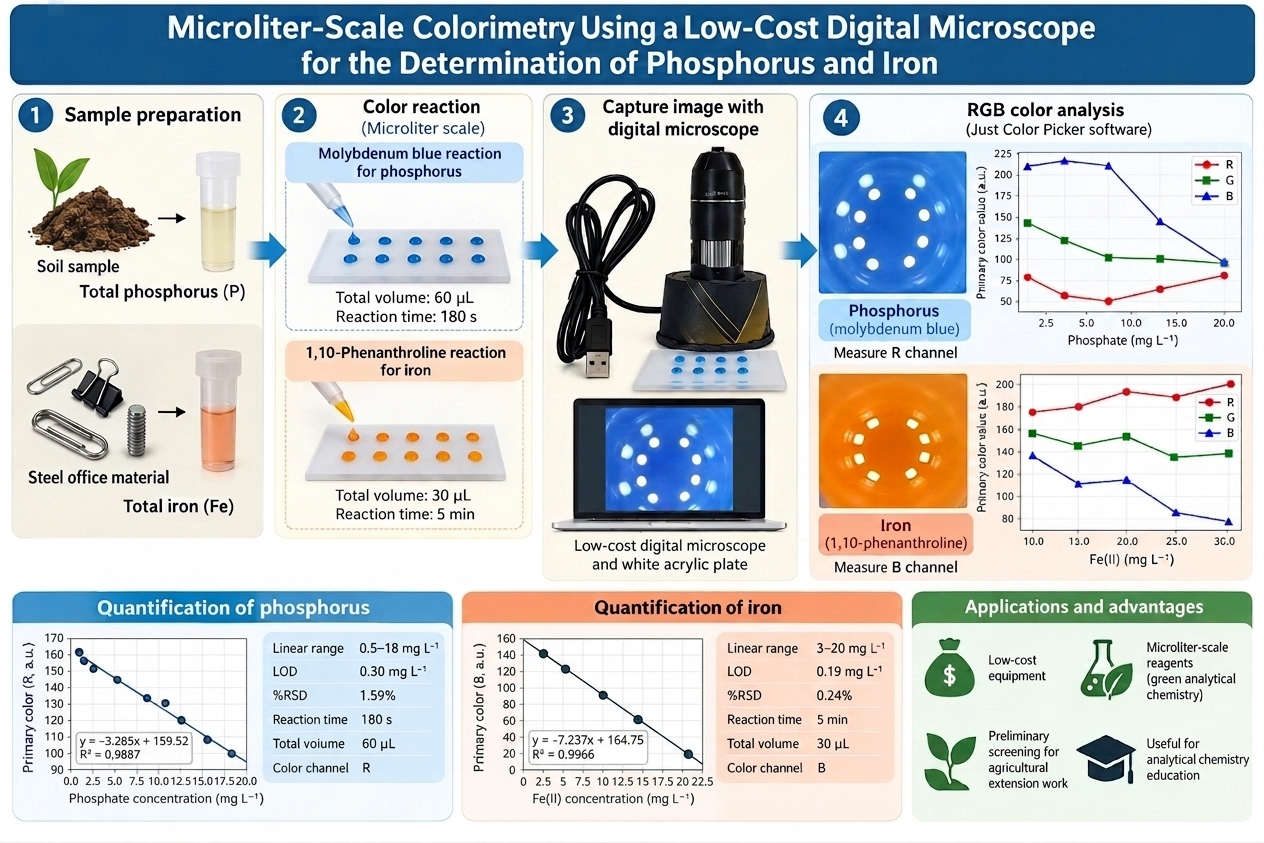
Quantitative analysis using standard methods requires expensive instruments and large amounts of chemical reagents, which can be a limitation for organizations with restricted budgets. This study aimed to develop a microliter-scale colorimetric method using an economical digital microscope for the determination of total phosphorus in soil and total iron in steel office materials, and to evaluate the method performance against reference methods. The developed method was based on RGB color measurement of reaction droplets placed on a white acrylic plate using the Just Color Picker software. Phosphate was determined using the molybdenum blue reaction, while iron was determined using the 1,10-phenanthroline reaction. The investigated conditions included the color channel used for measurement, reaction time, and the volume ratio of reagents to sample solution. The optimum conditions for phosphate determination were the R color channel, a reaction time of 180 s, and a total volume of 60 µL, whereas those for iron determination were the B color channel, a reaction time of 5 min, and a total volume of 30 µL. The developed method exhibited linear ranges of 0.5–18 mg L-1 (R² = 0.9887) for phosphate and 3–20 mg L-1 (R² = 0.9966) for iron, with limits of detection of 0.30 and 0.19 mg L-1 and %RSD values of 1.59 and 0.24%, respectively. The results obtained for five soil samples and three types of office materials were in good agreement with those obtained by ultraviolet–visible spectrophotometry, with mean relative percent differences (%RPD) of 8.90% and 1.80%, respectively. The percentage recoveries of iron ranged from 94.40% to 102%. The developed method requires only microliter-scale volumes of reagents and employs a single device for the determination of both analytes. Therefore, it has potential as a preliminary screening method for agricultural extension work and analytical chemistry education in educational institutions with limited budgets.
Downloads
References
American Public Health Association, American Water Works Association, & Water Environment Federation. (2017). 3500-Fe iron. In R. B. Baird, A. D. Eaton, & E. W. Rice (Eds.), Standard methods for the examination of water and wastewater. (23rd ed.). APHA Press.
AOAC International. (2016). Appendix F: Guidelines for standard method performance requirements. In Official methods of analysis of AOAC International. (20th ed.). AOAC International.
Capitán-Vallvey, L. F., López-Ruiz, N., Martínez-Olmos, A., Erenas, M. M., & Palma, A. J. (2015). Recent developments in computer vision-based analytical chemistry: A tutorial review. Analytica Chimica Acta, 899, 23–56. https://doi.org/10.1016/j.aca.2015.10.009
Fan, Y., Li, J., Guo, Y., Xie, L., & Zhang, G. (2021). Digital image colorimetry on smartphone for chemical analysis: A review. Measurement, 171, 108829. https://doi.org/10.1016/j.measurement.2020.108829
Gałuszka, A., Migaszewski, Z., & Namiesśnik, J. (2013). The 12 principles of green analytical chemistry and the SIGNIFICANCE mnemonic of green analytical practices. TrAC Trends in Analytical Chemistry, 50, 78–84. https://doi.org/10.1016/j.trac.2013.04.010
Jeffery, G. H., Bassett, J., Mendham, J., & Denney, R. C. (1989). Vogel's textbook of quantitative chemical analysis. (5th ed.). Longman Scientific & Technical.
Kanna, M., Luangton, S., & Somnam, S. (2022). Application of an economic USB digital microscope for microvolume colorimetric determination of iron in supplements with a guava leaf extract. Chiang Mai Journal of Science, 49(5), 1365–1375. https://doi.org/10.12982/CMJS.2022.086
Lavanya, V., Das, A., Nayak, A., Chawla, Y., Dasgupta, S., Weindorf, D. C., Li, B., & Chakraborty, S. (2024). Digital soil mapping of available phosphorus using a smartphone-integrated RGB imaging device and ascorbic acid extraction method. Smart Agricultural Technology, 9, 100591. https://doi.org/10.1016/j.atech.2024.100591
Lovato, P. F. F., Chaves, E. S., Vidal, L. N., & Santos, P. M. (2024). Feasibility of digital image colorimetric methods for iron determination in river sediment. International Journal of Sediment Research, 39(5), 714–719. https://doi.org/10.1016/j.ijsrc.2024.02.005
Moonrungsee, N., Pencharee, S., & Jakmunee, J. (2015). Colorimetric analyzer based on mobile phone camera for determination of available phosphorus in soil. Talanta, 136, 204–209. https://doi.org/10.1016/j.talanta.2015.01.024
Murphy, J., & Riley, J. P. (1962). A modified single solution method for the determination of phosphate in natural waters. Analytica Chimica Acta, 27, 31–36. https://doi.org/10.1016/S0003-2670(00)88444-5
O'Halloran, I. P., & Cade-Menun, B. J. (2008). Total and organic phosphorus. In M. R. Carter & E. G. Gregorich (Eds.), Soil sampling and methods of analysis. (2nd ed., pp. 265–291). CRC Press.
Pena-Pereira, F., Wojnowski, W., & Tobiszewski, M. (2020). AGREE—Analytical GREEnness metric approach and software. Analytical Chemistry, 92(14), 10076–10082. https://doi.org/10.1021/acs.analchem.0c01887
Pennock, D., Yates, T., & Braidek, J. (2008). Soil sampling designs. In M. R. Carter & E. G. Gregorich (Eds.), Soil sampling and methods of analysis. (2nd ed., pp. 1–14). CRC Press.
Sheppard, S. C., & Addison, J. A. (2008). Soil sample handling and storage. In M. R. Carter & E. G. Gregorich (Eds.), Soil sampling and methods of analysis. (2nd ed., pp. 39–49). CRC Press.
Somnam, S., Kanna, M., & Jakmunee, J. (2019). Application of a smartphone to increase effectiveness in the determination of soil pH by using indicators. Chiang Mai Journal of Science, 46(4), 733–740. https://epg.science.cmu.ac.th/ejournal/journal-detail.php?id=10222
Tobiszewski, M., Marć, M., Gałuszka, A., & Namiśnik, J. (2015). Green chemistry metrics with special reference to green analytical chemistry. Molecules, 20(6), 10928–10946. https://doi.org/10.3390/molecules200610928
Downloads
Additional Files
Published
How to Cite
Issue
Section
License
Copyright (c) 2026 Science and Technology to Community

This work is licensed under a Creative Commons Attribution-NonCommercial-NoDerivatives 4.0 International License.
1. Articles, information, content, images, etc. that are published in "Science and Technology for Community Journal" is the copyright of science and Technology for Community Journal. Chiang Mai Rajabhat University. If any person or organization wants to distribute all or any part of it or do any action Must have written permission from the science and Technology for Community Journal, Chiang Mai Rajabhat University.
2. Content of articles appearing in the journal is the responsibility of the author of the article. The journal editor is not required to agree or take any responsibility.