Effect of Milling Methods on Physicochemical and Pasting Properties of Ayutthaya 1 Rice and Brown Rice Flours
DOI:
https://doi.org/10.57260/stc.2026.1853Keywords:
Rice flour, Brown rice flour, Ayutthaya 1 variety, Viscosity, Swelling index, Water solubility indexAbstract
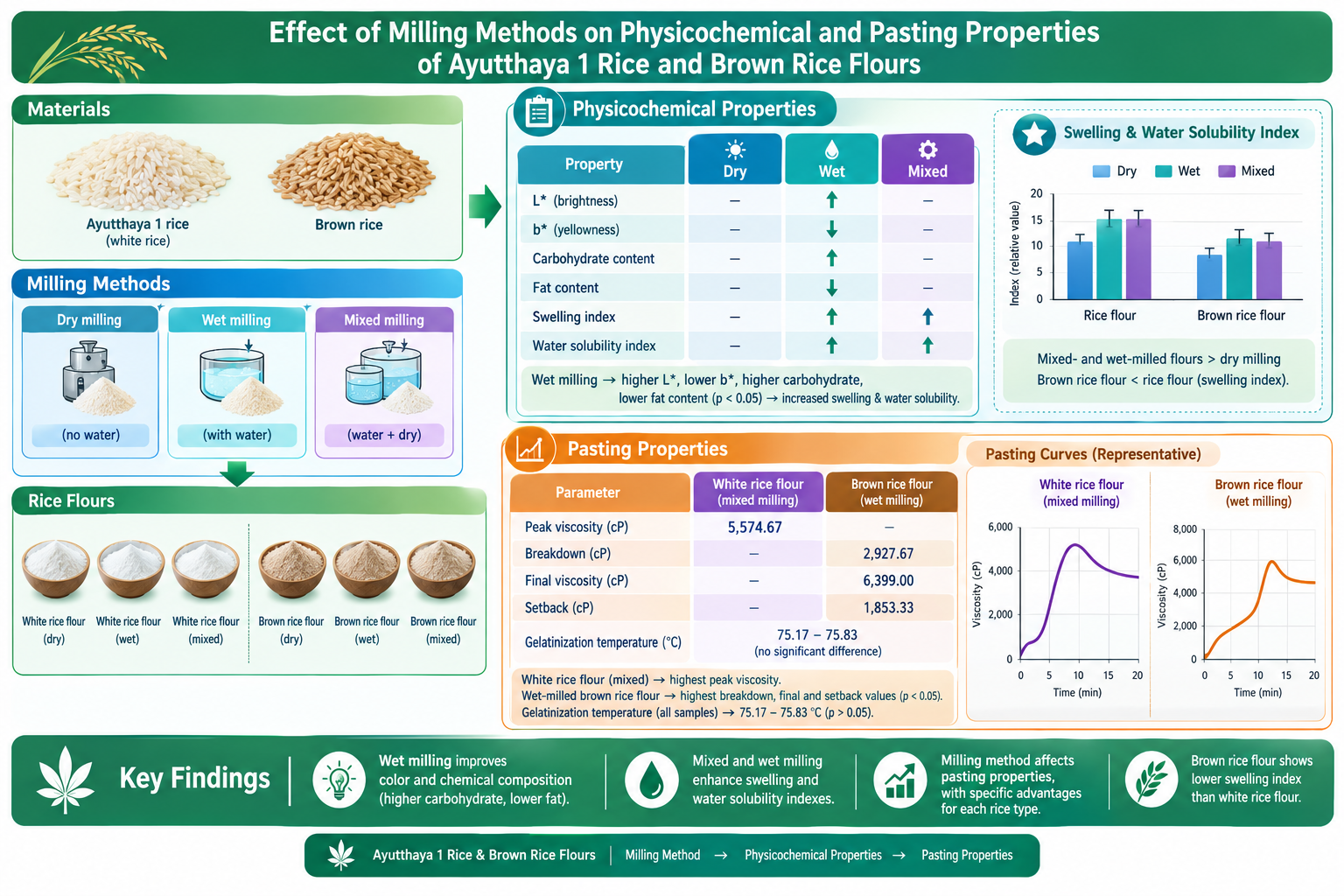
The purpose of this research was to study the effects of the dry, wet and mixed milling methods on the physicochemical quality and pasting properties of Ayutthaya 1 rice and brown rice flours. From the comparative experiment of white rice flour and brown rice flour that have been milled in 3 methods: dry milling; wet milling and mixed milling, it was found that the milling method affected its physicochemical properties, with the wet milling method resulting in the highest L* value color (brightness), the lowest b* color value (yellowness), the highest carbohydrate content, and the lowest fat content (p<0.05). As a result, swelling index and water solubility index of rice flour were likely to increase. The mixed- and wet-milled flours had a higher swelling and water solubility indexes than dry milling method. Brown rice flour had a lower swelling index than rice flour. The gelatinization temperature of both rice and brown rice flours milling by all 3 milling methods was no significant difference (p>0.05) in the range of 75.17 – 75.83 oC. White rice flour produced by the mixed milling method showed the highest peak viscosity (5,574.67 cP), while wet milled brown rice flour had the highest values of a breakdown, final and setback values (p<0.05, which were 2,927.67, 6,399.00 and 1,853.33 cP, respectively).
Downloads
References
กรมการข้าว. (2559). องค์ความรู้เรื่องข้าว พันธุ์ข้าวอยุธยา 1. กองวิจัยและพัฒนาข้าว กรมการข้าว กระทรวงเกษตรและสหกรณ์.
กล้าณรงค์ ศรีรอด และ เกื้อกูล ปิยะจอมขวัญ. (2550). เทคโนโลยีของแป้ง. (พิมพ์ครั้งที่ 4), สำนักพิมพ์ มหาวิทยาลัยเกษตรศาสตร์.
เชาวนีพร ชีพประสพ, หาสันต์ สาเหล็ม และ ฤทัยทิพ อโนมุณ. (2560). องค์ประกอบทางเคมีและปริมาณอะไมโลสในข้าวพันธุ์พื้นเมืองจากศูนย์วิจัยข้าวพัทลุง. วารสารวิทยาศาสตร์และเทคโนโลยี มทร. ธัญบุรี, 7(2), 84-97. https://ph02.tci-thaijo.org/index.php/past/article/view/243065
ฌัชษชี ฌัชปภาส์มณ, สันทณีย์ ปัญจอานนท์ และ ดุษฎี อุตภาพ. (2559). ผลของการดัดแปรแป้งด้วยวิธีการใช้ความร้อนชื้นต่อสมบัติและโครงสร้างของแป้งที่มีโครงสร้างผลึกแบบ A และ B. วารสารวิจัยและพัฒนา มจธ., 39(2), 257-270. https://digital.lib.kmutt.ac.th/journal/loadfile.php?A_ID=803
พิมพ์เพ็ญ ถิรพร, นฤดม บุญ-หลง, งามชื่น คงเสรี และ จินตนา อุปดิสสกุล. (2533). ผลของการใช้แป้งมันสำปะหลังผสมแป้งข้าวเจ้าต่อคุณภาพของเส้นก๋วยเตี๋ยว. ใน รายงานผลการวิจัยในการประชุมทางวิชาการของมหาวิทยาลัยเกษตรศาสตร์ ครั้งที่ 28. (น. 307-317). มหาวิทยาลัยเกษตรศาสตร์.
ภัทรา ฉัตรชัยพันธ์, ราฮีมา วาแมดีซา, สุนีย์ โชตินีรนารท, อุษา ย้อนโคกสูง และ โรสลาวาตี โตะแอ. (2568). องค์ประกอบทางเคมีและคุณสมบัติทางเคมีฟิสิกส์ของฟลาวข้าวกล้องสายพันธุ์พื้นเมืองจังหวัดนราธิวาส. วารสารวิทยาศาสตร์ชีวภาพ การเกษตร และเทคโนโลยี, 4(2), 44-54. https://li04.tci-thaijo.org/index.php/psj/article/view/8455
วิจิตรา เหลียวตระกูล และ วชิรญา เหลียวตระกูล. (2563). ผลของวิธีการโม่ต่อสมบัติทางเคมีกายภาพ ความหนืด และการแยกตัวของน้ำของแป้งกระจับ. วารสารวิทยาศาสตร์และเทคโนโลยี, 9(2), 251–264. https://li01.tci-thaijo.org/index.php/tjst/article/view/240005
วิจิตรา เหลียวตระกูล, วชิรญา เหลียวตระกูล และ วรรภา วงศ์แสงธรรม. (2564). ผลของปริมาณแป้งกระจับและการอบแห้งต่อคุณสมบัติทางเคมีกายภาพ การต้านอนุมูลอิสระ และทางประสาทสัมผัสของก๋วยเตี๋ยวเส้นเล็ก. วารสารวิทยาศาสตร์บูรพา, 26(1), 341-357. https://li05.tci-thaijo.org/index.php/buuscij/article/view/1473
ศันสนีย์ อุดมระติ, พัชรี ตั้งตระกูล และ งามจิตร โล่วิทูร. (2562). ผลของวิธีการโม่ต่อสมบัติทางเคมีฟิสิกส์ของแป้งข้าวขาวดอกมะลิ 105 และการนำไปประยุกต์ใช้ในผลิตภัณฑ์ปลอดกลูเตน. วารสารวิทยาศาสตร์และเทคโนโลยี, 27(2), 311-325. https://li01.tci-thaijo.org/index.php/tstj/article/view/181305
ศิริกาญจนา ศิรินนทร์ และ ณัชฐ์ธพงศ์ เพชรอำไพ. (2567). การศึกษาปริมาณสารอะไมโลสที่มีผลต่อค่าความ ข้นหนืดของเจลแป้งและลักษณะเนื้อสัมผัสข้าวหลากสายพันธุ์ในพื้นที่ปลูกจังหวัดนครสวรรค์. วารสารมหาวิทยาลัยศรีนครินทรวิโรฒ สาขาวิทยาศาสตร์และเทคโนโลยี, 16(32), 1-11. https://ph02.tci-thaijo.org/index.php/swujournal/article/view/251997/
ศิวาพร แดงโชติ, สุนันท์ สีสังข์ และ สำอาง สืบสมาน. (2561). การบริโภคข้าวที่มีคุณค่าทางโภชนาการสูงของแต่ละกลุ่มวัย กรณีศึกษาผู้บริโภคในเขตกรุงเทพมหานคร. ใน รายงานสืบเนื่องจากการประชุมเสนอผลงานวิจัยระดับชาติ มหาวิทยาลัยสุโขทัยธรรมาธิราช ครั้งที่ 9. (น. 1633–1651). มหาวิทยาลัยสุโขทัยธรรมาธิราช.
สวนิต อิชยาวณิชย์, มณฑิรา นพรัตน์ และพรรณ จิราวงศ์สวัสดิ์. (2547). คุณสมบัติทางเคมี กายภาพและรีโอโลจีของแป้งข้าวเจ้าที่ผลิตโดยกระบวนการโม่เปียกและโม่แห้งในระดับอุตสาหกรรม. วารสารวิจัยและพัฒนา มจธ., 27(3), 357-374. https://digital.lib.kmutt.ac.th/journal/loadfile.php?A_ID=195
สันทณีย์ ปัญจอานนท์, วิทวัส จิรนันทกูล และดุษฎี อุตภาพ. (2557). สมบัติทางเคมีกายภาพและโครงสร้างโมเลกุลของแป้งกลอย (Dioscorea hispida Dennst.) และแป้งมันมือเสือ (Dioscorea esculenta (Lour.) Burkill). วารสารวิจัยและพัฒนา มจธ., 37(2), 185-198. https://digital.lib.kmutt.ac.th/journal/loadfile.php?A_ID=560
AOAC International. (2020). Official methods of analysis of AOAC International. (21st ed.). AOAC International.
Chiang, P. Y., & Yeh, A. I. (2002). Effect of soaking on wet-milling of rice. Journal of Cereal Science, 35(1), 85-94. https://doi.org/10.1006/jcrs.2001.0419
Dorantes-Campuzano, M. F., Cabrera-Ramírez, A. H., Rodríguez-García, M. E., Palacios-Rojas, N., Preciado-Ortíz, R. E., Luzardo-Ocampo, I., & Gaytán Martínez, M. (2022). Effect of maize processing on amylose-lipid complex in pozole, a traditional Mexican dish. Applied Food Research, 2(1), 100078. https://doi.org/10.1016/j.afres.2022.100078
Hamaker, B. R., & Griffin, V. K. (1993). Effect of disulfide bond-containing protein on rice starch gelatinization and pasting. Cereal Chemistry, 70(4), 377-380. https://www.cerealsgrains.org/publications/cc/backissues/1993/Documents/70_377.pdf
Leewatchararongjaroen, J., & Anuntagool, J. (2016). Effects of Dry-Milling and Wet-Milling on Chemical, Physical and Gelatinization Properties of Rice Flour. Rice Science, 23(5), 274–281. https://doi.org/10.1016/j.rsci.2016.08.005
Liaotrakoon, W., Liaotrakoon, V., Wongsaeng tham, W., & Rodsiri, S. (2014). Influence of dry- and wet-milling processes on physicochemical properties, syneresis, pasting profile and microbial count of job’s tear flour. International Food Research Journal, 21, 1745-1749. https://www.academia.edu/download/110386681/6_20IFRJ_2021_2005_202014_20Liaotrakoon_20666.pdf
Likitwattanasade, T., & Hongsprabhas, P. (2010). Effect of storage proteins on pasting properties and microstructure of Thai rice. Food Research International, 43(5), 1402-1409. https://doi.org/10.1016/j.foodres.2010.04.011
Lim, S. T., Lee, J. H., Shin, D. H., & Lim, H. S. (1999). Comparison of protein extraction solutions for rice starch isolation and effects of residual protein content on starch pasting properties. Starch/Starke, 51(4), 120-125. https://www.scopus.com/pages/publications/0000879409
Soojung, H.., Seung, M. L., Jae-Hoon, S., Sang-Ho, Y., & Suyong, L. (2013). Effect of dry- and wet-milled rice flours on the quality attributes of gluten-free dough and noodles. Journal of Food Engineering, 116(1), 213-217. https://doi.org/10.1016/j.jfoodeng.2012.11.017
Yu, J. K., & Moon, Y. S. (2021). Corn Starch: Quality and Quantity Improvement for Industrial Uses. Plants (Basel), 11(1), 92. https://doi.org/10.3390/plants11010092
Downloads
Additional Files
Published
How to Cite
Issue
Section
License
Copyright (c) 2026 Science and Technology to Community

This work is licensed under a Creative Commons Attribution-NonCommercial-NoDerivatives 4.0 International License.
1. Articles, information, content, images, etc. that are published in "Science and Technology for Community Journal" is the copyright of science and Technology for Community Journal. Chiang Mai Rajabhat University. If any person or organization wants to distribute all or any part of it or do any action Must have written permission from the science and Technology for Community Journal, Chiang Mai Rajabhat University.
2. Content of articles appearing in the journal is the responsibility of the author of the article. The journal editor is not required to agree or take any responsibility.