Design and Evaluation of a Smart Greenhouse Control System for Hemp (Hemp plant) Seed and Fiber Production
DOI:
https://doi.org/10.57260/stc.2026.1429คำสำคัญ:
Hemp, Smart greenhouse, Environmental control system, Analysis of variance (ANOVA), Controlled environment agriculture (CEA)บทคัดย่อ
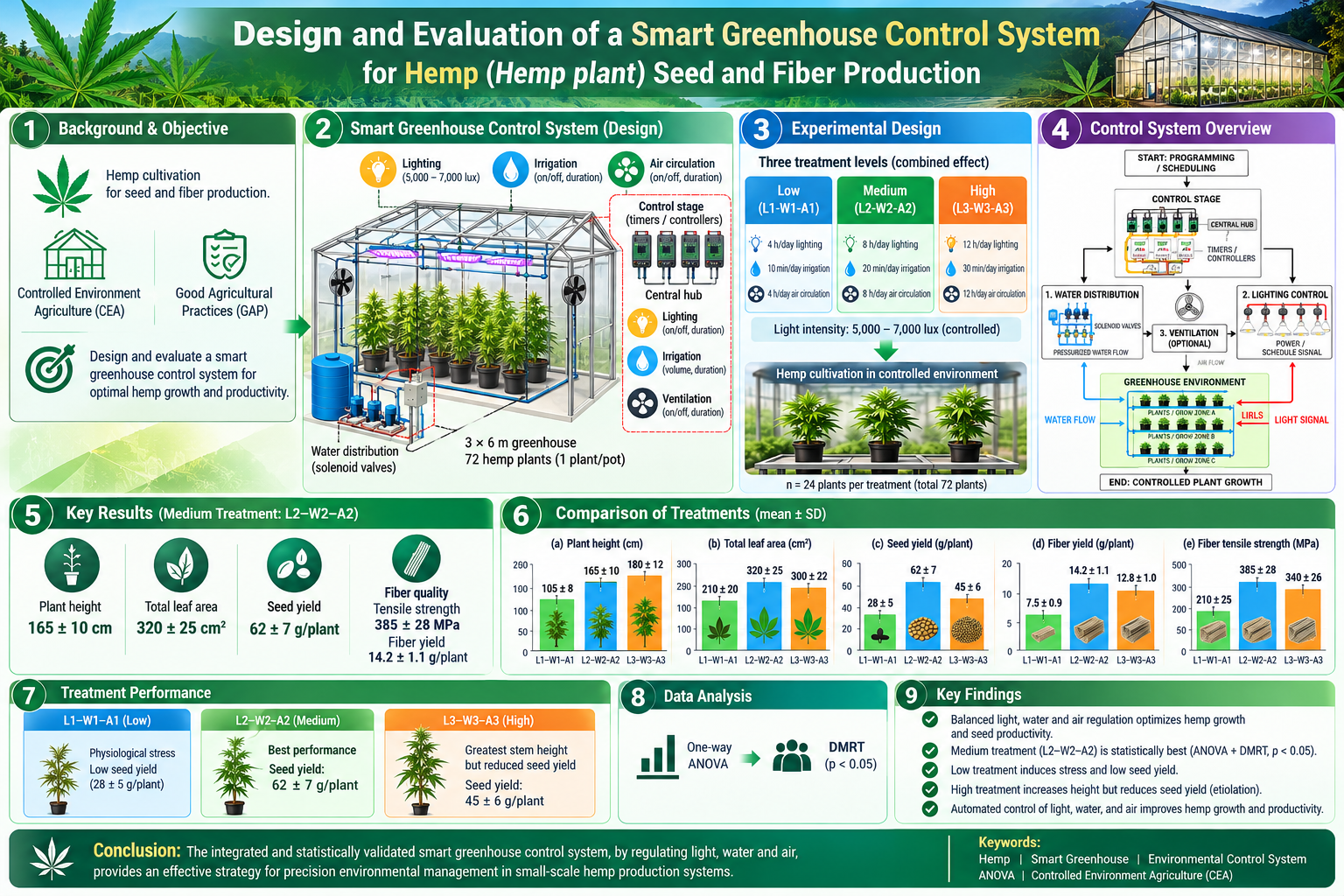
This study aimed to design and evaluate the performance of a smart greenhouse control system for hemp (Hemp plant) cultivation for seed and fiber production, based on the principles of Controlled Environment Agriculture (CEA) and Good Agricultural Practices (GAP). The experiment was conducted in a closed greenhouse measuring 3 meters by 6 meters, containing 72 hemp plants cultivated in pots with one plant per pot defined as the experimental unit, evaluated using a completely randomized design (CRD) with $n = 24$ independent biological replicates per treatment. An automated control system was employed to regulate key environmental parameters, including lighting, irrigation, and air circulation. Because lighting duration, irrigation volume, and air circulation were manipulated simultaneously across treatments, this study evaluated the combined synergistic effects of these microclimatic factors rather than isolated individual main effects. The experimental design consisted of three treatment levels: low (L1–W1–A1), medium (L2–W2–A2), and high (L3–W3–A3), under a controlled light intensity ranging from 5,000 to 7,000 lux. Data were analyzed using one-way analysis of variance (ANOVA), and mean comparisons were performed using Duncan’s Multiple Range Test (DMRT) at a significance level of less than 0.05. The results demonstrated that the medium-level treatment (L2–W2–A2), consisting of 8 hours per day of lighting, 20 minutes per day of irrigation, and 8 hours per day of air circulation, was statistically identified as the best-performing combination condition among the tested set. Under this treatment, plants achieved an average stem height of 165 ± 10 centimeters, an average total leaf area per plant of 320 ± 25 square centimeters, and the highest average seed yield of 62 ± 7 grams per plant, along with superior fiber quality (tensile strength of 385 ± 28 MPa and fiber yield of 14.2 ± 1.1 g/plant). In contrast, the low-level treatment (L1–W1–A1) induced physiological stress and resulted in a substantially lower seed yield of 28 ± 5 grams per plant. Although the high-level treatment (L3–W3–A3) produced the greatest stem height (180 ± 12 centimeters), it significantly reduced seed yield to 45 ± 6 grams per plant, likely due to imbalanced vegetative growth and etiolation. In conclusion, the balanced regulation of light, water, and air through a statistically validated automated control system plays a critical role in optimizing hemp growth performance and seed productivity. These findings provide a scientifically grounded guideline for precision-controlled environmental management in small-scale smart greenhouse systems.
Downloads
เอกสารอ้างอิง
Atoloye, I. A., Adesina, I., Shahbazi, A., & Bhowmik, A. (2022). Response of cannabidiol hemp (Cannabis sativa L.) varieties grown in the southeastern United States to nitrogen fertilization. Open Agriculture, 7(1), 373–381. https://doi.org/10.1515/opag-2022-0094
Chansrakoo, W. (2020). Research and development of greenhouse automatic environment control for safe vegetables production (Final report, pp. 1–61). Department of Agriculture.
Hall, K. D., Heymsfield, S. B., Kemnitz, J. W., Klein, S., Schoeller, D. A., & Speakman, J. R. (2012). Energy balance and its components: Implications for body weight regulation. The American Journal of Clinical Nutrition, 95(4), 989–994. https://doi.org/10.3945/ajcn.112.036350
Jansote, J., Rodniam, W., Buakong, W., & Sae-lim, S. (2024). Development of controlled environment greenhouse increases organic vegetable yield. Khon Kaen Agriculture Journal, 52(1), 75–88. https://li01.tci-thaijo.org/index.php/agkasetkaj/article/view/259540
Jareczek, J. J., Grover, E. C., & Wendel, F. Jonathan. (2023). Cotton fiber as a model for understanding shifts in cell development under domestication. Frontiers in Plant Science, 14, 1146802. https://doi.org/10.3389/fpls.2023.1146802
Jung, C., & Arar, M. (2023). Natural vs. artificial light: A study on the influence of light source on chlorophyll content and photosynthetic rates on indoor plants. Buildings, 13(6), 1482. https://doi.org/10.3390/buildings13061482
Kaveeta, L., Promratrak, K., Nanakorn, M., Papun, Y., Suwanwong, S., Thantiviwat, S., & Nanakorn, W. (2004). Morphological and anatomical characters of hemp. In Proceedings of the 42nd Kasetsart University Annual Conference: Plants, Agricultural Extension and Communication (pp. 576–583). Kasetsart University.
Ketpet, W., Manokam, P., Taejasoi, N., Wongsawad, P., Tipparat, P., Khamsukdee, S., Srimaueng, C., & Chaichom, S. (2024). Comparison studies of cultivation technology of CBD and superfood hemp varieties. Journal of Agricultural Research & Extension, 41(3), 1–20. https://li01.tci-thaijo.org/index.php/MJUJN/article/view/260378
Ketu-u, J., Aim-sut-jai, C., Boon-u, P., & Seefah, W. (2024). Humidity controlled vegetable growing greenhouse and smart temperature (Final report). Lopburi Technical College, Office of the Vocational Education Commission.
Nanakhon, V. (2021). Hemp (marijuana). Nonthaburi: Thammasarn.
Nguanhom, J., Suthiphasilp, P., & Suwannamanee, J. (2025). Intercropping for forage crops and herbs production. Science and Technology to Community, 3(1), 1–13. https://doi.org/10.57260/stc.2025.919
Nikolaou, G., Neocleous, D., Katsoulas, N., & Kittas, C. (2019). Effects of Cooling Systems on Greenhouse Microclimate and Cucumber Growth under Mediterranean Climatic Conditions. MDPI, 9(6), 300. https://doi.org/10.3390/agronomy9060300
Noonong, K. (2014). Factor of hydroponics smart greenhouse for residence. In Rethink: Social Development for Sustainability in the ASEAN Community. June 11-13. (pp. 243–248).
Osakabe, Y., Osakabe, K., Shinozaki, K., & Tran, L. S. P. (2014). Response of plants to water stress. Frontiers in Plant Science, 5, 86. https://doi.org/10.3389/fpls.2014.00086
Proietti, S., Moscatello, S., Riccio, F., Downey, P., & Battistelli, A. (2021). Continuous lighting promotes plant growth, light conversion efficiency, and nutritional quality of Eruca vesicaria (L.) Cav. in controlled environment with minor effects due to light quality. Frontiers in Plant Science, 12, 730119. https://doi.org/10.3389/fpls.2021.730119
Rayaraddi, R. F., Priyadarshi, R., Manjunath, C. R., & Soumya, K. N. (2018). Smart greenhouse using IoT. International Journal of Innovative Science and Research Technology, 3(5), 235–238. https://goo.gl/qAuY5X
Suphan, P., Addoddr, C., Supama, M., Deeya, K., Kathawi, W., & Khunthothom, T. (2024). Applying the IoT system to marijuana greenhouse. Engineering Journal of Siam University, 25(1), 13–25. https://ejsu.siam.edu/index.php/ejsu/issue/view/9/42
Suthiphasilp, P. (2024). Assessment of Chiang Mai Province farmers' GAPs in preparation for ASEAN competition. Science and Technology to Community, 2(5), 1–15. https://doi.org/10.57260/stc.2024.796
Viboonpanich, R. (2017). The development of plant caring system for elderly to encourage convenience with the internet of things (IoTs) technology (Final report). North Bangkok University.
Wei, X., Zhou, W., Long, S., Guo, Y., Qiu, C., Zhao, X., & Wang, Y. (2023). Effects of different N, P, and K rates on the growth and cannabinoid content of industrial hemp. Journal of Natural Fibers, 20(1), 2159605. https://doi.org/10.1080/15440478.2022.2159605
Yang, X., Lu, M., Wang, Y., Wang, Y., Liu, Z., & Chen, S. (2021). Response mechanism of plants to drought stress. Horticulturae, 7(3), 50. https://doi.org/10.3390/horticulturae7030050
Yanaphan, R. (2019). A guide to growing hemp for fiber production under control. (2nd ed.). Highland Research and Development Institute (Public Organization).
Yanaphan, R., Kuppatarat, S., & Pinmanee, S. (2023). The test of hemp varieties and their potential for fiber production. Khon Kaen Agriculture Journal SUPPL., 1, 141–145. https://agkaj.kku.ac.th/papers/469/pdf
ดาวน์โหลด
ไฟล์ประกอบ
เผยแพร่แล้ว
รูปแบบการอ้างอิง
ฉบับ
ประเภทบทความ
สัญญาอนุญาต
ลิขสิทธิ์ (c) 2026 วารสารวิทยาศาสตร์และเทคโนโลยีสู่ชุมชน

อนุญาตภายใต้เงื่อนไข Creative Commons Attribution-NonCommercial-NoDerivatives 4.0 International License.
1. บทความ ข้อมูล เนื้อหา รูปภาพฯลฯ ที่ได้รับการตีพิมพ์ใน “วารสารวิทยาศาสตร์และเทคโนโลยีสู่ชุมชน” ถือเป็นลิขสิทธิ์ของวารสารวิทยาศาสตร์และเทคโนโลยีสู่ชุมชน มหาวิทยาลัยราชภัฏเชียงใหม่ หากบุคคลหรือหน่วยงานใดต้องการนำทั้งหมดหรือส่วนหนึ่งส่วนใดไปเผยแพร่ต่อหรือกระทำการใดๆ จะต้องได้รับอนุญาตเป็นลายลักษณ์อักษรจาก วารสารวิทยาศาสตร์และเทคโนโลยีสู่ชุมชน มหาวิทยาลัยราชภัฏเชียงใหม่
2. เนื้อหาบทความที่ปรากฏในวารสารเป็นความรับผิดชอบของผู้เขียนบทความโดยตรง ซึ่งกองบรรณาธิการวารสารไม่จำเป็นต้องเห็นด้วยหรือร่วมรับผิดชอบใดๆ