Optimal Growth Conditions of Auricularia cornea Mycelium Isolated from Para Rubber Plantation
DOI:
https://doi.org/10.57260/stc.2026.1465คำสำคัญ:
Optimal conditions, Growth factor, Para rubber plantation, Auricularia corneaบทคัดย่อ
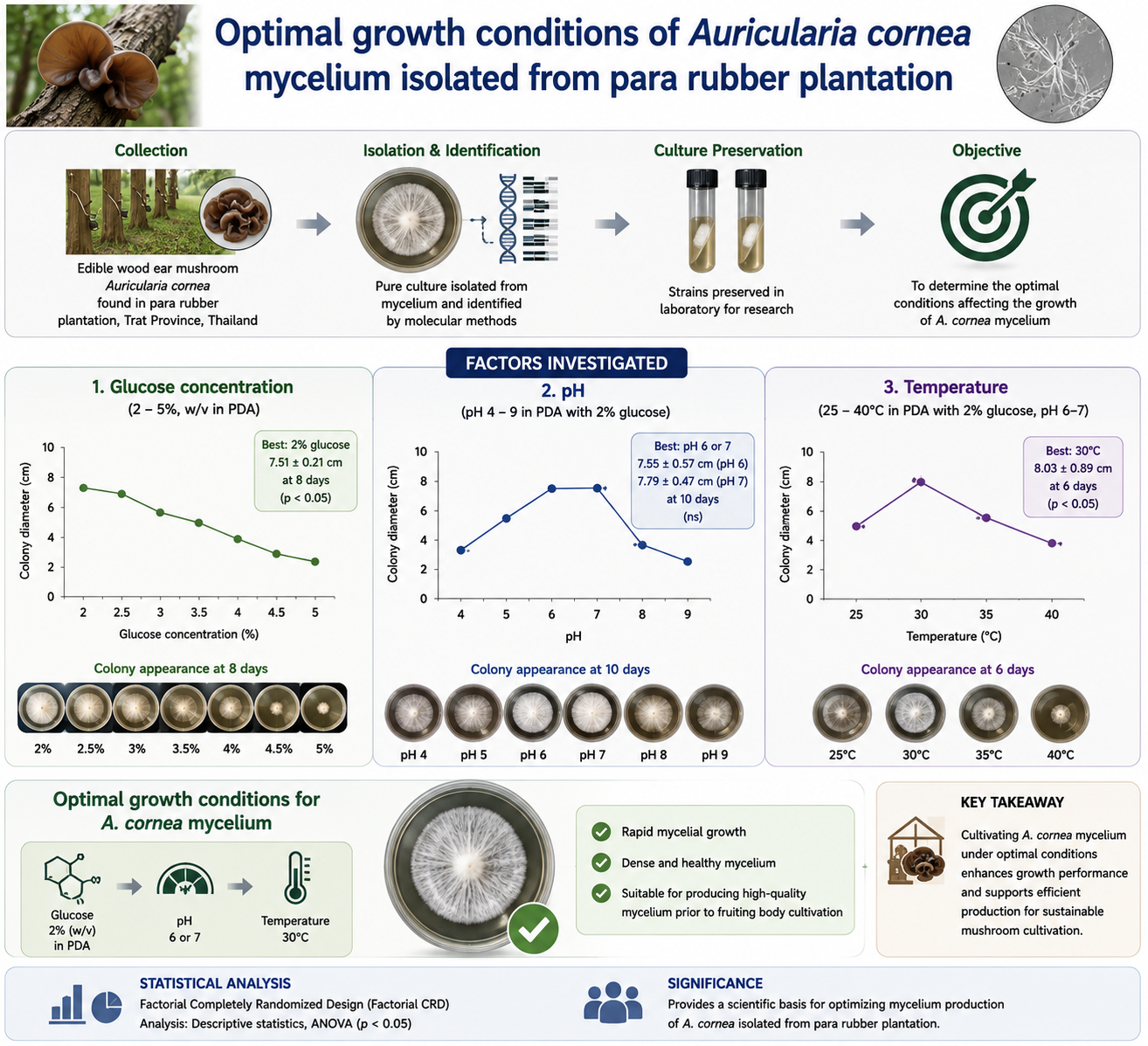
A survey of para rubber plantations belonging to farmers in Wang Takien Subdistrict, Khao Saming District, Trat Province, Thailand, revealed the presence of edible wood ear mushrooms (Auricularia cornea). Pure cultures were subsequently isolated from the mycelium of this mushroom and identified using molecular identification. The strains were then preserved in the laboratory for further research. The objective of this research was to determine the factors affecting the growth of the mycelium of A. cornea isolated from para rubber plantation. The factors, glucose concentration (2, 2.5, 3, 3.5, 4, 4.5, and 5%), pH (4, 5, 6, 7, 8, and 9), and temperature (25, 30, 35, and 40ºC) had been investigated on mycelium growth. The factorial completely randomized design (Factorial CRD) was used to design all the experiments. It was found that this strain grew the greatest on Potato Dextrose Agar (PDA) containing 2% glucose, which had the significantly highest colony diameter (7.51±0.21 cm at 8 days, p-value<0.05). At pH 6 and 7, the mycelium grew similarly well and condensed mycelium that revealed colonies diameter of 7.55±0.57 and 7.79±0.47 cm at 10 days, respectively (not significantly different). Finally, the mycelium was able to grow the best at 30ºC with the significantly highest colony diameter (8.03±0.89 cm at 6 days, p-value<0.05). The findings of this study revealed that the optimal conditions for A. cornea mycelium cultivation are growth on PDA containing 2% glucose, at pH 6 or 7, and incubation at 30ºC. Under these optimal conditions, the mycelium of this strain grew rapidly and exhibited dense growth. Therefore, it is suitable for application in cultivating high-quality mycelium before fruiting body cultivation.
Downloads
เอกสารอ้างอิง
Bandara, A., Rapior, S., Mortimer, P., Kakumyan, P., Kd, H., & Xu, J. (2019). A review of the polysaccharide, protein and selected nutrient content of Auricularia, and their potential pharmacological value. Mycosphere, 10(1), 579–607. https://doi.org/10.5943/mycosphere/10/1/10
Bandara, A. R., Karunarathna, S. C., Phillips, A. J. L., Mortimer, P. E., Xu, J. C., Kakumyan, P., & Hyde, K. D. (2017). Diversity of Auricularia (Auriculariaceae, Auriculariales) in Thailand. Phytotaxa, 292(1), 19-34. https://doi.org/10.11646/phytotaxa.292.1.2
Drewinski, M. P., Zied, D. C., Gomes, E. P. C., & Menolli, N., Jr. (2024). Cultivation of a wild strain of wood ear Auricularia cornea from Brazil. Current Microbiology, 81, 390. https://doi.org/10.1007/s00284-024-03920-5
Hoa, H. T., & Wang, C. L. (2015). The effects of temperature and nutritional conditions on mycelium growth of two oyster mushrooms (Pleurotus ostreatus and Pleurotus cystidiosus). Mycobiology, 43(1), 14-23. https://doi.org/10.5941/myco.2015.43.1.14
Lan, G., Wu, Z., Yang, C., Sun, R., Chen, B., & Zhang, X. (2020). Tropical rainforest conversion into rubber plantations results in changes in soil fungal composition, but underling mechanisms of community assembly remain unchanged. Geoderma, 375, 114505. https://doi.org/10.1016/j.geoderma.2020.114505
Li, H., Guo, J., Karunarathna, S. C., Ye, L., Xu, J., Hyde, K. D., & Mortimer, P. E. (2018). Native forests have a higher diversity of macrofungi than comparable plantation forests in the Greater Mekong Subregion. Forests, 9(7), 1-14. https://doi.org/10.3390/f9070402
Liu, M., Jiang, W., Huang, K., Li, L., Meng, Q., You, X., Pu, K., Cheng, M., Gao, Z., Qi, J., & Li, M.
(2025). Sustainable cultivation and functional bioactive compounds of Auricularia
Mushrooms: Advances, challenges, and future prospects. Biology, 14(11), 1555. https://www.mdpi.com/2079-7737/14/11/1555
Monkai, J., Hyde, K. D., Xu, J., & Mortimer, P. E. (2017). Diversity and ecology of soil fungal communities in rubber plantations. Fungal biology reviews, 31(1), 1-11. https://doi.org/10.1016/j.fbr.2016.08.003
Osemwegie, O., & Okhuoya, J. (2011). Diversity and abundance of macrofungi in rubber agroforests in southwestern Nigeria. Nordic Journal of Botany, 29(1), 119-128. https://doi.org/10.1111/j.1756-1051.2010.00717.x
Osemwegie, O., Okhuoya, J., Oghenekaro, A., & Evueh, G. (2010). Macrofungi community in rubber plantations and a forest of Edo State, Nigeria. Journal of Applied Sciences, 10(5), 391-398. https://doi.org/10.3923/jas.2010.391.398
Regis, J., Geösel, A., & Geösel, R. M. (2024). Cultivation of Auricularia species: a review of the history, health benefits, principles, practices, environmental conditions, research methods, and recent trends. Sydowia, 76, 21-33. https://doi.org/10.12905/0380.sydowia76-2024-0021
Surawut, S., Kunsook, C., Nak-eiam, S., Khamchatra, N.-m., Bhudharak, S., Phontharod, W., Boonmee, O., Yasawong, M., & Kanjanavas, P. (2023). Biodiversity and functional distribution of macrofungi from Plant Genetic Conservation Area, Chanthaburi province, Thailand. Current Applied Science and Technology, 23(5), 1-19. https://doi.org/10.55003/cast.2023.05.23.003
Thongklang, N., Keokanngeun, L., Taliam, W., Hyde, K.D. (2020). Cultivation of a wild strain of
Auricularia cornea from Thailand. Current Research in Environmental & Applied Mycology, 10(1),120-130. https://doi.org/10.5943/cream/10/1/13
Walker, A., Wannasawang, N., Taliam, W., Keokanngeun, L., Luangharn, T., & Thongklang, N. (2023). Optimal conditions for mycelial growth and nutritional values of the Auricularia cornea. Studies in Fungi, 8(19), 1-10. https://www.maxapress.com/article/doi/10.48130/SIF-2023-0019
Wanich, U., Kunsook, C., Kanjanavas, P., Thanyaponl, P., Boonmee, O., Apinansawat, N., Panisan, T., & Surawut, S. (2024). Edible macrofungi in Plant Genetic Conservation Area, Chanthaburi province: Auricularia cornea strain RSPG5 fruiting body formation and nutritional value. Science & Technology Asia, 29(4), 247-256. https://ph02.tci-thaijo.org/index.php/SciTechAsia/article/view/252797
Zhang Bo, Z. B., Miao RenYun, M. R., Zhou Jie, Z. J., Huang ZhongQian, H. Z., Li XiaoLin, L. X., & Tan Wei, T. W. (2017). Effects of cultivating substrates with different nitrogen sources on agronomic traits, quality and production efficiency of Auricularia cornea. Journal of Southern Agriculture, 48(12), 2210-2217. http://nfnyxb.xml-journal.net/en/article/doi/10.3969/j.issn.2095-1191.2017.12.15
Zhang, J., Li, X., & Yin, Y. (2018). A method for measuring the degree of fermentation of the edible mushroom cultivation substrate. Natural Resources, 9(11), 355-360. https://doi.org/10.4236/nr.2018.911022
ดาวน์โหลด
ไฟล์ประกอบ
เผยแพร่แล้ว
รูปแบบการอ้างอิง
ฉบับ
ประเภทบทความ
สัญญาอนุญาต
ลิขสิทธิ์ (c) 2026 วารสารวิทยาศาสตร์และเทคโนโลยีสู่ชุมชน

อนุญาตภายใต้เงื่อนไข Creative Commons Attribution-NonCommercial-NoDerivatives 4.0 International License.
1. บทความ ข้อมูล เนื้อหา รูปภาพฯลฯ ที่ได้รับการตีพิมพ์ใน “วารสารวิทยาศาสตร์และเทคโนโลยีสู่ชุมชน” ถือเป็นลิขสิทธิ์ของวารสารวิทยาศาสตร์และเทคโนโลยีสู่ชุมชน มหาวิทยาลัยราชภัฏเชียงใหม่ หากบุคคลหรือหน่วยงานใดต้องการนำทั้งหมดหรือส่วนหนึ่งส่วนใดไปเผยแพร่ต่อหรือกระทำการใดๆ จะต้องได้รับอนุญาตเป็นลายลักษณ์อักษรจาก วารสารวิทยาศาสตร์และเทคโนโลยีสู่ชุมชน มหาวิทยาลัยราชภัฏเชียงใหม่
2. เนื้อหาบทความที่ปรากฏในวารสารเป็นความรับผิดชอบของผู้เขียนบทความโดยตรง ซึ่งกองบรรณาธิการวารสารไม่จำเป็นต้องเห็นด้วยหรือร่วมรับผิดชอบใดๆ