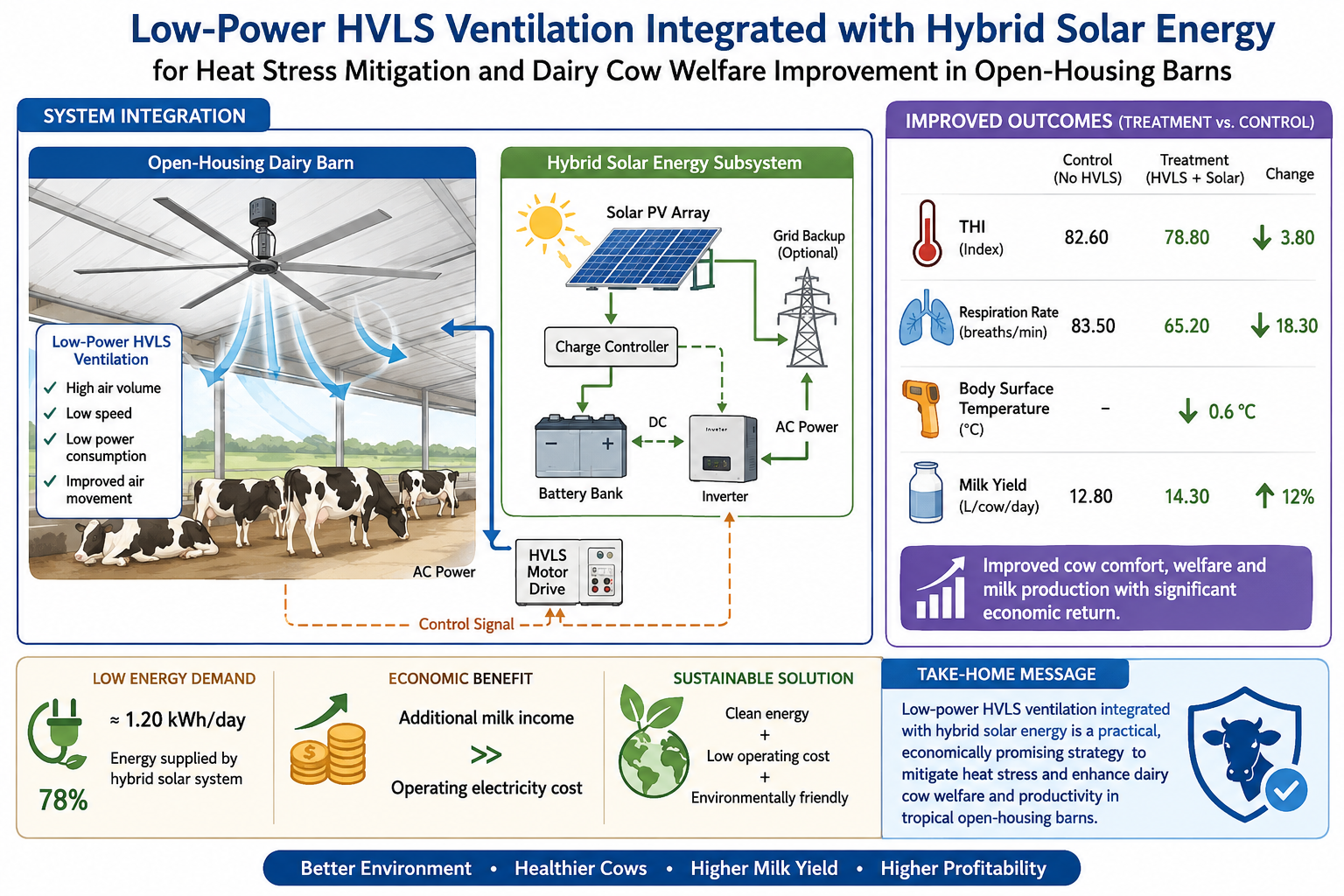
Low-Power Hvls Ventilation Integrated with Hybrid Solar Energy for Heat Stress Mitigation and Dairy Cow Welfare Improvement in Open-Housing Barns
DOI:
https://doi.org/10.57260/stc.2026.1636คำสำคัญ:
Heat stress mitigation, Dairy farm management, HVLS ventilation system, Hybrid solar energy, Open-housing dairy systemบทคัดย่อ
Heat stress is a major constraint on dairy production in tropical regions, particularly in open-housing barns with limited environmental control. This study evaluated a low-power high-volume low-speed (HVLS) ventilation system integrated with a hybrid solar energy supply using a matched-season controlled before-and-after quasi-experimental field design. Baseline data were collected from May to August 2023, and post-installation data were collected from May to August 2024. The study was conducted in an open-housing dairy farm with 104 Holstein Friesian crossbred dairy cows. Among these animals, 48 lactating cows were included in the primary evaluation and allocated by barn-zone exposure into a control group (n = 19) located in the non-HVLS zone and a treatment group (n = 29) located under the HVLS airflow coverage area. Barn temperature and relative humidity were measured using custom-built DHT11-based sensor nodes. Respiration rate was determined by counting flank movements for one minute (60 s) before afternoon milking during the hot period, and infrared body surface temperature was measured at the lateral body region using a non-contact infrared thermometer (3CMEDICAL FI-01). In the treatment group, THI decreased from 82.60 to 78.80, average respiration rate decreased from 83.50 to 65.20 breaths/min, and infrared body surface temperature decreased by approximately 0.6 °C. Average daily milk yield increased from 12.80 to 14.30 L/cow/day, representing an approximate 12% improvement in the treatment group, whereas the control group showed no clear change. The system consumed approximately 1.20 kWh/day, with 78% of the energy supplied by the hybrid solar subsystem. Economic estimation using cooperative milk-price records and the electricity tariff during the monitoring period indicated that the additional milk income greatly exceeded the operating electricity cost. These findings suggest that low-power HVLS ventilation integrated with hybrid solar energy is a practical and economically promising approach for improving dairy cow welfare and milk production in tropical open-housing barns.
Downloads
เอกสารอ้างอิง
Armstrong, D. V. (1994). Heat stress interaction with shade and cooling. Journal of Dairy Science, 77(7), 2044–2050. https://doi.org/10.3168/jds.S0022-0302(94)77149-6
Bernabucci, U., Lacetera, N., Baumgard, L. H., Rhoads, R. P., Ronchi, B., & Nardone, A. (2010). Metabolic and hormonal acclimation to heat stress in domesticated ruminants. Animal, 4(7), 1167–1183. https://doi.org/10.1017/S175173111000090X
Bohmanova, J., Misztal, I., & Cole, J. B. (2007). Temperature-humidity indices as indicators of milk production losses due to heat stress. Journal of Dairy Science, 90(4), 1947–1956. https://doi.org/10.3168/jds.2006-513
Bucklin, R. A., Turner, L. W., Beede, D. K., Bray, D. R., & Hemken, R. W. (1991). Methods to relieve heat stress for dairy cows in hot, humid climates. Applied Engineering in Agriculture, 7(2), 241–247. https://doi.org/10.13031/2013.26218
Chantalakhana, C., & Falvey, L. (Eds.). (1999). Smallholder dairying in the tropics. International Livestock Research Institute. https://cgspace.cgiar.org/items/52b16602-5779-4264-bed0-99cfb9792b72
Collier, R. J., Dahl, G. E., & VanBaale, M. J. (2006). Major advances associated with environmental effects on dairy cattle. Journal of Dairy Science, 89(4), 1244–1253. https://doi.org/10.3168/jds.S0022-0302(06)72193-2
Collier, R. J., & Gebremedhin, K. G. (2015). Thermal biology of domestic animals. Annual Review of Animal Biosciences, 3, 513–532. https://doi.org/10.1146/annurev-animal-022114-110659
European Food Safety Authority (EFSA). (2009). Scientific report on the effects of farming systems on dairy cow welfare and disease. EFSA Journal, 7(7), 1143r. https://doi.org/10.2903/j.efsa.2009.1143r
Food and Agriculture Organization of the United Nations (FAO). (2009). Asia smallholder dairy development strategy and investment plan. FAO Regional Office for Asia and the Pacific. https://www.fao.org/4/ai429e/ai429e00.htm
Gebremedhin, K. G., & Wu, B. X. (2003). Characterization of flow field in a ventilated space and simulation of heat exchange between cows and their environment. Journal of Thermal Biology, 28(4), 301–319. https://doi.org/10.1016/S0306-4565(03)00007-X
Hahn, G. L. (1999). Dynamic responses of cattle to thermal heat loads. Journal of Animal Science, 77(2), 10–20. https://doi.org/10.2527/1997.77suppl_210x
Herrero, M., Wirsenius, S., Henderson, B., Rigolot, C., Thornton, P., Havlík, P., de Boer, I., & Gerber, P. J. (2015). Livestock and the environment: What have we learned in the past decade?. Annual Review of Environment and Resources, 40, 177–202. https://doi.org/10.1146/annurev-environ-031113-093503
IRENA & FAO. (2021). Renewable energy for agri-food systems: Towards the Sustainable Development Goals and the Paris Agreement. International Renewable Energy Agency and Food and Agriculture Organization of the United Nations. https://doi.org/10.4060/cb7433en
Ji, B., Banhazi, T. M., Perano, K. M., Ghahramani, A., Bowtell, L., Wang, C., & Li, B. (2020). A review of measuring, assessing and mitigating heat stress in dairy cattle. Biosystems Engineering, 199, 4–26. https://doi.org/10.1016/j.biosystemseng.2020.07.009
Kadzere, C. T., Murphy, M. R., Silanikove, N., & Maltz, E. (2002). Heat stress in lactating dairy cows: A review. Livestock Production Science, 77(1), 59–91. https://doi.org/10.1016/S0301-6226(01)00330-X
Khongdee, S., Chaiyabutr, N., Hinch, G. N., Markvichitr, K., & Vajrabukka, C. (2006). Effects of evaporative cooling on reproductive performance and milk production of dairy cows in hot wet conditions. International Journal of Biometeorology, 50(5), 253–257. https://doi.org/10.1007/s00484-006-0030-2
Lacetera, N. (2019). Impact of climate change on animal health and welfare. Animal Frontiers, 9(1), 26–31. https://doi.org/10.1093/af/vfy030
Mader, T. L., Davis, M. S., & Brown-Brandl, T. (2006). Environmental factors influencing heat stress in feedlot cattle. Journal of Animal Science, 84(3), 712–719. https://doi.org/10.2527/2006.843712x
Mekhilef, S., Saidur, R., & Safari, A. (2011). A review on solar energy use in industries. Renewable and Sustainable Energy Reviews, 15(4), 1777–1790. https://doi.org/10.1016/j.rser.2010.12.018
Mondaca, M. R. (2019). Ventilation systems for adult dairy cattle. Veterinary Clinics of North America: Food Animal Practice, 35(1), 139–156. https://doi.org/10.1016/j.cvfa.2018.10.006
Provincial Electricity Authority (PEA). (2023). Electricity tariffs (May 2023 onward). Provincial Electricity Authority. https://www.pea.co.th/sites/default/files/documents/tariff/EN_Electricity_Tariffs_May_2023.pdf
Provincial Electricity Authority (PEA). (2024). Ft May 2024–August 2024. Provincial Electricity Authority. https://www.pea.co.th/en/our-services/tariff/ft/view/9afb5214-09c3-4af1-9ed7-7aafd6092b74
Rehman, S., Alam, M. M., Meyer, J. P., & Al-Hadhrami, L. M. (2012). Feasibility study of a wind-PV-diesel hybrid power system for a village. Renewable Energy, 38(1), 258–268. https://doi.org/10.1016/j.renene.2011.06.028
Rhoads, M. L., Rhoads, R. P., VanBaale, M. J., Collier, R. J., Sanders, S. R., Weber, W. J., Crooker, B. A., & Baumgard, L. H. (2009). Effects of heat stress and plane of nutrition on lactating Holstein cows: I. Production, metabolism, and aspects of circulating somatotropin. Journal of Dairy Science, 92(5), 1986–1997. https://doi.org/10.3168/jds.2008-1641
St-Pierre, N. R., Cobanov, B., & Schnitkey, G. (2003). Economic losses from heat stress by U.S. livestock industries. Journal of Dairy Science, 86, E52–E77. https://doi.org/10.3168/jds.S0022-0302(03)74040-5
Thornton, P. K., van de Steeg, J., Notenbaert, A., & Herrero, M. (2009). The impacts of climate change on livestock and livestock systems in developing countries: A review of what we know and what we need to know. Agricultural Systems, 101(3), 113–127. https://doi.org/10.1016/j.agsy.2009.05.002
West, J. W. (2003). Effects of heat-stress on production in dairy cattle. Journal of Dairy Science, 86(6), 2131–2144. https://doi.org/10.3168/jds.S0022-0302(03)73803-X
ดาวน์โหลด
ไฟล์ประกอบ
เผยแพร่แล้ว
รูปแบบการอ้างอิง
ฉบับ
ประเภทบทความ
สัญญาอนุญาต
ลิขสิทธิ์ (c) 2026 วารสารวิทยาศาสตร์และเทคโนโลยีสู่ชุมชน

อนุญาตภายใต้เงื่อนไข Creative Commons Attribution-NonCommercial-NoDerivatives 4.0 International License.
1. บทความ ข้อมูล เนื้อหา รูปภาพฯลฯ ที่ได้รับการตีพิมพ์ใน “วารสารวิทยาศาสตร์และเทคโนโลยีสู่ชุมชน” ถือเป็นลิขสิทธิ์ของวารสารวิทยาศาสตร์และเทคโนโลยีสู่ชุมชน มหาวิทยาลัยราชภัฏเชียงใหม่ หากบุคคลหรือหน่วยงานใดต้องการนำทั้งหมดหรือส่วนหนึ่งส่วนใดไปเผยแพร่ต่อหรือกระทำการใดๆ จะต้องได้รับอนุญาตเป็นลายลักษณ์อักษรจาก วารสารวิทยาศาสตร์และเทคโนโลยีสู่ชุมชน มหาวิทยาลัยราชภัฏเชียงใหม่
2. เนื้อหาบทความที่ปรากฏในวารสารเป็นความรับผิดชอบของผู้เขียนบทความโดยตรง ซึ่งกองบรรณาธิการวารสารไม่จำเป็นต้องเห็นด้วยหรือร่วมรับผิดชอบใดๆ