
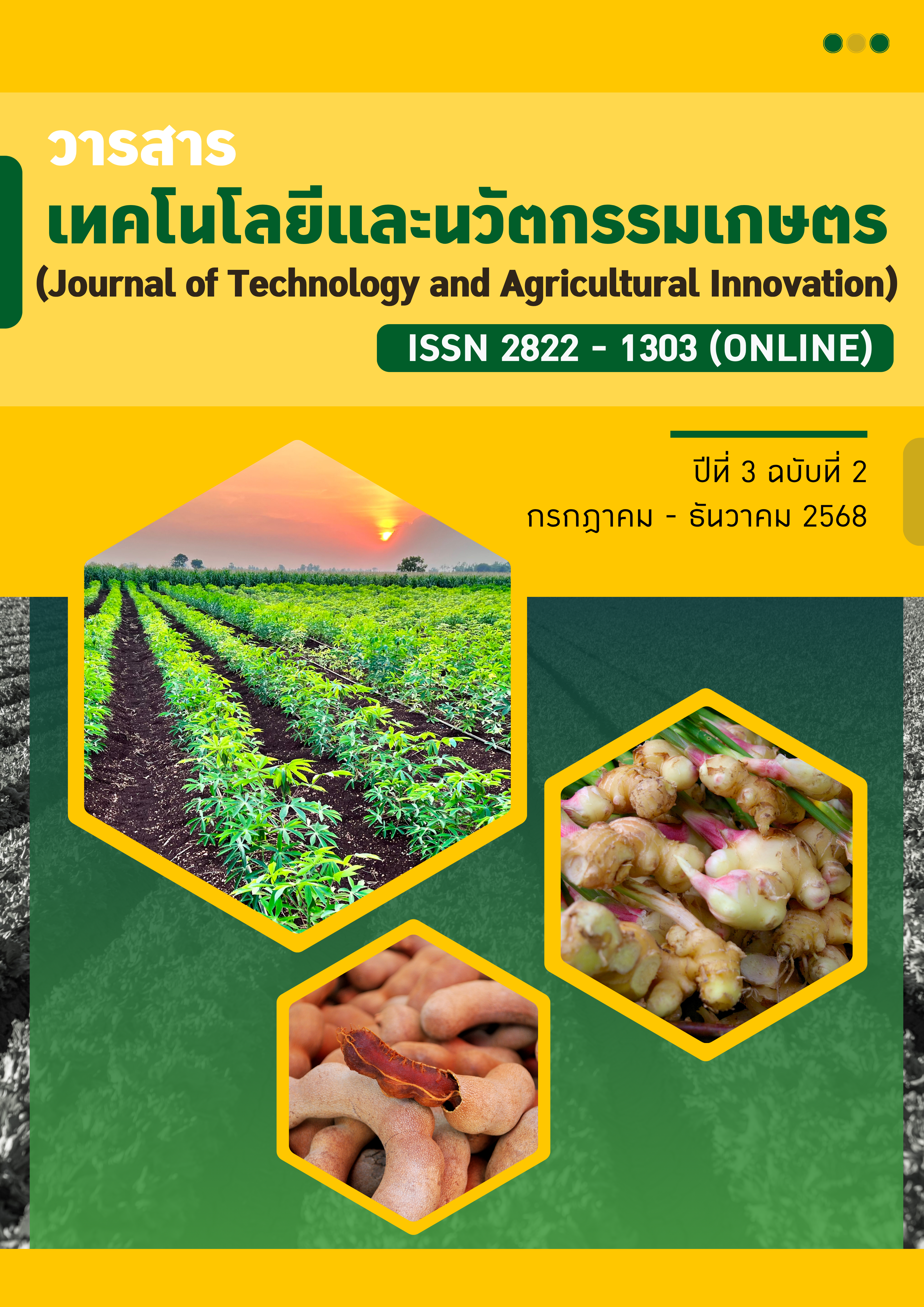
Calcium Chloride Foliar Application Increases Production Efficiency and Maintains the Postharvest Quality of Sweet Tamarind
DOI:
https://doi.org/10.55164/jtai.v3i2.1208Keywords:
Sweet tamarind, Calcium chloride (CaCl2), Fungi, Postharvest qualityAbstract
Fungal infection is one of the serious problems found in the pod of sweet tamarind which degrades their quality and shelf life.Therefore, this study is aimed to investigate the optimal calcium chloride foliar application reducing fungal infection before and after harvest in the pods of sweet tamarind cv. Si Thong. It was found that sweet tamarind treated with 0.5% calcium chloride three times before harvesting three months had the highest total yield per plant 26.89 kg per plant, pod weight 39.56 g and pod length 18.16 cm. In addition, sweet tamarind treated with calcium chloride had higher firmness and peel calcium content than other treatments. However, the quality of sweet tamarind such as soluble solids, titratable acidity and vitamin C were not statistically different among treatments. After storage at room temperature 30 ± 2°C for three months, sweet tamarind treated 0.5% calcium chloride three times before harvesting three months had the lowest fungal count of 1.0×10² CFU/g. In terms of economic returns, sweet tamarind treated with 0.5% calcium chloride three times before harvesting three months had the highest income of 43,024 baht per rai and profit increased by 26.22% when compared with the other treatment. Therefore, foliar application of 0.5% calcium chloride three times before harvesting three months was highly effective in increasing yield and reducing quality loss of sweet tamarind.
References
กรมส่งเสริมการเกษตร. (2559,พฤศจิกายน). ข่าวเตือนการระบาดศัตรูพืชประจำสัปดาห์ ประจำวันที่ 23 พฤศจิกายน 2559. กองส่งเสริมการอารักขาพืชและจัดการดินปุ๋ย กรมส่งเสริมการเกษตร. http://www.ppsf.doae.go.th/forecast/2560/noverbem/73_pod_rot.pdf.
จินตนา สนามชัยกุล และ เบญจพร ศรีสุวรมาศ. (2555). รายงานวิจัยฉบับสมบูรณ์การจัดการเชื้อราแบบผสมผสานในสวนมะขามหวานของเกษตรกรเครือข่ายวิสาหกิจชุมชนมะขามหวาน จังหวัดเพชรบูรณ์. เพชรบูรณ์. ศูนย์ข้อมูลการวิจัย วช.
เฉลิมชัย วงษ์อารี. (2561). การใช้แคลเซียมเพื่อรักษาผลคุณภาพของผลไม้ที่ดีหลังการเก็บเกี่ยว. Postharvest Newsletter. 17(4), 5-7.
มหาวิทยาลัยราชภัฏเพชรบูรณ์. (2557). มะขามหวานจังหวัดเพชรบูรณ์. เพชบูรณ์. คณะเทคโนโลยีการเกษตร มหาวิทยาลัยราชภัฏเพชรบูรณ์.
สายน้ำผึ้ง เหลาพะวัง, เจนจิรา ชุมภูคำ, อิษยา นะมิกิ, วีระ ศรีเมฆตรง และกฤษณา กฤษณพุกต์. (2562). ผลของแคลเซียมโบรอนและจิบเบอเรลลิคแอซิดต่อการพัฒนาคุณภาพผลผลิตพลับพันธุ์ฟูยู. Thai Journal of Science and Technology. 8(1), 10–19.
สำนักงานเกษตรจังหวัดเพชรบูรณ์. (2567, มกราคม). ข้อมูลผลผลิตมะขามหวานปี 2566. https://www.dailynews.co.th/news/3122599/.
สุมิตรา ภู่วโรดม และนุจรี บุญแปลง. (2557). แคลเซียม: ธาตุอาหารสำคัญในการผลิตผลไม้คุณภาพ. ดินและปุ๋ย. 36(1-4), 13–26.
AOAC. (1990). Methods of Analysis. 14th ed. Washington, DC: Association of Official Analytical Chemists. Arlington, VA.
Bender, R. J. (1998). Elevated CO2 in controlled atmosphere storage and regulation of mango ripening. Annual Review of Phytopathology. 7, 97–112.
Fallahi, E., Fallahi, B., Neilsen, G. H., Neilsen, D., and Peryea, F. J. (2010). Effects of mineral nutrition on fruit quality and nutritional disorders in apples. Acta Horticulturae, 868, 49–59.
Irfan, I., Khan, M. N., Ibrahim, M., Dawood, B. S., and Shah, S. Q. (2020). Effect of foliar application of calcium chloride on yield and quality of apple varieties. Pure and Applied Biology (PAB), 9(2), 1294–1303.
Kaiser, S. A. K. M., Dhua, R. S., and Banik, A. K. (2001). Effect of pre- and postharvest treatment with calcium compounds on the incidence of postharvest fruit rots of mango. Mycopathological Research. 39(2), 91–94.
Madani, B., Mirshekari, A., Sofo, A., and Tengku Muda Mohamed, M. (2016). Preharvest calcium applications improve postharvest quality of papaya fruits (Carica papaya L. cv. Eksotika II). Plant Nutrition. 39(10), 1483-1492.
Manganaris, G. A., Vasilakakis, M., Mignani, I., Diamantidis, G., and Tzavella-Klonari, K. (2005). The effect of preharvest calcium sprays on quality attributes, physicochemical aspects of cell wall components, and susceptibility to brown rot of peach fruits (Prunus persica L. cv.Andross). Scientia Horticulturae. 107(1), 43–50.
Poovaiah, B. W., and Reddy, A. S. N. (1993). Calcium and signal transduction in plants. Critical Reviews in Plant Sciences. 12(3), 185–211.
White, P. J., and Broadley, M. R. (2003). Calcium in plants. Annals of Botany. 92(4), 487–511.
Downloads
Published
How to Cite
Issue
Section
License
Copyright (c) 2025 Thaksin University

This work is licensed under a Creative Commons Attribution-NonCommercial-NoDerivatives 4.0 International License.


