Development of a Community Information System for Managing Recycling waste Banks through the Integration of SDLC with Social Engineering Process
DOI:
https://doi.org/10.57260/stc.2026.1263Keywords:
Community informatics, Social engineering process, Software development life cycle (SDLC), Recycling waste bankAbstract
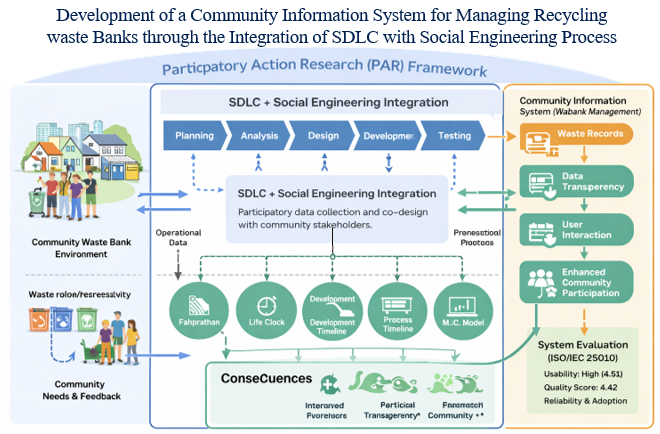
This research presents an analysis of operational patterns, the design, and the development of a community-based information system for managing recycling waste banks, which integrates the Software Development Life Cycle (SDLC) with social engineering within a Participatory Action Research (PAR) framework. The study was conducted in the context of Sam Ngam Pattana Subdistrict Municipality, Hankha District, Chai Nat Province. The research followed six SDLC phases combined with five social engineering tools—Fahprathan, Life Clock, Development Timeline, Process Timeline, and the M.I.C. Model—to collect in-depth contextual data and design an information system aligned with community needs. The outcome was a Community Information System that reduced paperwork, enhanced data transparency, and encouraged active community participation in waste bank management. The system was evaluated by experts using the ISO/IEC 25010 quality framework, achieving a high mean score of 4.42. The end-user satisfaction score was also high, at 4.51. These results confirm the system's usability, reliability, and potential for sustainable community adoption.
Downloads
References
กฤษณะ คำดีตัน และ จักรกฤษณ์ โปณะทอง. (2566). แนวทางการพัฒนาทักษะวิศวกรสังคมของนักศึกษามหาวิทยาลัยราชภัฏกลุ่มภาคเหนือ.วารสาร มจร อุบลปริทรรศน์, 9(3), 353-366. https://so06.tci-thaijo.org/index.php/mcjou/article/view/274900
เกสสิณี ตรีพงศ์พันธุ์. (2564). การบูรณาการวิศวกรสังคมสำหรับการท่องเที่ยววิถีชีวิตในชนบทของไทยสู่ความยั่งยืน. วารสารบริหารธุรกิจและสังคมศาสตร์ มหาวิทยาลัยรามคำแหง, 4(3), 16-32. https://so02.tci-thaijo.org/index.php/ibas/article/view/250105
จิตราภรณ์ ธาราพิทักษ์วงศ์. (2566). การพัฒนารูปแบบสารสนเทศที่เหมาะสมเพื่อเพิ่มศักยภาพการท่องเที่ยว อย่างยั่งยือำเภอแม่วาง จังหวัดเชียงใหม่ โดยการมีส่วนร่วมของชุมชน. วารสารวิทยาศาสตร์และเทคโนโลยี มหาวิทยาลัยราชภัฏบุรีรัมย์ (ออนไลน์), 7(1), 1-18. https://ph02.tci-thaijo.org/index.php/scibru/article/view/247839
พัชราภรณ์ หงษ์สิบสอง. (2564). การพัฒนาเว็บแอปพลิเคชันเพื่อการจัดการข้อมูลธนาคารขยะโดยการมี ส่วนร่วมของชุมชนมหาโพธิ์ อำเภอเมือง จังหวัดน่าน. วารสารวิชาการการจัดการเทคโนโลยี มหาวิทยาลัยราชภัฏมหาสารคาม, 8(1), 73-86. https://ph02.tci-thaijo.org/index.php/itm-journal/article/view/243976
พรรณเพ็ญ สิทธิพัฒนา และ เรวดี ศักดิ์ดุลยธรรม. (2566). การพัฒนาระบบสารสนเทศทางการบัญชีของ ธนาคารแยกขยะประกันชีวิตชุมชนคุณธรรมวัดโคนอนมหาสวัสดิ์ จังหวัดนนทบุรี. วารสารวิชาการสังคมศาสตร์ เครือข่ายวิจัยประชาชื่น, 5(3), 42-65. https://so03.tci-thaijo.org/index.php/prn/article/view/272461
นิเวศ เผื่อนทิม, ภัทราพร โชคไพบูลย์ และ สุธีนี วงศ์วัฒนานุกุล. (2567). การเพิ่มศักยภาพวิศวกรสังคมสู่การพัฒนาท้องถิ่นอย่างยั่งยืน. Lawarath Social E-Journal, 6(1), 181-200. https://so04.tci-thaijo.org/index.php/lawarathjo/article/view/270690
รัตนา ชินบุตรานนท์. (2568). การเสริมพลังการบริหารชุมชนยุคใหม่ด้วยปัญญาประดิษฐ์: ทางสู่ความยั่งยืน. วารสารสหวิทยาการนวัตกรรมปริทรรศน์, 8(2), 256-268. https://so04.tci-thaijo.org/index.php/jidir/article/view/278550
รัตนา ทิมเมือง, และ สรวล สรรค์พจนอารี. (2562). การสื่อสารแบบมีส่วนร่วมเพื่อจัดการขยะชุมชนกรณี ศึกษา ตำบลศีรษะจรเข้น้อย อำเภอบางเสาธง จังหวัดสมุทรปราการ. มหาวิทยาลัยหัวเฉียวเฉลิมพระเกียรติ.
ศิริรัตน์ เช็งเส็ง, สุทัศน์ กำมณี และ กรัณย์ พลวิวรรธมงคล. (2567). แนวทางการสร้างทักษะซอฟต์สกิล ด้วยกระบวนการวิศวกรสังคมสำหรับนักศึกษามหาวิทยาลัยราชภัฏกาญจนบุรี. วารสารมจรกาญจนปริทรรศน์, 4(2), 236-246. https://so05.tci-thaijo.org/index.php/Kanchana-editor/article/view/273722
เอกราช ดีนาง, คณิศรา ธัญสุนรสกุล และ ฐิรพร ไพศาล. (2566). การพัฒนาตัวบ่งชี้ทักษะวิศวกร สังคมของนักศึกษา มหาวิทยาลัยราชภัฏอุดรธานี. วารสารสหวิทยาการวิจัยและวิชาการ, 3(4), 371-388. https://so03.tci-thaijo.org/index.php/IARJ/article/view/268961
Conceição, P. (2020). Human development report 2020-the next frontier: Human development and the anthropocene. United Nations Development Programme: Human Development Report.
Estdale, J., & Georgiadou, E. (2018). Applying the ISO/IEC 25010 quality models to software product. In European Conference on Software Process Improvement, (pp. 492-503). Cham: Springer International Publishing.
Kumar, M., & Rashid, E. (2018). An efficient software development life cycle model for developing software project. International Journal of Education and Management Engineering, 8(6), 59-68. https://doi.org/10.5815/ijeme.2018.06.06
Preece, J., Rogers, Y., Sharp, H., Benyon, D., Holland, S., & Carey, T. (1994). Human-computer interaction. Addison-Wesley Longman Ltd.
Ramaano, A. I. (2023). Geographical information systems in sustainable rural tourism and local community empowerment: A natural resources management appraisal for Musina Municipality’Society. Local Development & Society, 4(1), 74-105. https://doi.org/10.1080/26883597.2021.2011610
Sommerville, I. (2016). YAZILIM MÜHENDİSLİĞİ-Software Engineering. Nobel Akademik Yayıncılık.
Downloads
Published
How to Cite
Issue
Section
License
Copyright (c) 2026 Science and Technology to Community

This work is licensed under a Creative Commons Attribution-NonCommercial-NoDerivatives 4.0 International License.
1. Articles, information, content, images, etc. that are published in "Science and Technology for Community Journal" is the copyright of science and Technology for Community Journal. Chiang Mai Rajabhat University. If any person or organization wants to distribute all or any part of it or do any action Must have written permission from the science and Technology for Community Journal, Chiang Mai Rajabhat University.
2. Content of articles appearing in the journal is the responsibility of the author of the article. The journal editor is not required to agree or take any responsibility.