
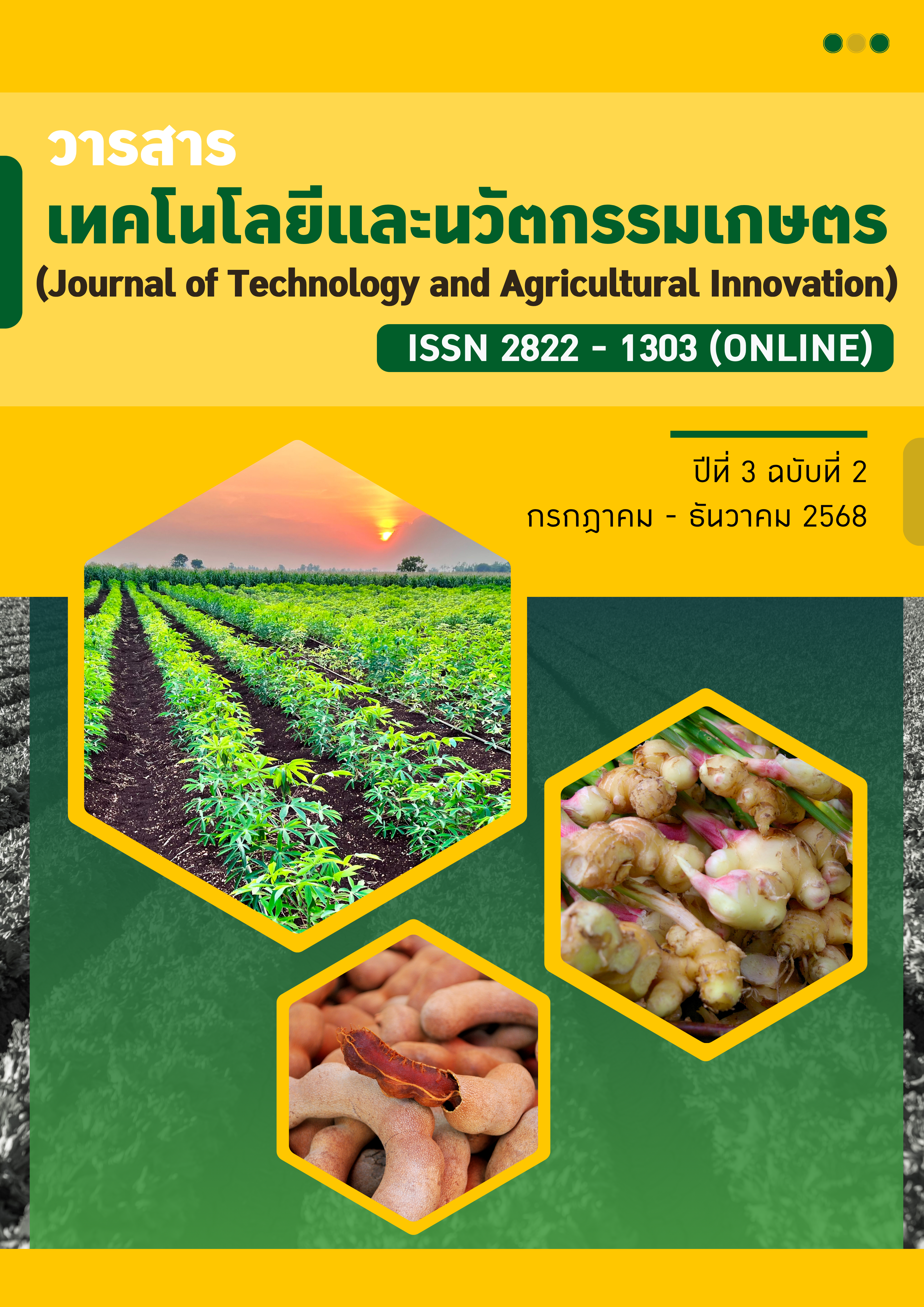
Evaluation of Yield and Profit of Cassava Production under Precision Water and Fertilizer Management System
DOI:
https://doi.org/10.55164/jtai.v3i2.1264Keywords:
Precision agriculture, Drip fertigation, Cost-benefit analysis, Smallholder farmerAbstract
The research evaluated the yield, quality, and economic profitability of cassava when precision water and fertilizer management were compared with farming practices. The experiment was conducted in Nakhon Ratchasima Province in 10 farmer fields, which spanned 5–10 rai with different soil textures (clay loam, clay, and sandy loam soils). Cassava cultivar ‘Rayong 72’ was planted across all fields, with drip irrigation providing a water supply. Two water and fertilizer management practices were compared (T1: The precision management, T2: Farmer practice). These systems were compared in terms of their effects on cassava growth, yield, starch content, and production profitability. The results revealed that precision management produced 6.91 tons/rai of cassava with 24.74% starch content, which exceeded the farmer practice output of 5.02 tons/rai with 23.17% starch. The tuber yield from precision management increased by 40.37% and starch content rose by 7.07% compared to farmer practice. The production costs between these systems did not show any significant statistical difference (T1 = 11,211 THB/rai; T2 = 12,198 THB /rai). The income generated by precision management reached 15,915 THB/rai, whereas farmer practice produced 10,848 THB/rai. The precision management produced a net profit of 4,704 THB/rai, but farmer practice resulted in a net loss of 1,350 THB/rai. The research demonstrates that precision water and fertilizer management lead to improved cassava yield and quality, as well as enhanced economic performance.
References
สำนักงานนโยบายและยุทธศาสตร์การค้า. (2568). พาณิชย์ผนึก TDRI เปิดเวทีระดมความคิดเห็นผลักดันนโยบาย หนุนการค้ามันสำปะหลัง ข้าวโพดเลี้ยงสัตว์. ข่าวสารสำนักงานนโยบายและยุทธศาสตร์การค้า กระทรวงพาณิชย์.
Allen, R.G., Pereira, L.S., Raes, D., and Smith, M. (1998). Crop Evapotranspiration: Guidelines for Computing Crop Water Requirements, FAO Irrigation and Drainage. Rome, Italy.
Anderson, J.M., and Ingram, J.S. (1994). Tropical soil biology and fertility: A handbook of methods. Soil Science. 157(4), 265.
Ayars, J., Phene, C., Hutmacher, R., Davis, K., Schoneman, R., Vail, S., and Mead, R. (1999). Subsurface drip irrigation of row crops: A review of 15 years of research at the Water Management Research Laboratory. Agricultural Water Management. 42(1), 1-27.
Burns, A., Gleadow, R., Cliff, J., Zacarias, A., and Cavagnaro, T. (2010). Cassava: the drought, war and famine crop in a changing world. Sustainability. 2(11), 3572-3607.
Chien, S.H., Prochnow, L.I., and Cantarella, A.H. (2009). Recent developments of fertilizer production and use to improve nutrient efficiency and minimize environmental impacts. Advances in Agronomy. 102, 267-322.
Ezui, K.S., Franke, A.C., Mando, A., Ahiabor, B.D.K., Tetteh, F.M., Sogbedji, J., Janssen, B.H., and Giller, K.E. (2016). Fertiliser requirements for balanced nutrition of cassava across eight locations in West Africa. Field Crops Research. 185, 69-78.
FAO. (2021). Save and Grow: Cassava. Rome: FAO.
Fereres, E., and Soriano, M.A. (2007). Deficit irrigation for reducing agricultural water use. Journal of Experimental Botany. 58(2), 147-159.
Gebbers, R., and Adamchuk, V.I. (2010). Precision agriculture and food security. Science. 327(5967), 828-831.
Howeler, R.H. (2018). Mineral Nutrition and Fertilization of Cassava. Centro Internacional de Agricultura Tropical (CIAT), Cali, Colombia. https://www.researchgate.net/publication/322628495.
Kaushal, P., Kumar, V., and Sharma, H.K. (2012). Comparative study of physicochemical, functional, antinutritional and pasting properties of taro (Colocasia esculenta), rice (Oryza sativa) flour, pigeonpea (Cajanus cajan) flour and their blends. LWT - Food Science and Technology. 48(1), 59–68.
Kiziloglu, F.M., Sahin, U., Kuslu, Y., and Tunc, T. (2009). Determining water–yield relationship, water use efficiency, crop and pan coefficients for silage maize in a semiarid region. Irrigation Science. 27(2), 129-137.
López-Bellido, L., López-Bellido, R.J., and Redondo, R. (2005). Nitrogen efficiency in wheat under rainfed Mediterranean conditions as affected by split nitrogen application. Field Crops Research. 94(1), 86-97.
Polthanee, A., and Srisutham, M. (2018). Growth, yield and water use of drip irrigated cassava planted in the late rainy season of Northeastern Thailand. Indian Journal of Agricultural Research. 52(5), 554-559.
Prammanee, S., Kamprerasart, K., Salakan, S., and Sriroth, K. (2010). Growth and starch content evaluation on newly released cassava cultivars, Rayong 9, Rayong 7 and Rayong 80 at different harvest times. Agriculture and Natural Resources. 44(4), 558-563.
Sadler, E.J., Evans, R.G., Stone, K.C., and Camp, C. (2005). Opportunities for conservation with precision irrigation. Journal of Soil and Water Conservation. 60(6), 371-379.
Sriroth, K., Piyachomkwan, K., Santisopasri, V., and Oates, C.G. (2001). Environmental conditions during root development: Drought constraint on cassava starch quality. Euphytica. 120(1), 95-102.
Vanlauwe, B., Coyne, D., Gockowski, J., Hauser, S., Huising, J., Masso, C., Nziguheba, G., Schut, M., and Van Asten, P. (2014). Sustainable intensification and the African smallholder farmer. Current Opinion in Environmental Sustainability. 8, 15-22. http://dx.doi.org/10.1016/j.cosust.2014.06.001.
Zebalho, C.S., Pilecco, I.B., Streck, N.A., Cardoso, P.D.S., Freitas, C.P.D.O.D., Vieira, E.A., Soares, M.F., Tagliapietra, B.L., Ferigolo, A.A., and Swarowsky, A. (2025). Assessing management factors limiting yield and starch content of cassava in the western Brazilian Cerrado. Agronomy Journal. 117(1), e21722.
Downloads
Published
How to Cite
Issue
Section
License
Copyright (c) 2025 Thaksin University

This work is licensed under a Creative Commons Attribution-NonCommercial-NoDerivatives 4.0 International License.


