
The Traffic Flow Control Algorithm Based on Graph Theory together with the Maximum Flow: A Case Study on Consecutive Road at Pattani Hospital and City Hall
DOI:
https://doi.org/10.53848/ssstj.v13i1.1663Keywords:
graph theory, maximum flow, Ford-Fulkerson algorithm, traffic signal management, traffic light control algorithm, consecutive intersectionsAbstract
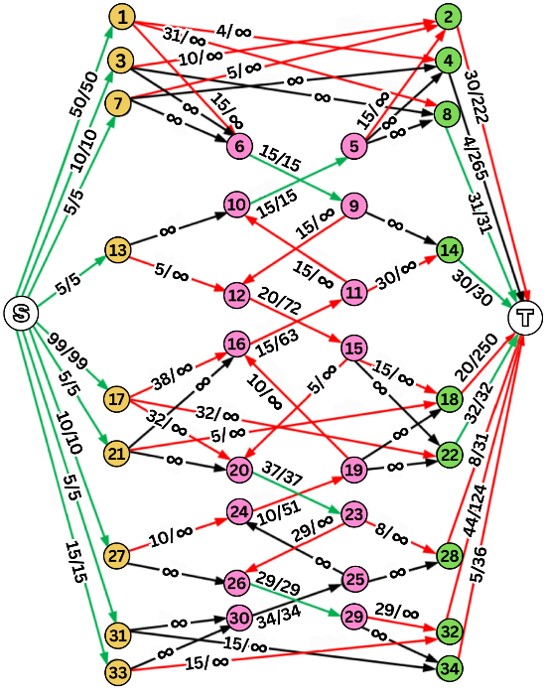
This study proposes a traffic signal control algorithm for consecutive intersections surrounding Pattani Hospital and City Hall based on graph theory and maximum flow analysis. The traffic system is formulated as a flow network in which arc weights represent road capacities, and the Ford–Fulkerson algorithm is employed to determine the maximum feasible traffic flow. Optimal green signal durations for inbound approaches are subsequently derived from the resulting flow distribution to improve traffic performance. Furthermore, the study investigates the relationship between green signal duration and the maximum traffic clearance capacity of an intersection during a signal phase. Signal timing optimization is conducted with the objective of reducing vehicle delay and enhancing overall traffic efficiency. The analytical framework integrates effective road length with estimated traffic flow capacity derived from vehicle registration statistics in Pattani Province, while intersection traffic volumes are computed using fundamental kinematic principles. Numerical results indicate that while the proposed model successfully discharges all queued vehicles within a single green phase at certain intersections, residual queues still remain at highly congested nodes. However, by actively accounting for the receiving capacity of downstream intersections and the available roadway storage capacity, the algorithm ensures that all segments can accommodate the remaining queued vehicles. Consequently, although temporary queue accumulation occurs, the system effectively prevents complete traffic blockage or cascading gridlock across the network. Ultimately, a comparative evaluation demonstrates that the proposed approach provides superior traffic clearance performance and more efficient signal utilization compared to the Averaged-Time (AT) model.
References
Baruah, N., & Baruah, A. K. (2012). On a traffic control problem using cut-set of graph. International Journal of Advanced Networking and Applications, 3(4), 1240–1244.
Bondy, J. A., & Murty, U. S. R. (2008). Graph theory. Springer.
Chatrakijvarun, A. (1991). Graph theory and its applications. Department of Mathematics, Faculty of Science, Prince of Songkla University (in Thai).
Cormen, T. H., Leiserson, C. E., Rivest, R. L., & Stein, C. (2009). Introduction to algorithms (3rd ed.). MIT Press.
Darmaji, D., Lubis, U. K., Fitriani, R., Bulayi, M., Ade, J. A., Allahverdiev, K., & Sangsuwan, A. (2024). Optimizing traffic light timing using graph theory: A case study at urban intersections. Interval: Indonesian Journal of Mathematical Education, 2(2), 149–163. https://doi.org/10.37251/ijome.v2i2.1361
Ford, L. R., Jr., & Fulkerson, D. R. (1956). Maximal flow through a network. Canadian Journal of Mathematics, 8, 399–404. https://doi.org/10.4153/CJM-1956-045-5
Mandanaka, T., & Lekhadiya, H. (2024). Optimizing urban traffic flow with graph theory-based light scheduling. Indian Journal of Natural Sciences, 14(81), 66352–66357.
Muhiuddin, G., Takallo, M. M., Jun, Y. B., & Borzooei, R. A. (2020). Cubic graphs and their application to a traffic flow problem. International Journal of Computational Intelligence Systems, 13(1), 1265–1280.https://doi.org/10.2991/IJCIS.D.200730.002
Ngaosai, A., & Chawachat, J. (2018). Traffic signal management using maximum flow approach for consecutive intersections. In Proceedings of the 15th International Conference on Electrical Engineering/Electronics, Computer, Telecommunications and Information Technology (ECTI-CON) (pp. 457–460). IEEE. https://doi.org/10.1109/ECTICon.2018.8620034
Rahman, R., Mamun, M., Rofi, R. I., Paul, G., & Hasan, N. (2025). Smart traffic signal optimization using real-time data and geotextile-based road sensors: A review. Open Access Journal of Applied Science and Technology, 3(1), 1–4.
Roess, R. P., Prassas, E. S., & McShane, W. R. (2011). Traffic engineering (4th ed.). Pearson.
Rosen, K. H. (2000). Discrete mathematics and its applications (4th ed.). McGraw-Hill.
Setiawan, E. K., & Budayasa, I. K. (2017). Application of graph theory concept for traffic light control at crossroads. AIP Conference Proceedings, 1867, Article 020054. https://doi.org/10.1063/1.4994457
Wang, X., & Shao, W. (2025). Networked sensor-based adaptive traffic signal control for dynamic flow optimization. Sensors, 25(11), 3501. https://doi.org/10.3390/s25113501
Webster, F. V. (1958). Traffic signal settings (Road Research Technical Paper No. 39). Road Research Laboratory, Her Majesty’s Stationery Office.
Xing, Y., Li, W., Liu, W., Li, Y., & Zhang, Z. (2022). A dynamic regional partitioning method for active traffic control. Sustainability, 14(16), 9802. https://doi.org/10.3390/su14169802
Downloads
Published
How to Cite
Issue
Section
License
Copyright (c) 2026 Suan Sunandha Rajabhat University

This work is licensed under a Creative Commons Attribution 4.0 International License.