
Diversity, Abundance, Dispersion and Temporal Spread of Arthropods Associated with Golden melon (Cucumis melo L.) in Wukari, Taraba State, Nigeria
DOI:
https://doi.org/10.53848/ssstj.v13i2.1689Keywords:
Buzas and Gibson’s Evenness, Golden melon, Iwao’s patchiness regression, Shannon-Weiner index, Taylor’s power law, Spatial distributionAbstract
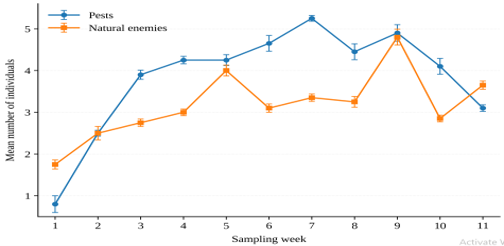
Arthropod community structure of golden melon (Cucumis melo L.) was investigated in Wukari, Nigeria wherein arthropods were sampled weekly across the crop growth stages using a modified portable 2-stroke gasoline-powered leaf-blower and vacuum machine (Model number: EBV260E; Power: 0.7KW/7500Min.) with a 5cm diameter inlet cone used to sweep through 4m length of the middle row of 12, 16m2 experimental plots at an approximate walking speed of 1m/sec. The relative abundance (RA), frequency of occurrence (FO), diversity indices, spatial dispersion and pest:natural enemy ratio of the specimens were documented. Diversity indices were computed, and spatial distribution patterns of dominant species were determined using Taylor’s and Iwao’s patchiness regression models. Forty-eight (48) species belonging to 30 families and 10 orders were recorded. Coleopterans and Hymenopterans were the most diverse orders while chrysomelid beetles and sap sucking Hemipterans constituted the major pest groups. Natural enemies; particularly ants, coccinellid beetles, wasps, and spiders were abundant and widely distributed. Dominant pest species (RA≥1.0% and FO≥25.0%) included Aphis gossypii, Asbecesta nigripennis, Aulacophora africana, Bactrocera cucurbitae and Bemisia tabaci. The population densities of pests and natural enemies largely peaked within the vegetative to flowering. Overall, spatial distribution analyses for the dominant arthropods largely show a tendency to aggregated distribution. Community diversity was high (H=3.361) with high species richness (R=6.650) and moderately high evenness (E=0.600). Overall pest-natural enemy ratio was 0.78:1. These findings highlight effective biological regulation and ecological stability of the golden melon agro-ecosystem at Wukari and underscore the potential for conservation based integrated pest management strategies.
References
Alao, F. O., Adebayo, T. A., Odewole, A. F., & Emmanuel, O. O. (2017). Comparative Assessment of Insect Pests Population Densities of Three Selected Cucurbits Crop. Actafytotechn zootechn, 20(4), 78–83.
Aleem, M., Voorrips, R. E., Braat. L, Strijker. M. F., Visser, R. G. F., Scholten. O., Voorrips, R. E., & Caarls, L. (2025). Identifying Resistance to Aphid Aphis gossypii and Whitefly Bemisia tabaci in Cucurbita and Possibility of Broad Spectrum Resistance to both Insects. Euphytica, 221, 144. https://doi.org/10.1007/s10681-025-03584-7
Cuza, P., Sîrbu, T., & Pînzaru, P. (2026). Assessment of Diversity and Evenness of Herbaceous Vegetation and Natural Regeneration Communities in the Plaiul Fagului Reserve. Ecologies, 7(1), 18. https://doi.org/10.3390/ecologies7010018
Diamé, L., Rey, J.-Y., Vayssières, J.-F., Grechi, I., Chailleux, A. & Diarra, K. (2018). Ants: Major Functional Elements in Fruit Agro-Ecosystems and Biological Control Agents. Sustainability, 10(1), 23. https://doi.org/10.3390/su10010023
Egbon, I. N., Dingha, B. N., Mukoko, G. N., & Jackai, L. E. (2025). Intercropping Enhances Arthropod Diversity and Ecological Balance in Cowpea, Hemp, and Watermelon Systems. Insects, 16(7), 724.https://doi.org/10.3390/insects16070724
Fenemore, P. G., & Prakash A. (1992). Applied Entomology. Wiley: pp. 186–190
Filani, C. O., Adeoti, A. O., Pitan, O. O. R., Sholanke, M. O., & Yekini, B. A. (2024). Assessment of Major Insect Pests of Golden melon (Cucumis melo L.) and Control with Commercial Beauvaria bassiana in Abeokuta Southwestern, Nigeria. Nigerian Journal of Entomology, 40(2), 47-61.
Gichimu, B. M., Owuor, B. O., & Dida, M. M. (2008) Assessment of Four Commercial Watermelon Cultivars and One Local Landrace for their Response to Naturally Occurring Disease, Pests and Non-pathogenic Disorders. In sub-humid Tropical Conditions. Journal of Agricultural and Biological Science, 3(5&6), 32–43.
Haber, A. I., Wallingford, A. K., Grettenberger, I. M., Bonilla, J. P. R, Vinchesi-Vahl, A. C., & Weber, D. C. (2021). Striped cucumber Beetle and Western Striped Cucumber Beetle (Coleoptera: Chrysomelidae), Journal of Integrated Pest Management, 12,1. https://doi.org/10.1093/jipm/pmaa026
Hammer, O., Harper, D. A. T., & Ryan, P. D. (2001). PAST: Paleontological Statistics Software Package for Education and Data Analysis, Palaeontologia Electron., 49pp.
Hawkins, B. A., Thomas, M. B., & Hochberg, M. E. (1993). Refuge Theory and Biological Control. Science, 262(5138), 1429–1432. http://www.jstor.org/stable/2882431
Iwao, S. (1968). A New Regression Method for Analysis of the Aggregation Pattern of Animal Populations. Researches on Population Ecology, 10(1), 1–20.
Iwao, S., & Kuno, E. (1968). Use of the Regression of Mean Crowding on Mean Density for Estimating Sample Size and the Transformation of Data for the Analysis of Variance. Researches on Population Ecology, 10: 210 - 214.
Khalid, W., Ikram, A., Rahan, M., Afzan, F.A., Ambreen, S., Ahmad, M., Aziz, A., & Sadiq, A. (2021). Chemical Composition and Health Benefits of Melon Seed: A Review. Pakistan Journal of Agricultural Research, 34(2), 309-317. https//doi.org/10.17582/journal.pjar/2021/34.2.309.317
Li, H., Jiang, Z., Zhou, J., Liu, X., Zhang, Y., & Chu, D. (2023). Ecological Factors Associated with the Distribution of Bemisia tabaci Cryptic Species and Their Facultative Endosymbionts. Insects, 14(3), 252. https://doi.org/10.3390/insects14030252
Liu, J., Wang, C., Desneux, N., & Lu, Y. (2021). Impact of Temperature on Survival Rate, Fecundity, and Feeding Behavior of Two Aphids, Aphis gossypii and Acyrthosiphon gossypii, when Reared on Cotton. Insects, 12(6), 565. https://doi.org/10.3390/insects12060565
Lloyd, M. (1967). Mean Crowding. Journal of Animal Ecology, 36, 1-30. https://doi.org/10.2307/3012.
Magurran, A. E. (2004). Measuring Biological Diversity. Blackwell Publishing.
Mollet, J., Trumble, J. T., & Sevacherian, V. (1984). Comparison of Dispersion Indices for Tetranychus cinnabarinus (Boisduval) (Acari: Tetranychidae) Population in Cotton. Environmental Entomology, 13, 1511-1514.
Myers, J. H. (1978). Selecting a Measure of Dispersion. Environmental Entomology, 7, 619-621.
Ofuya, T. I., Okunlola, A. I., & Mbata, G. N. (2023). A Review of Insect Pest Management in Vegetable Crop Production in Nigeria. Insects, 14, 111. https://doi.org/10.3390/ insects1402011
Okrikata, E., & Ogunwolu, E. O. (2017). Farmers’ Perceptions on Arthropod Pests of Watermelon and their Management Practices in the Nigerian Southern Guinea Savanna. International Journal of Agricultural Research, 12(4), 146–155. https://doi.org/10.3923/ijar.2017.146.155
Okrikata, E., Ogunwolu, E. O., & Ukwela, M. U. (2019) Diversity, Spatial and Temporal Distribution of Above-ground Arthropods Associated with Watermelon in the Nigerian southern guinea savanna. Journal of Insect Biodiversity and Systematics, 5 (1), 11–32. https://doi.org/10.52547/jibs.5.1.11
Okrikata, E., & Yusuf, O. A. (2016). Diversity and Abundance of insects in Wukari, Taraba State, Nigeria. Journal of International Biological and Biomedical Journal, 2(4), 156–166.
Olubunmi, I. P., Olajumoke, A. A., Bamidele, J. A., & Omolara, O. F. (2019). Phytochemical Composition and in vitro Antioxidant Activity of Golden Melon (Cucumis melo L.) Seeds or Functional Food Application. International Journal of Biochemistry Research & Review, 25(2), 1-13. https//doi.org/10.9734/IJBCRR/2019/v25i230070
Opoku, E., Haseeb, M., Rodriguez, E. J., Steck, G. J., & Cabral, M. J. S. (2025). Economically Important Fruit Flies (Diptera: Tephritidae) in Ghana and Their Regulatory Pest Management. Insects, 16(3), 285. https://doi.org/10.3390/insects16030285
Perfecto, I., Vandermeer, J. H., & Wright, A. L. (2009). Nature's Matrix: Linking Agriculture, Conservation and Food Sovereignty. Boca Raton, FL: Routledge. https://doi.org/10.4324/9781849770132
Rao, K., & Kanaujia, A. (2023). Spiders' Impact on Controlling Insect Pests in the Agricultural Ecosystem. International Journal of Research Publication and Reviews, 4(7), 2389-2392.
Sarwar, M. (2016). Insect Pests of Honeybees and Choosing the Right Management Strategic Plan. International Journal of Entomology Research, 1(2), 16–22.
Shang, J., Kong, S., Li, N., & Ma, S. (2020). Genetic Mapping and Localization of Major QTL for Bitterness in Melon (Cucumis melo L). Scientia Horticulturae, 266, 1-14. https//doi.org/10.1016/j.scienta.2020.109286
Solomon, M. E. (1949). The Natural Control of Animal Populations. Journal of Animal Ecology, 18, 1–35.
Southwood, T. R. E. (1978). Ecological Methods with Particular Reference to the Study of Insect Populations. 2nd Ed. Chapman and Hall, London. pp. 524.
Southwood, T. R. E., & Henderson, P. A. (2000). Ecological Methods (3rd ed.). Blackwell Science.
Steffan-Dewenter, I., Kerr, R. B., and Peters, M. K. (2024). Insect Diversity for Agroecosystem Resilience in a Changing Climate. One Earth, 7(4), 541-544. https://doi.org/10.1016/j.oneear.2024.03.003
Tamer, C. E., Needayi, B., Parseker, A. S., & Copur, T. S. (2010). Evaluation of Several Quality Criteria of Low-calorie Pumpkin Dessert. Natulae Botanicae Horti Agrobotanici Cluj-Napoca, 38:76-80.
Taylor, L. R. (1961). Aggregation, Variance and the Mean. Nature, 189(4766), 732–735.
Taylor, L. R. (1984). Assessing and Interpreting the Spatial Distribution of Insect Populations. Annual Review of Entomology, 29, 321 - 357.
Theis, N., Barber, N. A., Gillespie, S. D., Hazzard, R. V., & Adler, L. S. (2014). Attracting Mutualists and Antagonists: Plant Trait Variation Explains the Distribution of Specialist Floral Herbivores and Pollinators on Crops and Wild Gourds. American Journal of Botany, 101(8), 1314-1322.
Rajabpour, A., & Yarahmadi, F. (2024). Biodiversity and Pest Outbreaks. In: Decision System in Agricultural Pest Management. Springer, Singapore. https://doi.org/10.1007/978-981-97-1506-0_8
Downloads
Published
How to Cite
Issue
Section
License
Copyright (c) 2026 Suan Sunandha Rajabhat University

This work is licensed under a Creative Commons Attribution 4.0 International License.